
Strength Training for HYROX should make every station more economical while preserving your ability to run. The goal is not simply to lift the heaviest possible weight or turn every workout into a race simulation. It is to build usable force, repeatable movement quality, and enough muscular endurance to keep working when your heart rate is high.
HYROX alternates eight one-kilometre runs with eight functional stations: SkiErg, sled push, sled pull, burpee broad jumps, rowing, farmer’s carry, sandbag lunges, and wall balls. That sequence rewards athletes who can produce force, manage fatigue, and return to an efficient running rhythm.
What strength qualities matter most for HYROX?
- Maximal strength: A larger strength reserve can make a fixed race load represent a smaller share of your capacity.
- Strength endurance: You need to repeat submaximal efforts without a sharp loss of pace or technique.
- Trunk control: Carries, sleds, lunges, ergs, and wall balls all require you to transfer force through a stable torso.
- Single-leg capacity: Running and lunging repeatedly load one side at a time.
- Grip endurance: Sled pulls and farmer’s carries can expose weak hands and forearms.
These qualities overlap, but they are not trained identically. Heavy controlled lifts can develop force, moderate-load sets can build repeatability, and race-specific combinations can teach you to use both under fatigue.
Which foundational exercises provide the best return?
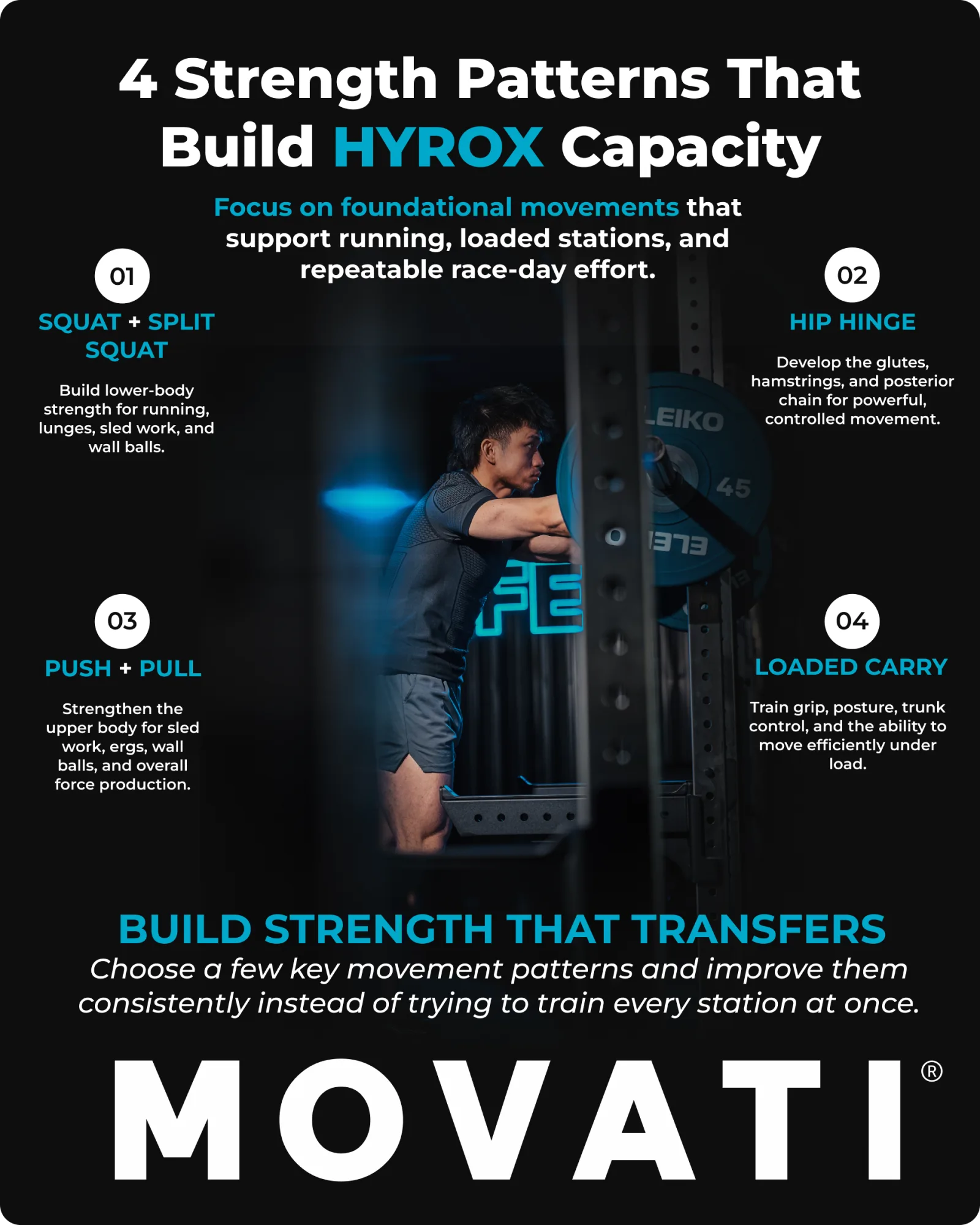
Squat and split-squat patterns
Squats build lower-body strength through a bilateral stance, while split squats and step-ups challenge each leg independently. Both can support the demands of running, lunges, sled work, and wall balls. Choose a variation that allows stable feet, controlled knees, and a range of motion you can own.
Useful options include goblet squats, front squats, back squats, split squats, and step-ups. You do not need all of them in one program. Select one primary squat and one unilateral movement, then improve them consistently.
Hip hinges
Deadlifts and Romanian deadlifts strengthen the hips and posterior chain. That capacity contributes to forceful sled work, loaded carries, and resilient running mechanics. Keep the load close, brace before moving, and use a range that allows you to maintain control.
Pushes and pulls
Rows, pulldowns, and assisted pull-ups can support the pulling strength used in sled work and erg training. Presses and push-ups develop the upper body for wall balls and general force production. Balance these patterns across the week instead of treating every station as a separate muscle group.
Loaded carries
Farmer’s carries are directly specific to the race and train grip, posture, trunk stiffness, and walking under load. Start with distances that let you keep the weights controlled at your sides. Progress load or distance gradually, and practise turns without letting momentum pull you out of position.
How should you train the race stations?
Sled push and sled pull
Technique changes the cost of sled work. Practise body angle, foot pressure, short driving steps, rope management, and hand-over-hand pulling before using fatigue as the main challenge. Sled resistance varies considerably with the surface and equipment, so compare sessions in context rather than assuming the same plates create the same demand everywhere.
Burpee broad jumps and sandbag lunges
Burpee broad jumps require rhythm, landing control, and repeatable transitions more than maximal jump distance. Sandbag lunges demand unilateral strength and trunk position. Practise each movement fresh, then add modest race-style sets once your mechanics are reliable.
Wall balls
Build the squat and overhead pattern separately, then connect them. Use the legs to launch the ball, aim consistently, and receive it softly. Planned set sizes can prevent a late collapse in accuracy. Training one giant set is less useful if every repetition looks different.
SkiErg and rowing
The ergs are conditioning stations, but strength and technique affect their efficiency. Learn to connect the legs, hips, trunk, and arms in sequence. Practise controlled efforts so you can leave each machine ready to run, not merely proud of an aggressive split.
How do you turn strength into race performance?
General strength creates capacity; specific training teaches you to express it. Progress from isolated strength work to short combinations that preserve quality. For example, complete a controlled set of lunges or sled pushes, then run at a steady effort until your stride settles.
Do not combine every station in every workout. A short sequence can teach the transition with less fatigue and clearer feedback. Full or extended simulations should be occasional tools, not the foundation of the week.
What might a balanced strength week include?
The exact schedule depends on your training age, running volume, and recovery. Two well-designed strength sessions can cover the major patterns for many athletes. A third session may be useful when it has a distinct purpose and does not reduce the quality of key runs.
Session A: force and foundational strength
- Primary squat variation
- Upper-body pull
- Hip hinge
- Press variation
- Loaded carry or trunk exercise
Session B: unilateral and race-specific strength
- Split squat or step-up
- Sled push and pull technique
- Row or pulldown
- Sandbag lunge or wall-ball practice
- Grip and trunk work
Keep the hardest strength work away from the running sessions where speed or race pace is the priority when possible. If two demands must share a day, decide which matters most and perform it first.
How should load and volume progress?
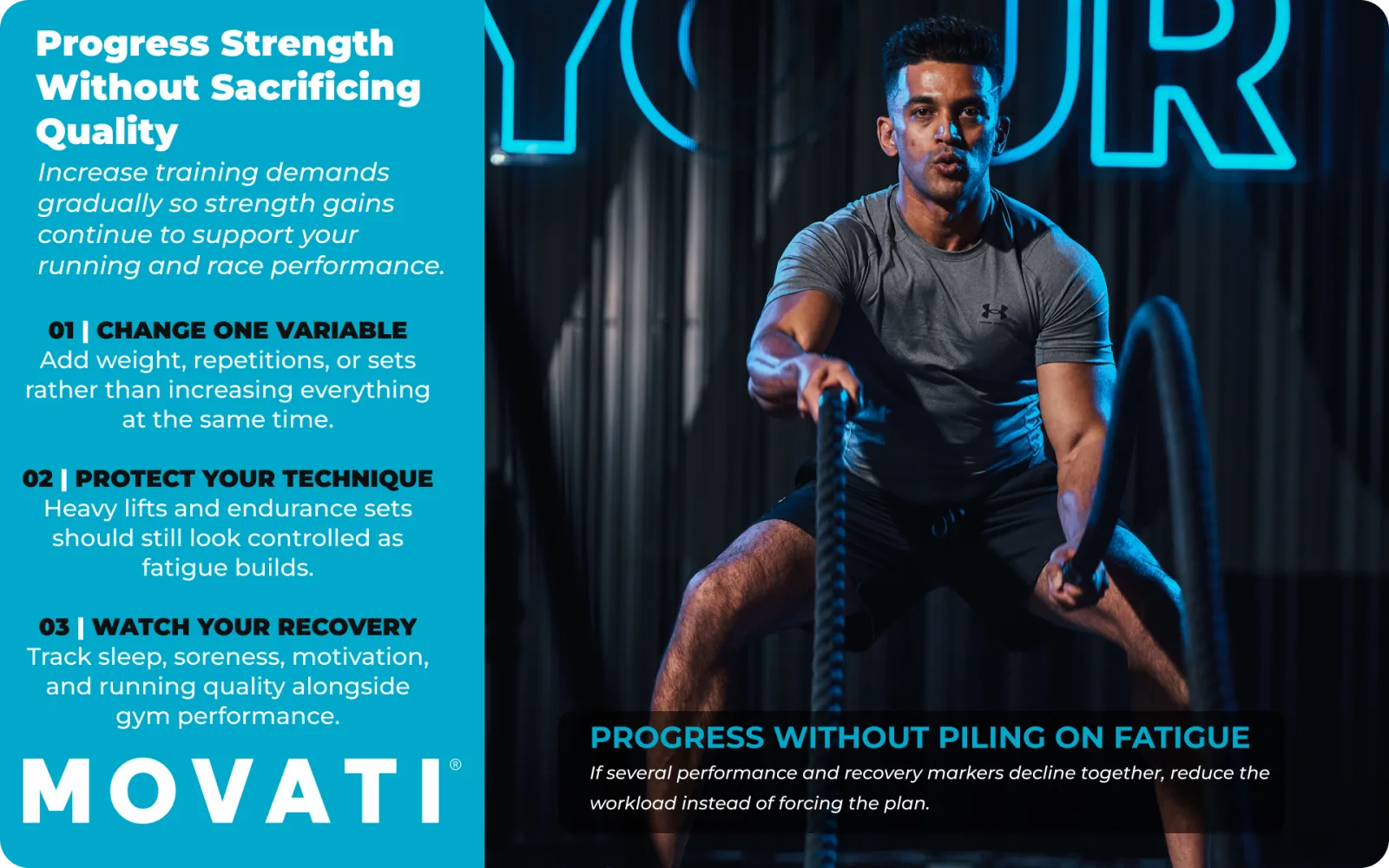
Change one major variable at a time. Add a small amount of weight, complete another controlled repetition, or add a set. Avoid increasing load, volume, and conditioning density in the same week.
Heavy lifting should still look technically consistent. Endurance sets should stop before movement becomes careless. Track performance along with sleep, soreness, motivation, and running quality. If several markers decline together, reduce the workload rather than forcing the plan.
What common mistakes limit results?
- Bodybuilding without race transfer: Muscle-focused training can help, but the program also needs force, unilateral work, carries, and station skills.
- Only performing high-repetition circuits: Constant fatigue can hide strength limitations and prevent quality progression.
- Ignoring running: Greater gym strength cannot compensate for inadequate running preparation in an event with eight kilometres of it.
- Testing race loads too often: Earn confidence through progressive practice instead of repeated exhaustion.
- Copying an advanced athlete’s volume: Training must match your history and recovery capacity.
Recover so your strength is available on race day
Adaptation requires adequate food, sleep, and lower-stress days. Include protein in regular meals, use carbohydrates to support demanding sessions, and develop a hydration routine suited to your needs and environment. Avoid introducing an unfamiliar strategy close to competition.
If pain changes your movement, stop and adjust. A qualified coach can help with station technique and programming; an appropriate health professional should assess persistent pain or injury concerns.
Effective Strength Training for HYROX is focused, progressive, and connected to the race. Build a dependable strength reserve, practise the exact skills while fresh, then introduce fatigue carefully. The payoff is not just a stronger lift—it is the ability to reach each station, work efficiently, and return to running with control.
