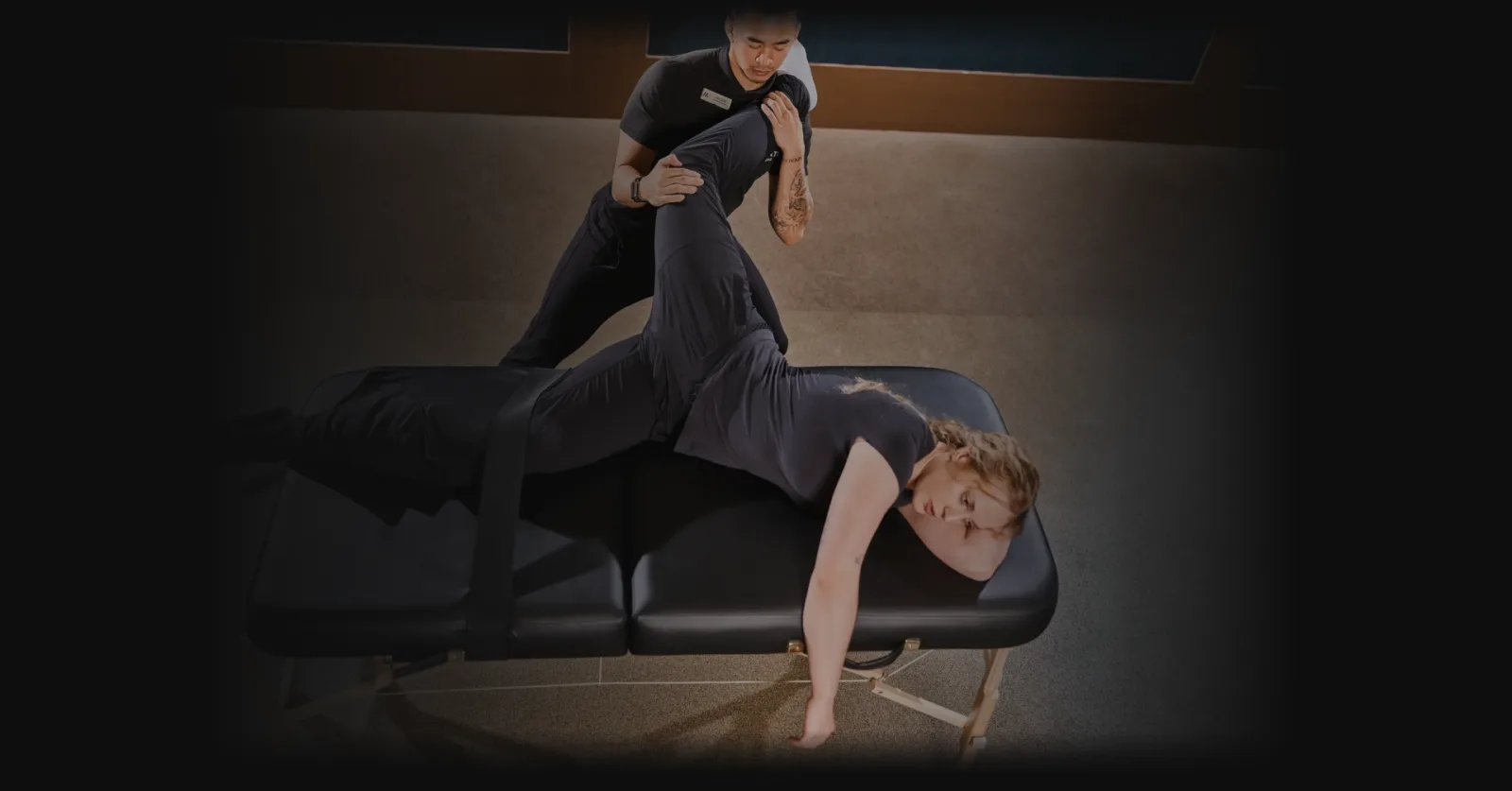
The simplest way to understand mobility vs flexibility is this: flexibility is the range available to a joint or tissue, while mobility is your ability to actively control movement through a useful range. You can be flexible without having strength or coordination at the edge of that range, and you can move well for a particular task without being exceptionally flexible.
Neither quality is automatically better. The right goal is enough range—and enough control—to perform the activities that matter to you comfortably and confidently.
What is flexibility?
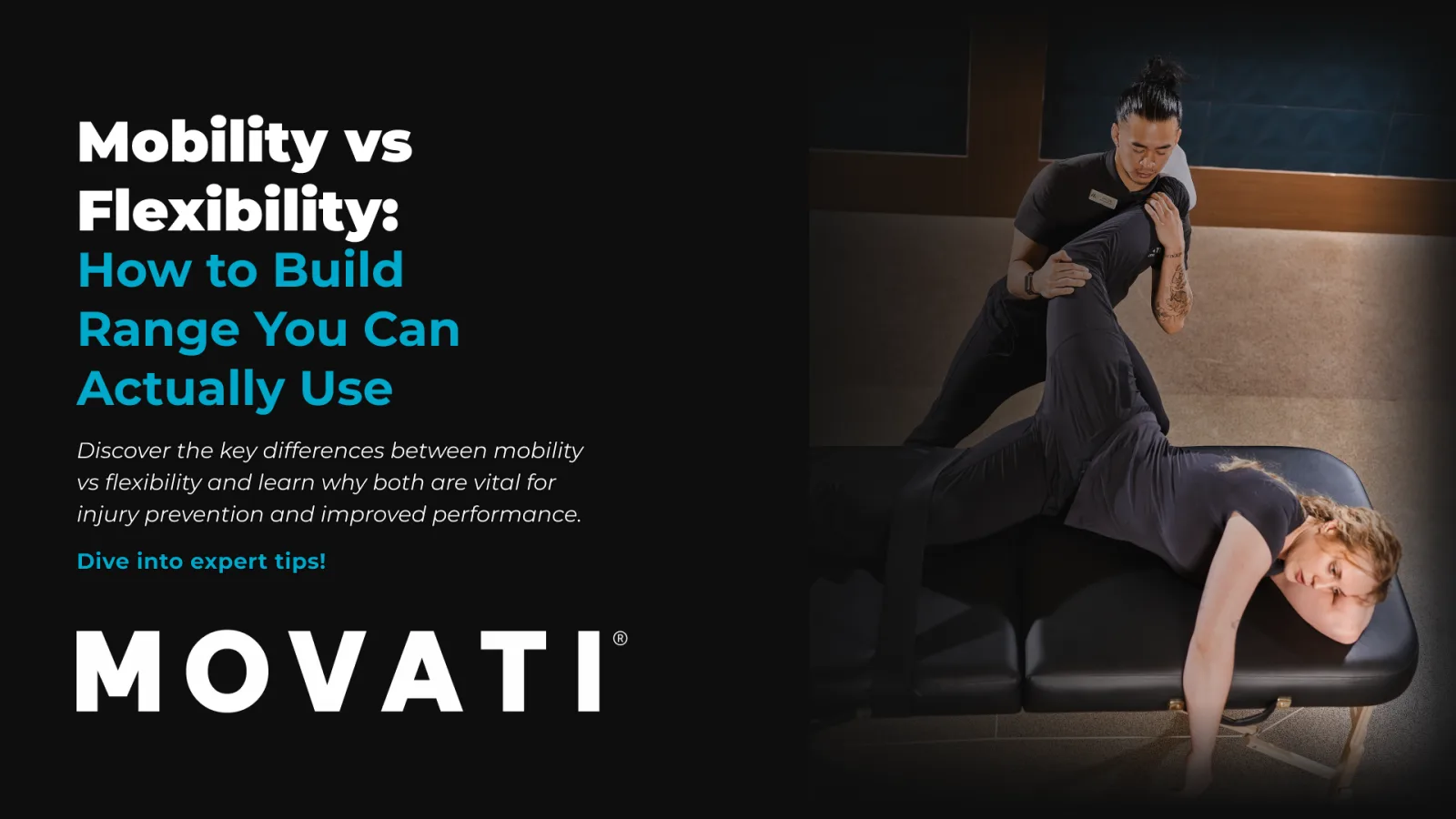
Flexibility describes how far a joint or group of joints can move, often when an external force helps create the position. A hamstring stretch in which a strap lifts the leg is one example: the strap and your hands help you access the range.
Static stretching is a common way to train flexibility. You move into a mild, tolerable stretch and hold the position without bouncing. Over time, consistent practice can make a position feel more comfortable and may increase the range you can access.
Flexibility is specific. Touching your toes does not mean every joint in your body is flexible, and a deep shoulder range does not guarantee comfortable hips or ankles.
What is mobility?
Mobility is active movement capacity. It combines available range with strength, coordination, and control. Raising your leg without a strap, moving into a squat while keeping your feet grounded, or reaching overhead without changing your rib position are mobility tasks.
Mobility also depends on the goal. A competitive weightlifter, swimmer, golfer, and office worker use different ranges and need different forms of control. There is no single test that defines “good mobility” for everyone.
How can you tell which quality is limiting you?
Compare a supported position with an active one. If an external force can move you comfortably into a range that you cannot reach or control on your own, active strength or coordination may be the larger limitation. If both supported and active ranges stop at a similar point, available range may deserve more attention.
This is a rough training observation, not a medical assessment. Pain, a hard block, numbness, sudden changes, or a meaningful difference between sides should not be forced. A qualified health professional can assess persistent restrictions or symptoms.
Why does the difference matter?
Stretching every restriction may not solve the actual problem. If you can passively reach a position but lose balance or control when moving into it, more passive range alone may add little. You may need to strengthen the movement and practise the skill.
The opposite is also true. If the required range is not available, trying to create stability without addressing that restriction can lead you to compensate elsewhere. Good programming identifies the task first, then trains the missing quality.
Does more range prevent injury?
No single amount of flexibility or mobility guarantees injury prevention. Injuries are influenced by training load, fatigue, previous injury, technique, recovery, environment, and many other factors. More range is not always protective, and forcing flexibility beyond what your activity needs can be counterproductive.
A better aim is usable capacity: appropriate range, strength through that range, gradual exposure to workload, and movement options that suit your body and activity.
How should you train flexibility?
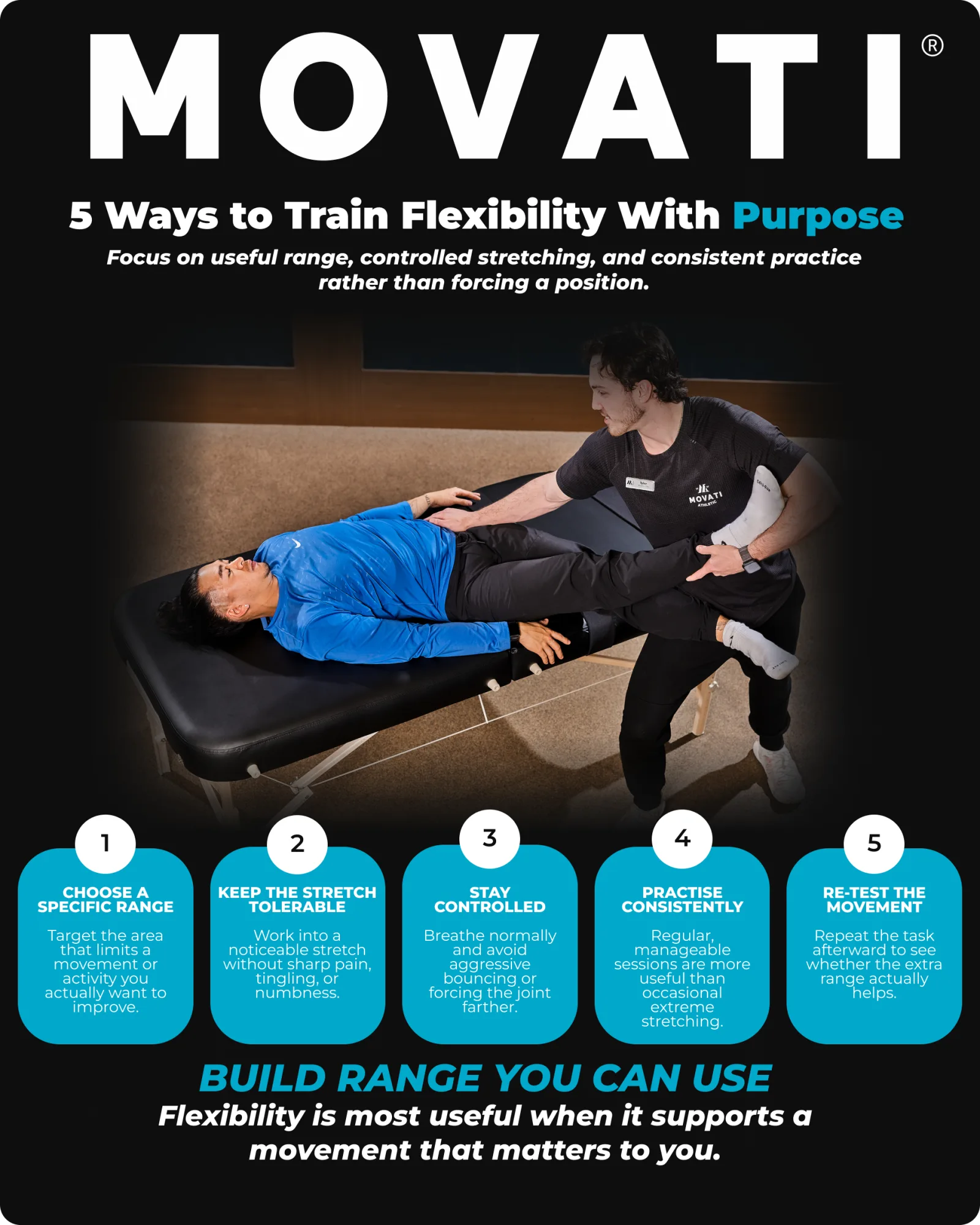
- Choose a specific position. Stretch the area that limits a movement you care about rather than completing a random full-body routine.
- Use a tolerable intensity. A stretch may feel noticeable, but it should not create sharp pain, tingling, or numbness.
- Breathe and stay controlled. Avoid bouncing aggressively or forcing the joint farther as you fatigue.
- Repeat consistently. Modest, regular practice is generally more useful than an occasional extreme session.
- Recheck the task. After stretching, repeat the movement you wanted to improve and see whether the change is useful.
Static stretching can fit well after training or in a separate session. Before a workout that requires speed or force, dynamic movement and gradual warm-up sets are often more specific preparation.
How should you train mobility?
Mobility drills should resemble the range and control your activity requires. Move slowly enough to notice where position changes, then add strength as appropriate.
- Ankles: Controlled knee-over-toe movements can practise ankle range while the foot remains grounded.
- Hips: Supported squat holds, hip rotations, and controlled split-stance movements can explore different directions.
- Upper back: Rotations performed without shifting the pelvis can separate thoracic movement from whole-body turning.
- Shoulders: Controlled reaches and light resistance can connect overhead range with shoulder-blade and trunk control.
Foam rolling may temporarily change how an area feels, but it does not replace active practice. Use it as an optional preparation tool, then move and strengthen through the range you want to keep.
How do strength exercises improve mobility?
Strength training performed through an appropriate range can develop both control and tolerance. A goblet squat can strengthen a comfortable squat depth. A split squat can build capacity at the hips and ankles. A light overhead press can train control through an available shoulder range.
You do not need separate mobility drills for every joint if your strength program already takes you through useful ranges with sound technique. Add targeted work where the main exercises do not address a specific limitation.
Where should both fit in a workout?
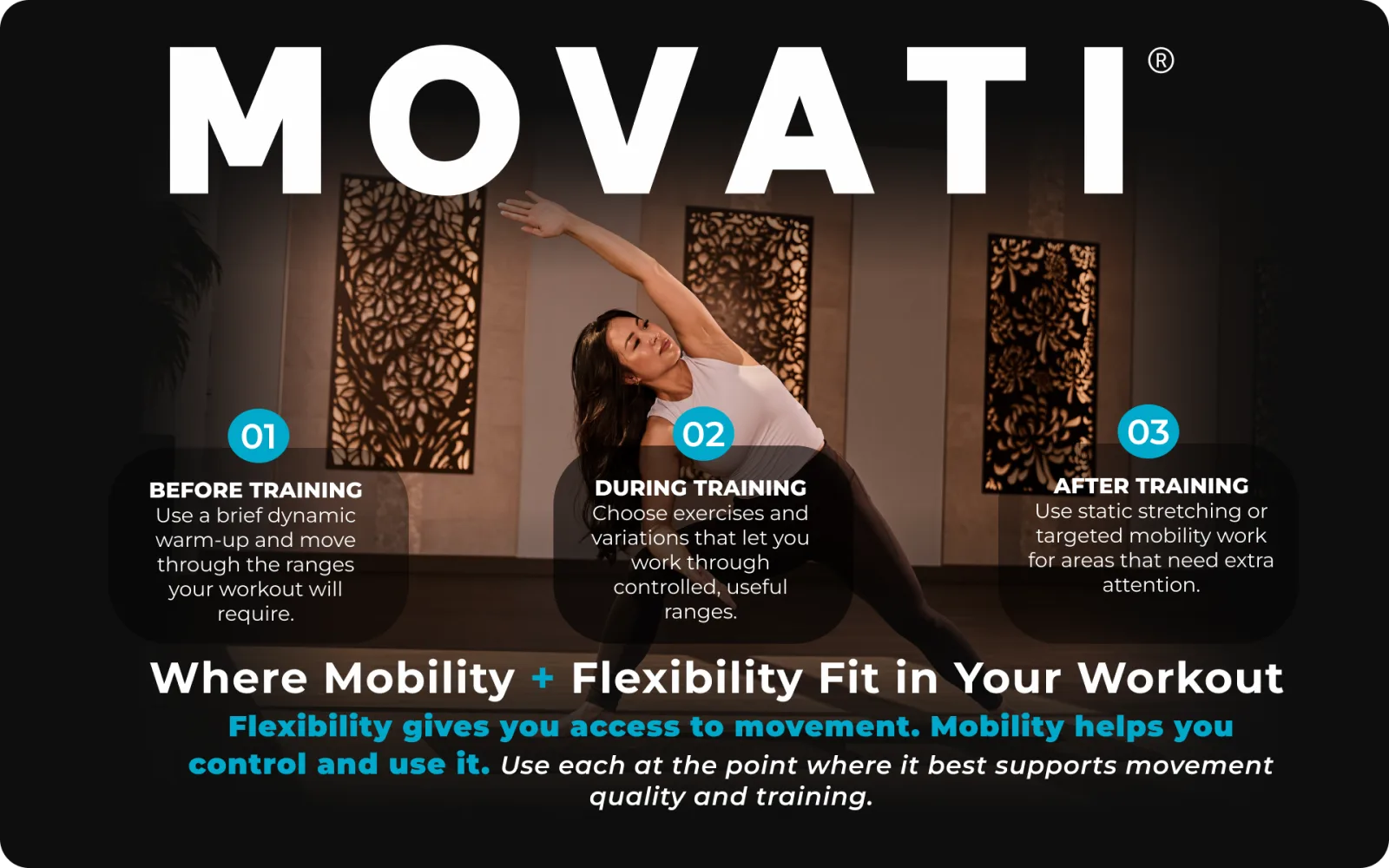
Before training
Use a brief, specific warm-up. Raise your body temperature, move the joints through ranges needed in the session, and complete progressively challenging practice sets. The warm-up should prepare you, not exhaust you.
During training
Choose exercise variations that let you work through controlled, relevant ranges. A small adjustment in stance, load, support, or depth may make the movement more productive.
After training or separately
Use static stretching or additional mobility practice for areas that need focused attention. A short routine performed consistently is easier to evaluate than a long sequence that changes every day.
What common mistakes should you avoid?
- Chasing ideal positions from social media: Your anatomy, sport, and goals may not require someone else’s range.
- Forcing through pain: Discomfort is not proof that a drill is working.
- Confusing temporary sensation with lasting change: Feeling looser after one session does not mean the new range is controlled.
- Ignoring strength: A range you cannot control may not transfer to real movement.
- Doing random drills: Select exercises that address a specific task and re-test it.
Build the range you can use
The mobility vs flexibility question is not a contest. Flexibility gives you access to range; mobility helps you use it. Identify what your activity demands, improve passive range when it is genuinely limited, and build active control through strength and practice. The result is movement that is not merely larger, but more useful.
