
One of the most frustrating experiences in fitness is putting in consistent effort without seeing meaningful improvements. You attend the gym regularly, complete your workouts, and follow a familiar routine, yet eventually your strength, endurance, or muscle development seems to stop progressing. This is a common challenge, and it often happens because the body has adapted to the demands of your existing exercise routine.
Progressive overload is one of the most important principles in strength and conditioning because it provides a structured way to continue improving. By gradually increasing the demands placed on your muscles and cardiovascular system, you encourage the body to adapt and become stronger, more capable, and better conditioned over time.
Whether you’re beginning your fitness journey, returning to exercise after years of inactivity, or training for a demanding event such as HYROX, understanding how to apply this principle can help you make steady, sustainable progress.
What Is Progressive Overload?
Progressive overload is the practice of gradually increasing the physical demands of exercise as your fitness improves.
When you begin a new workout routine, your body responds to unfamiliar challenges. Muscles adapt to resistance training, cardiovascular endurance improves with consistent aerobic activity, and movements often become easier as coordination develops.
However, repeating exactly the same workout indefinitely may eventually provide insufficient stimulus for continued improvement.
To keep progressing, your training demands generally need to increase over time.
This doesn’t necessarily mean lifting heavier weights during every workout. Progression can involve several different changes, including:
Increasing the amount of weight lifted.
Performing additional repetitions or sets.
Increasing exercise duration or distance.
Improving movement control or range of motion.
Gradually increasing training frequency.
Reducing rest periods when appropriate for the training goal.
The objective is to introduce manageable challenges that encourage adaptation without overwhelming your body’s ability to recover.
Why Your Fitness Progress Can Eventually Plateau
The human body is remarkably adaptable.
When you consistently perform an exercise, your muscles, nervous system, and cardiovascular system become more efficient at handling its demands.
For example, a set of ten squats that initially feels difficult may become relatively comfortable after several weeks of practice.
This improvement is a positive sign that your training is working.
However, if the exercise never becomes more challenging, the stimulus for further adaptation may become limited.
Repeating the Same Workout
Following an identical routine for months can make it difficult to continue improving strength or endurance.
Although consistency is important, your training program should evolve as your abilities develop.
Increasing Intensity Too Quickly
The opposite problem can be equally challenging.
Attempting to increase weights, repetitions, or workout intensity too aggressively may create excessive fatigue and interfere with recovery.
Progress requires an appropriate balance between training stress and the body’s ability to adapt.
Overlooking Recovery
Muscles and other tissues adapt during the recovery periods between training sessions.
Insufficient sleep, inadequate nutrition, and consistently demanding workouts can interfere with this process.
For sustainable progress, recovery needs to be considered part of the training program rather than something separate from it.
The Benefits of Progressive Overload Training
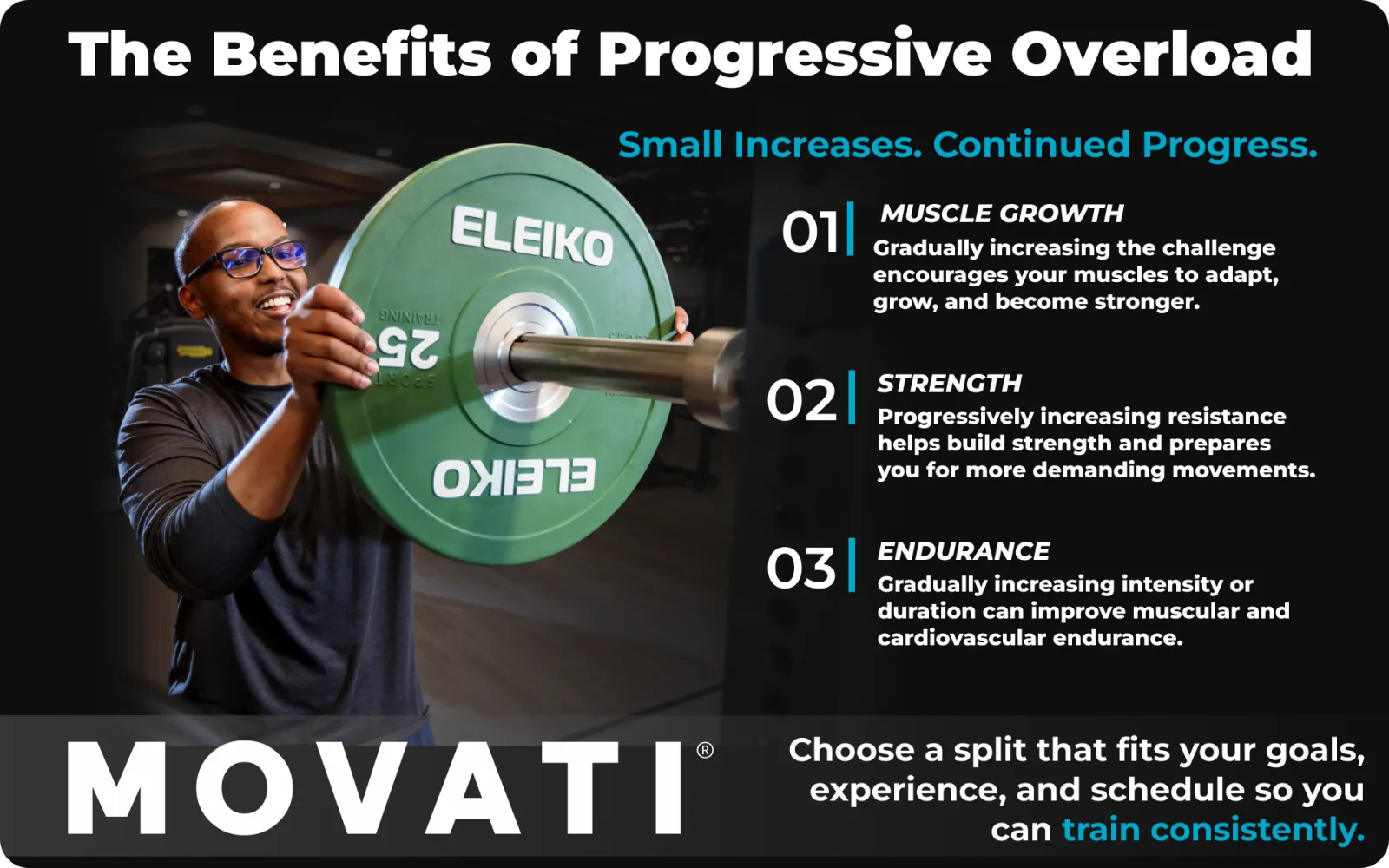
Gradually increasing training demands can support several aspects of physical fitness.
Increased Muscular Strength
Resistance training challenges muscles and the nervous system to produce force.
As training demands increase appropriately, the body adapts through improvements in muscular strength and movement coordination.
Over time, this can make exercises such as squats, presses, and rows more manageable while improving strength for everyday activities.
Muscle Growth and Development
Progressively challenging muscles is an important factor in stimulating muscle hypertrophy.
Resistance training creates mechanical tension and other signals that encourage muscle adaptation.
When combined with adequate nutrition and recovery, this can contribute to increased muscle size over time.
Improved Muscular Endurance
Progressive overload isn’t limited to heavy resistance training.
Gradually increasing repetitions, exercise duration, or total workload can improve the ability of muscles to sustain repeated effort.
This is particularly useful for activities involving prolonged physical demands, including functional fitness and HYROX training.
Better Cardiovascular Conditioning
The same principle applies to aerobic exercise.
Increasing walking distance, running duration, cycling intensity, or rowing volume over time can help develop cardiovascular endurance.
For beginners, progression might begin with walking for 15 minutes and gradually increasing to 20 or 30 minutes as conditioning improves.
Greater Confidence and Motivation
Tracking measurable improvements can provide valuable motivation.
Completing an additional repetition, lifting slightly more weight, or running farther than before demonstrates progress that isn’t always visible through physical appearance alone.
These achievements can help reinforce consistent exercise habits.
How to Apply Progressive Overload to Your Workouts
A successful approach begins with understanding your current abilities and making gradual, manageable adjustments.
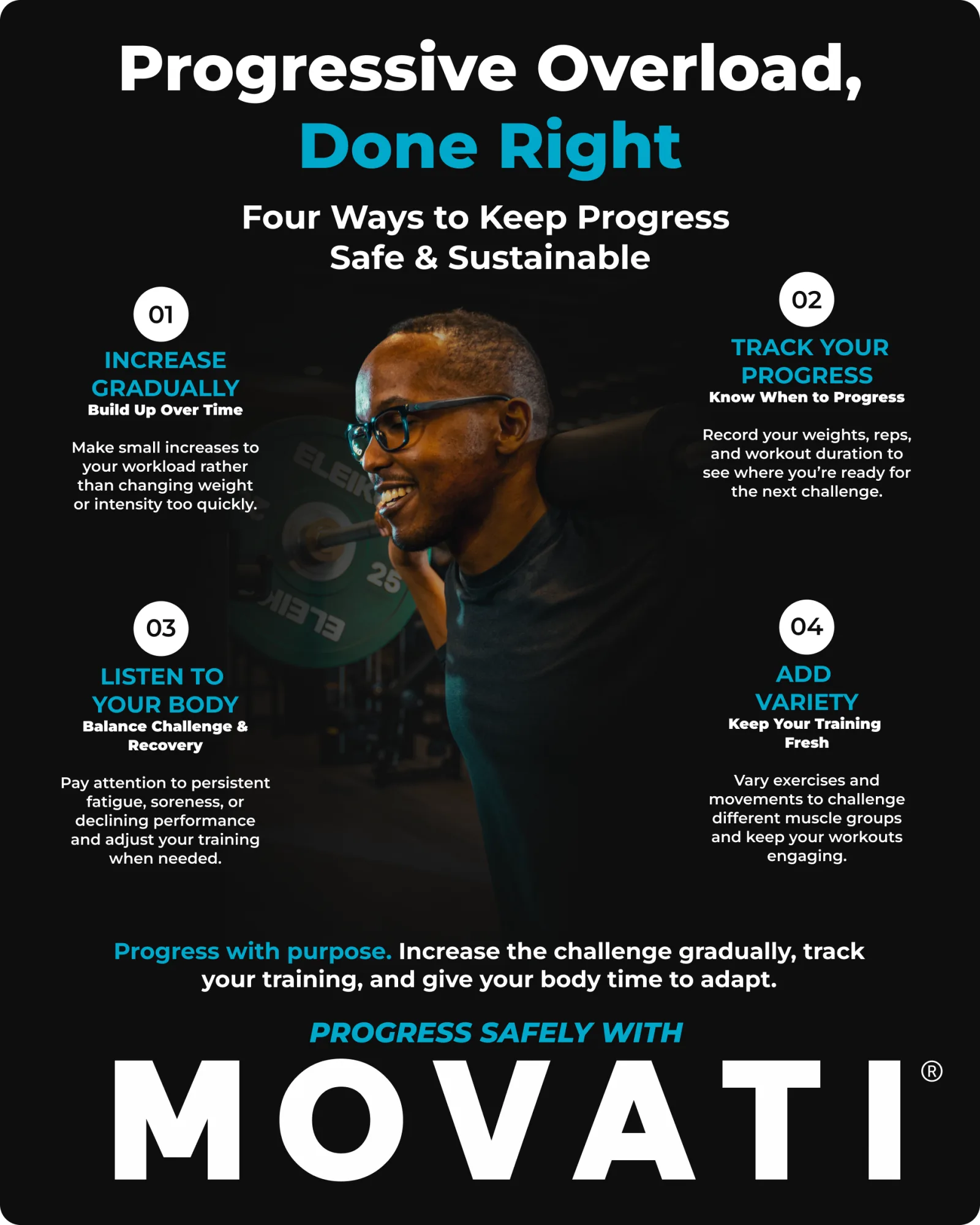
Increase Resistance Gradually
One of the most familiar methods involves increasing the amount of weight used during strength exercises.
For example, if you can comfortably complete three sets of ten repetitions with a particular weight while maintaining good technique, you may be ready to introduce a small increase.
The appropriate increase depends on the exercise, equipment, and your experience.
Smaller increases are often particularly useful for upper-body exercises or movements that require greater coordination.
Add Repetitions Before Increasing Weight
Increasing repetitions can provide an effective alternative when you’re not ready to lift heavier weights.
For example:
| Training Session | Weight | Sets | Repetitions |
|---|---|---|---|
| Week 1 | 10 kg | 3 | 8 |
| Week 2 | 10 kg | 3 | 9 |
| Week 3 | 10 kg | 3 | 10 |
| Week 4 | 12 kg | 3 | 8 |
This example illustrates how repetitions can increase before resistance is adjusted. Actual progression may take longer, and increases should depend on technique and recovery.
Improve Movement Quality
Progress isn’t always measured by heavier weights or additional repetitions.
Improving balance, coordination, control, or range of motion can also represent meaningful progress.
For example, someone learning to squat may initially use a chair for support.
As strength and confidence improve, they may progress to controlled bodyweight squats before introducing additional resistance.
This approach can be particularly valuable for individuals returning to exercise after prolonged inactivity.
Increase Workout Duration or Distance
For cardiovascular activities, progression may involve gradually increasing the amount of time spent exercising.
A beginner might start with short walking sessions before introducing longer distances or jogging intervals.
The key is to increase demands at a rate that allows the body to adapt without creating excessive fatigue.
Progressive Overload for Beginners and Those Returning to Fitness
For individuals who have spent years living a sedentary lifestyle, returning to exercise often requires a different perspective on progress.
The initial objective may not be lifting heavier weights or completing intense workouts.
Instead, it may involve rebuilding basic strength, improving mobility, developing cardiovascular endurance, and establishing consistent physical activity.
I can relate to this personally. After spending years working at a desk, I’ve come to recognize that becoming active again is a gradual recovery process.
It’s tempting to measure progress against what you could do years earlier, but that doesn’t always reflect your current physical condition.
For me, the more useful approach is recognizing improvements from where I am today.
Walking farther, feeling stronger during everyday activities, or completing an exercise with better control can all represent meaningful progress.
This is where gradual progression becomes especially valuable.
Rather than trying to accomplish too much immediately, the focus is on building a foundation that supports continued improvement over time.
Applying Progressive Overload to HYROX Training
HYROX combines endurance running with demanding functional exercises, making progressive training particularly important.
Athletes need to develop the strength required for sled pushes, sled pulls, farmer’s carries, and sandbag lunges while also improving their ability to sustain repeated running efforts.
Strength Progression
Gradually increasing resistance during squats, lunges, carries, and sled exercises can help develop the strength needed for competition.
Endurance Progression
Increasing running distance, interval duration, or total weekly aerobic training can help improve cardiovascular conditioning.
Race-Specific Progression
Athletes can gradually combine running with functional workout stations.
For example, a training session might begin with shorter running intervals and reduced station distances before progressing toward longer, more demanding combinations.
The goal is to prepare for competition without attempting full race-level intensity during every workout.
Avoiding Common Training Mistakes
Progressive training should be challenging, but it shouldn’t require constant maximum effort.
Several mistakes can interfere with long-term improvement.
Increasing too many variables at once: Adding weight, repetitions, sets, and training frequency simultaneously can create unnecessary fatigue.
Sacrificing technique for heavier resistance: Increasing weight before developing proper movement control may reduce exercise quality.
Ignoring persistent fatigue: Declining performance, prolonged soreness, and unusual exhaustion may indicate that additional recovery is needed.
Expecting progress every workout: Strength and endurance improvements aren’t always linear. Some training periods may involve maintaining performance while the body adapts.
Changing exercises too frequently: Variety can be useful, but consistently practicing key movements makes it easier to measure improvement.
A structured approach provides enough consistency to track progress while allowing appropriate adjustments as fitness develops.
How MOVATI Athletic Can Support Your Progress
Having access to suitable training equipment and professional guidance can make it easier to establish a consistent progression plan.
MOVATI Athletic offers members opportunities to develop strength, improve cardiovascular endurance, and incorporate different forms of exercise into their routines.
Depending on your club’s facilities, you can use resistance equipment, free weights, and cardiovascular machines to gradually increase training demands.
Personal training services can also help you establish realistic goals, refine exercise technique, and develop a program suited to your current fitness level.
For beginners and individuals returning to exercise, professional guidance can be particularly valuable when determining appropriate starting resistance and progression.
Conclusion: Small Improvements Create Long-Term Results
Progressive overload is a fundamental principle of effective fitness training because it encourages the body to continue adapting to gradually increasing demands.
Whether your goal is building muscle, improving endurance, preparing for HYROX, or simply becoming more active, meaningful progress comes from consistent effort combined with appropriate recovery.
The most important lesson is that improvement doesn’t need to happen quickly. Adding one repetition, increasing walking distance, improving exercise technique, or gradually lifting more weight can all contribute to long-term development.
By focusing on manageable challenges, tracking your progress, and allowing your body time to adapt, you can build a sustainable fitness routine that supports greater strength, confidence, and overall physical well-being.
*MOVATI’s trainers and/or consultants are not health care providers, and do not provide any medical diagnosis, treatment or advice, and any trainer and/or consultant tips are not intended to replace the advice of a health care professional.
