
HYROX has become a popular fitness challenge by combining endurance running with demanding functional exercises. Unlike traditional gym workouts that focus primarily on strength or cardiovascular conditioning, HYROX workouts challenge athletes to perform both under fatigue. Whether you’re preparing for your first competition, looking to improve your race time, or simply interested in developing a more complete fitness routine, understanding the eight exercise stations is an excellent place to start.
A successful training program requires more than practicing individual movements. Athletes must develop the cardiovascular endurance to complete repeated runs, the muscular strength to handle resistance-based stations, and the ability to transition efficiently between different exercises. This guide explores the eight official HYROX workout stations, their benefits, and practical ways to incorporate them into your fitness routine.
What Makes HYROX Different From Traditional Fitness Training?
HYROX is a standardized indoor fitness race combining eight 1-kilometre runs with eight functional workout stations. Participants complete a total of 8 kilometres of running, with an exercise station following each kilometre.
The challenge comes from performing demanding strength and endurance exercises while managing fatigue from the repeated running segments.
The official race follows this sequence:
| Station | Exercise | Distance or Repetitions |
|---|---|---|
| 1 | SkiErg | 1,000 metres |
| 2 | Sled Push | 50 metres |
| 3 | Sled Pull | 50 metres |
| 4 | Burpee Broad Jumps | 80 metres |
| 5 | Rowing | 1,000 metres |
| 6 | Farmer’s Carry | 200 metres |
| 7 | Sandbag Lunges | 100 metres |
| 8 | Wall Balls | 100 repetitions |
Each station is preceded by a 1-kilometre run. Equipment weights and certain movement requirements vary according to competition division.
The consistent race format allows participants to measure progress over time, making HYROX appealing to individuals who enjoy structured fitness challenges and measurable performance goals.
1. SkiErg: Build Upper-Body Endurance and Cardiovascular Fitness
The SkiErg is the first functional station in a HYROX race. This machine simulates the pulling motion used in cross-country skiing, challenging the upper body, core, and cardiovascular system.

Although the movement appears relatively straightforward, completing 1,000 metres after running requires controlled breathing, muscular endurance, and efficient technique.
How to Perform the SkiErg
Stand facing the machine with your feet approximately shoulder-width apart.
Reach overhead and grasp both handles.
Engage your core and pull the handles downward using your arms and torso.
Allow a controlled bend through your hips and knees.
Return your arms overhead smoothly to begin the next repetition.
Maintain a consistent rhythm throughout the exercise.
Why It Matters for HYROX
The SkiErg challenges your ability to sustain upper-body effort while maintaining cardiovascular control. Beginning this station too aggressively can create unnecessary fatigue that affects the remaining race.
Training tip: Start with intervals of 250 metres, focusing on consistent pacing and efficient movement. Gradually progress toward longer intervals and eventually the full 1,000-metre distance.
2. Sled Push: Develop Lower-Body Power and Strength
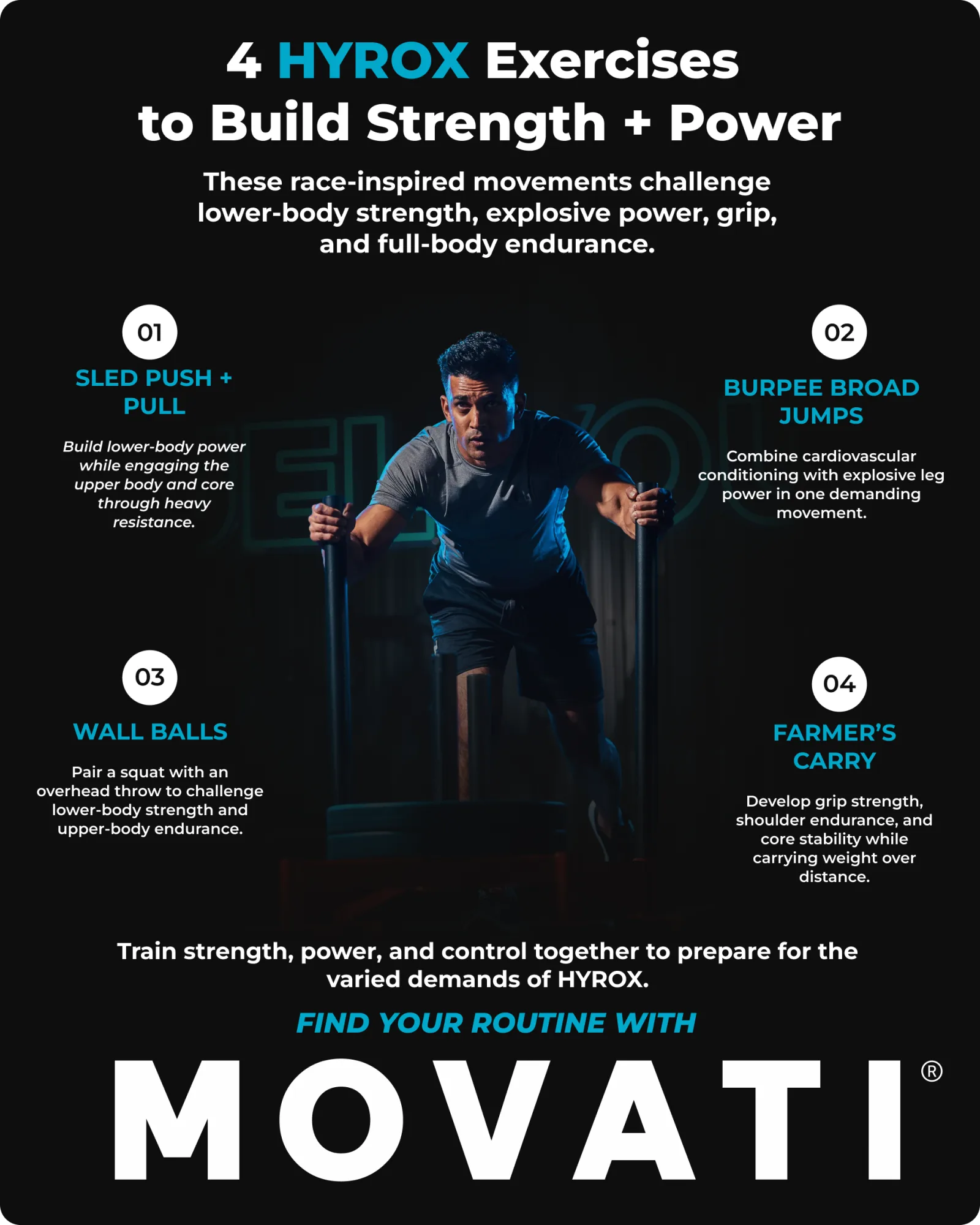
The sled push is one of the most demanding strength-based stations in HYROX. It requires athletes to move a weighted sled across a designated distance while maintaining forward momentum.
This movement primarily challenges the quadriceps, glutes, calves, and core, while also requiring upper-body stability.
How to Perform the Sled Push
Position yourself behind the sled with your hands firmly gripping the handles.
Lean forward while maintaining a stable torso.
Engage your core and drive through your legs.
Take controlled, powerful steps to move the sled forward.
Maintain consistent pressure rather than repeatedly stopping and restarting.
Adjust your pace to maintain control throughout the distance.
Why It Matters for HYROX
The sled push places considerable demands on the lower body, particularly after running. Developing strength and learning to maintain momentum can help improve efficiency during this station.
Training tip: Begin with a manageable sled resistance and focus on continuous movement. Gradually increase the load as your strength improves. Sled friction varies between surfaces, so training resistance may not feel identical to race conditions.
3. Sled Pull: Strengthen Your Back, Arms, and Core
The sled pull follows the sled push and introduces a different physical challenge. Instead of driving resistance forward with your legs, athletes use a rope to pull a weighted sled toward them.
This exercise engages the back, shoulders, arms, grip, and core while requiring stable lower-body positioning.
How to Perform the Sled Pull
Stand within the designated pulling area and grasp the rope securely.
Establish a stable stance with your knees slightly bent.
Engage your core and pull the rope toward your body.
Use controlled arm and back movements to move the sled.
Continue pulling while managing the rope safely.
Maintain steady breathing throughout the exercise.
Why It Matters for HYROX
The sled pull challenges muscular endurance and grip strength while requiring coordination between the upper and lower body.
Training tip: Practice with moderate resistance before progressing to heavier loads. Focus on controlled pulling technique and maintaining stability rather than relying entirely on arm strength.
4. Burpee Broad Jumps: Improve Full-Body Conditioning
Burpee broad jumps combine a burpee with a forward jump, creating a demanding exercise that challenges cardiovascular endurance, muscular strength, and coordination.
In HYROX, participants complete 80 metres of burpee broad jumps, making movement efficiency especially important.
How to Perform Burpee Broad Jumps
Begin standing with your feet approximately shoulder-width apart.
Lower your hands toward the floor.
Move your feet backward into the required burpee position.
Bring your feet forward beneath your body.
Perform a controlled forward jump.
Land with bent knees and prepare for the next repetition.
Competition standards specify movement requirements, so athletes should practice according to the rules for their event.
Why It Matters for HYROX
Burpee broad jumps challenge the entire body while significantly increasing cardiovascular demand. Maintaining an efficient rhythm can help prevent excessive fatigue.
Training tip: Begin with short distances of 10 to 20 metres and prioritize controlled landings. Gradually increase the distance while maintaining consistent technique.
5. Rowing: Build Aerobic Capacity and Muscular Endurance
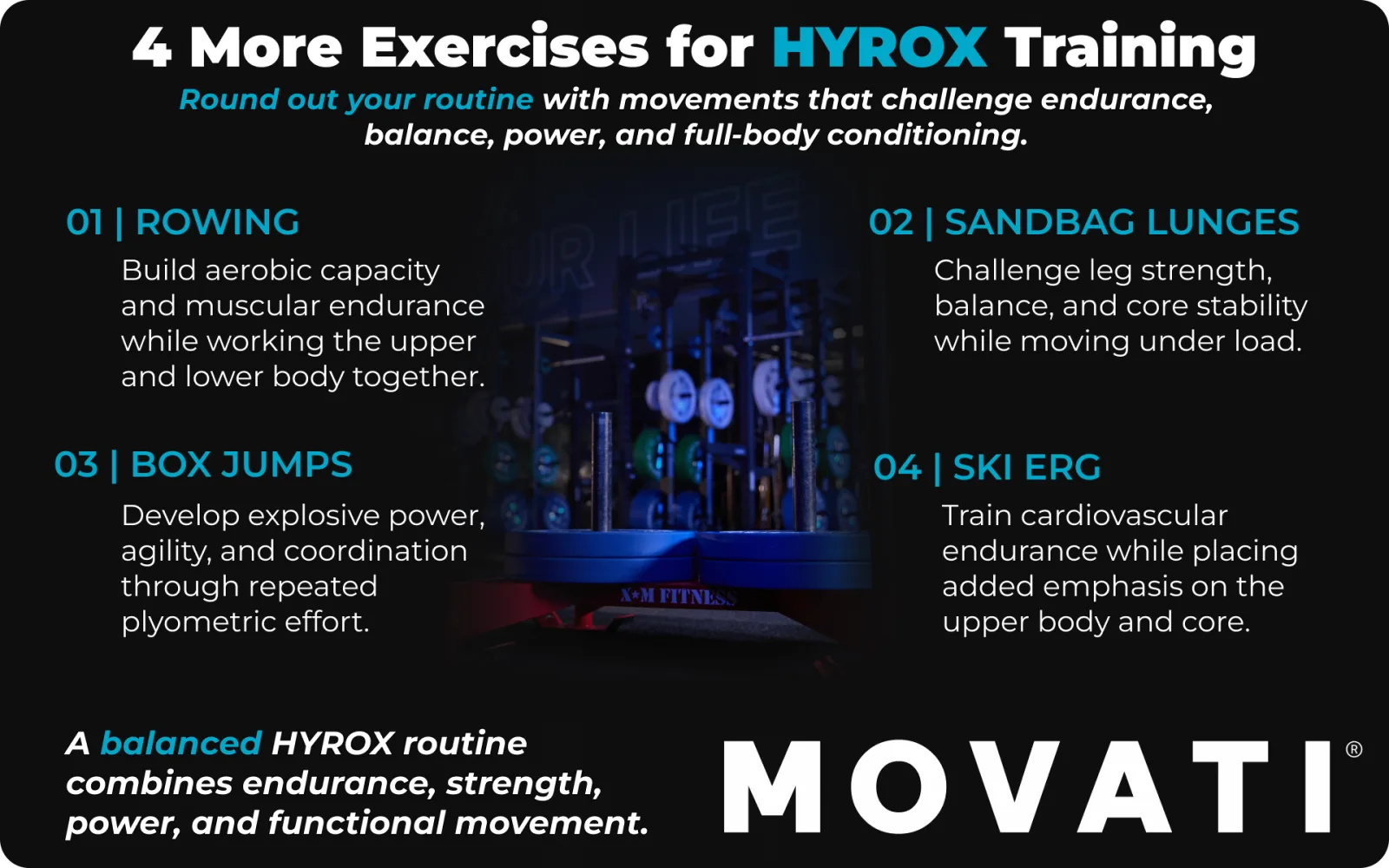
Rowing is the fifth functional station and requires athletes to complete 1,000 metres on a rowing machine.
This exercise engages the legs, back, arms, and core while providing a demanding cardiovascular challenge.
Effective rowing relies on coordinated movement and efficient pacing rather than simply pulling harder with the arms.
How to Perform the Rowing Movement
Sit on the rowing machine with your feet secured.
Begin with your knees bent and arms extended.
Push through your legs to initiate the movement.
Lean back slightly as your legs extend.
Pull the handle toward your lower ribs.
Reverse the sequence by extending your arms, hinging forward, and bending your knees.
Why It Matters for HYROX
Rowing provides an opportunity to maintain a steady effort while continuing to challenge the cardiovascular system.
However, poor pacing can quickly increase fatigue, particularly after completing several running segments and strength stations.
Training tip: Practice 250- to 500-metre intervals before progressing to longer distances. Focus on maintaining a consistent stroke rate and controlled breathing.
6. Farmer’s Carry: Build Grip Strength and Core Stability
The farmer’s carry requires participants to transport two weighted kettlebells over a total distance of 200 metres.
Although the movement is relatively simple, maintaining grip strength and posture over this distance can become increasingly challenging as fatigue develops.
How to Perform the Farmer’s Carry
Position two kettlebells beside your feet.
Bend at your hips and knees to grasp the handles.
Stand upright while keeping your core engaged.
Allow your arms to remain extended at your sides.
Walk forward using controlled, natural steps.
Maintain an upright posture without excessive leaning.
Why It Matters for HYROX
The farmer’s carry challenges grip endurance, shoulder stability, and core strength while requiring athletes to continue moving under load.
Training tip: Begin with lighter kettlebells and shorter distances of 20 to 40 metres. Gradually increase the weight or distance as your grip strength and conditioning improve.
7. Sandbag Lunges: Develop Leg Endurance and Balance
Sandbag lunges are particularly demanding because they combine lower-body resistance with repeated stepping movements.
During the race, athletes complete 100 metres of walking lunges while carrying a weighted sandbag.
This station challenges the quadriceps, glutes, hamstrings, and core while requiring balance and coordination.
How to Perform Sandbag Lunges
Position the sandbag securely across your upper back and shoulders.
Stand upright with your feet approximately hip-width apart.
Step forward into a controlled lunge.
Lower your body while maintaining stability.
Push through your front foot to move into the next step.
Continue alternating legs while maintaining proper posture.
Why It Matters for HYROX
Sandbag lunges place significant demands on the lower body late in the race, when fatigue may already be affecting balance and muscular endurance.
Training tip: Begin with bodyweight walking lunges before introducing a sandbag. Gradually increase resistance and distance while maintaining controlled knee and hip alignment.
8. Wall Balls: Finish Strong With Full-Body Endurance
Wall balls are the final functional station in HYROX and often represent one of the most mentally and physically demanding portions of the race.
Participants perform repeated squats while throwing a medicine ball toward a designated target.
The movement combines lower-body strength, upper-body coordination, and cardiovascular endurance.
How to Perform Wall Balls
Stand facing the target with your feet approximately shoulder-width apart.
Hold a medicine ball near chest height.
Lower into a controlled squat.
Drive upward through your legs.
Use the upward momentum to throw the ball toward the target.
Catch the returning ball and transition into the next repetition.
Why It Matters for HYROX
Completing 100 repetitions after the previous running segments and workout stations requires muscular endurance, consistent technique, and effective pacing.
Training tip: Begin with manageable sets of 10 to 15 repetitions. Gradually increase total volume and practice maintaining consistent technique as fatigue develops.
How to Build a Balanced HYROX Training Routine
Preparing for HYROX requires more than practicing the eight stations individually. Athletes must also develop the ability to run repeatedly while managing muscular fatigue.
A balanced program should incorporate cardiovascular conditioning, resistance training, station-specific practice, and recovery.
Combine Running With Functional Strength
Running accounts for a substantial portion of the HYROX race, making aerobic conditioning essential.
Include a combination of comfortable endurance runs, interval training, and sessions that alternate running with functional exercises.
For example, a training session might combine a 1-kilometre run with a shorter rowing interval, followed by another run and a set of walking lunges.
This helps prepare the body for transitioning between different physical demands.
Practice Movement Efficiency
Successful performance isn’t determined entirely by strength or speed.
Efficient movement can help conserve energy and reduce unnecessary fatigue throughout the race.
Focus on maintaining proper technique during sled movements, developing consistent rowing and SkiErg pacing, and practicing smooth transitions between exercises.
Prioritize Recovery
HYROX training places considerable demands on both the cardiovascular and muscular systems.
Adequate recovery is essential for maintaining consistent progress and reducing the risk of overuse injuries.
Schedule easier training days, prioritize sleep, maintain appropriate nutrition, and adjust workout intensity when experiencing excessive fatigue.
Example Weekly HYROX Training Schedule
A structured weekly routine can help distribute training demands while allowing time for recovery.
| Day | Training Focus | Suggested Activity |
|---|---|---|
| Monday | Strength | Sled push, sled pull, and lower-body exercises |
| Tuesday | Running | Easy endurance run |
| Wednesday | Functional conditioning | SkiErg, rowing, and farmer’s carry |
| Thursday | Recovery | Walking, mobility, or rest |
| Friday | Hybrid training | Running combined with burpees and lunges |
| Saturday | Strength and endurance | Wall balls, resistance training, and aerobic conditioning |
| Sunday | Rest | Full recovery |
This schedule is an example for individuals with an established fitness foundation. Training frequency, intensity, and volume should be adjusted according to experience, competition goals, and recovery needs.
Common HYROX Training Mistakes to Avoid
Preparing for a race that combines endurance and strength requires careful planning. Several common mistakes can limit performance or make training unnecessarily difficult.
Neglecting running: Strong performance at workout stations cannot fully compensate for insufficient running endurance.
Training at maximum intensity too frequently: Excessive high-intensity training can interfere with recovery and consistent progress.
Ignoring movement technique: Efficient exercise execution becomes increasingly important as fatigue develops.
Focusing exclusively on heavy weights: HYROX requires muscular endurance as well as strength.
Skipping race simulations: Practicing transitions between running and functional exercises helps prepare athletes for competition demands.
Progressing too quickly: Gradual increases in resistance, distance, and training volume help manage physical stress.
Preparing for Your First HYROX Competition
If you’re considering entering your first event, begin by assessing your current running ability, strength, and familiarity with the workout stations.
You don’t need to master every movement immediately. Start with manageable training sessions and gradually introduce more demanding exercises as your conditioning improves.
Familiarizing yourself with the official competition standards is also important. Equipment weights, wall-ball target heights, and certain movement requirements vary between divisions.
Practicing under conditions that resemble your selected race category can help establish realistic expectations and improve confidence.
Conclusion
Incorporating HYROX workouts into your fitness routine offers a challenging and rewarding way to develop cardiovascular endurance, functional strength, and muscular stamina. By practicing the eight official workout stations, improving running performance, and following a balanced training schedule, you can build the physical capabilities needed for competition or general fitness improvement.
Whether you’re preparing for your first HYROX event or working toward a faster race time, consistent training, proper technique, and adequate recovery are essential. Focus on gradual improvements, develop confidence with each movement, and approach your training as a long-term investment in strength, endurance, and overall athletic performance.
*MOVATI’s trainers and/or consultants are not health care providers, and do not provide any medical diagnosis, treatment or advice, and any trainer and/or consultant tips are not intended to replace the advice of a health care professional.
