This Hyrox competition overview explains the format in one sentence: competitors complete eight one-kilometre runs, with one standardized functional workout station after each run. The result is an indoor fitness race that rewards running endurance, strength, movement efficiency, and pacing rather than mastery of a single skill.
The course is demanding, but its appeal lies in its predictability. The station order is known, results are timed, and division rules define the required loads and repetitions. You can train for the exact movements and compare your performance across events while still facing the uncertainty that fatigue creates.
What happens during a HYROX race?

The race begins with a one-kilometre run. You then enter the workout area for the first station, return to the running course, and repeat that pattern until you have completed all eight runs and all eight stations.
The standard station order is:
- SkiErg
- Sled push
- Sled pull
- Burpee broad jumps
- Rowing
- Farmer’s carry
- Sandbag lunges
- Wall balls
Distances, loads, repetitions, movement standards, and division details are set by the applicable event rulebook. Check the current athlete guide for your race rather than relying on an old social post or a previous season’s requirements.
Why is the format harder than it looks?
No single component is the whole challenge. The difficulty comes from switching repeatedly between running and functional work. A sled station can leave your legs heavy for the next kilometre. A hard effort on the SkiErg or rower can disrupt breathing. Lunges and wall balls arrive when fatigue has already accumulated.
Success therefore depends on compromised running—the ability to settle into an efficient stride after a station—as well as sensible station pacing. The fastest possible effort at one point is not always the fastest strategy for the entire race.
Which division should you choose?
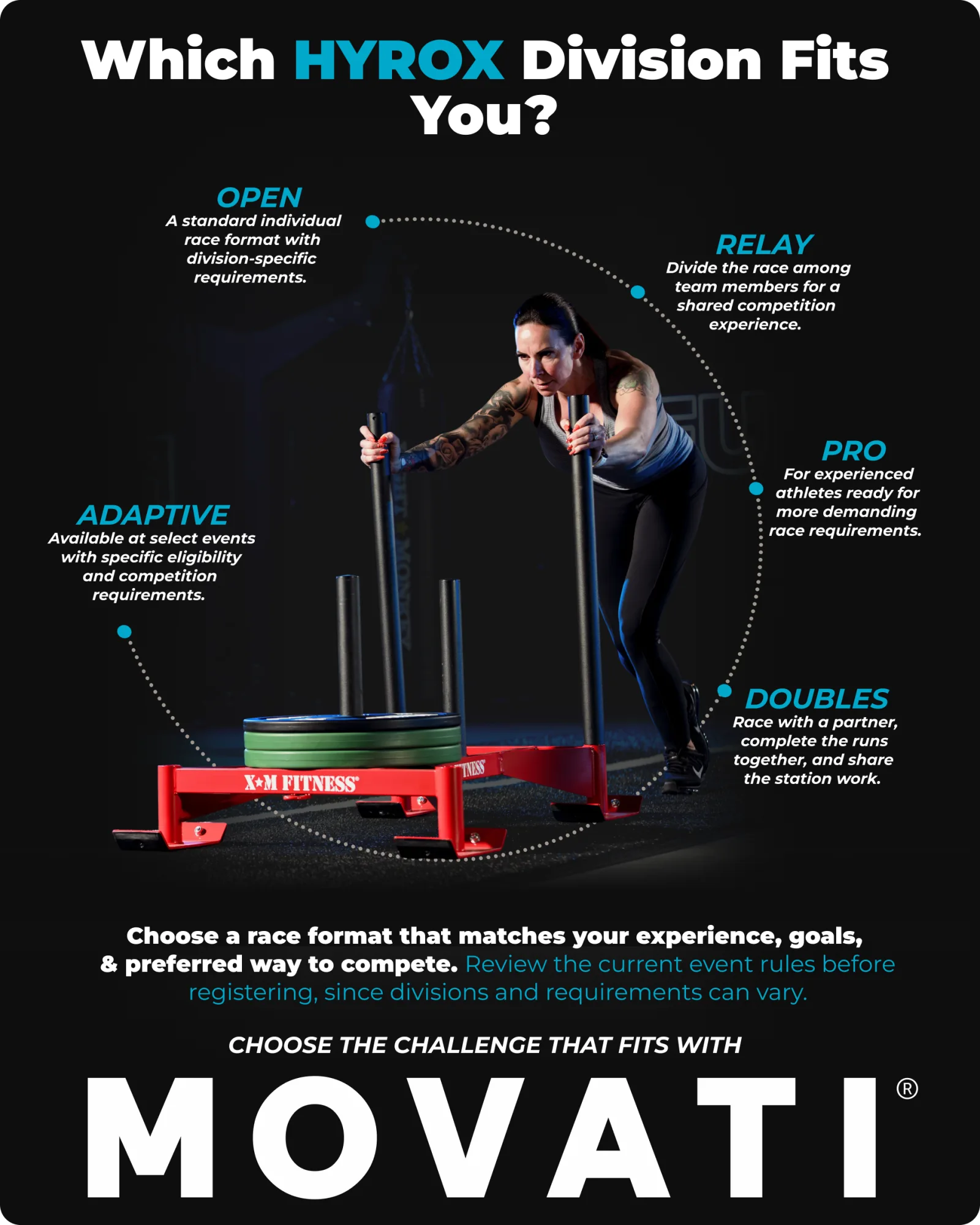
HYROX events offer individual racing and may include Open, Pro, Doubles, Relay, and Adaptive options, depending on the event. Open and Pro individual divisions complete the same running distance but use division-specific race requirements. In Doubles, partners complete the runs and share station work according to the rules. Relay divides the race among team members.
Choose based on your training history, experience with the movements, and whether you want to race alone or with others. Doubles can make the station volume more manageable, but it is not effortless: both partners still need to prepare for the running and coordinate how they divide the work.
Before registering, review the current official rulebook, eligibility requirements, and local event information. Formats and categories can evolve between seasons.
Do you need to be an elite athlete?
No, but you do need to respect the workload. Recreational athletes can prepare for the event, and the fixed format makes the goal tangible. That accessibility should not be confused with an easy day: eight kilometres of running plus eight stations creates substantial cumulative fatigue.
You should be able to train consistently, tolerate running, and practise the station patterns safely before race day. If you are new to exercise, return after a long break, or manage a health condition or injury, build a foundation first and seek appropriate guidance.
What fitness does HYROX test?
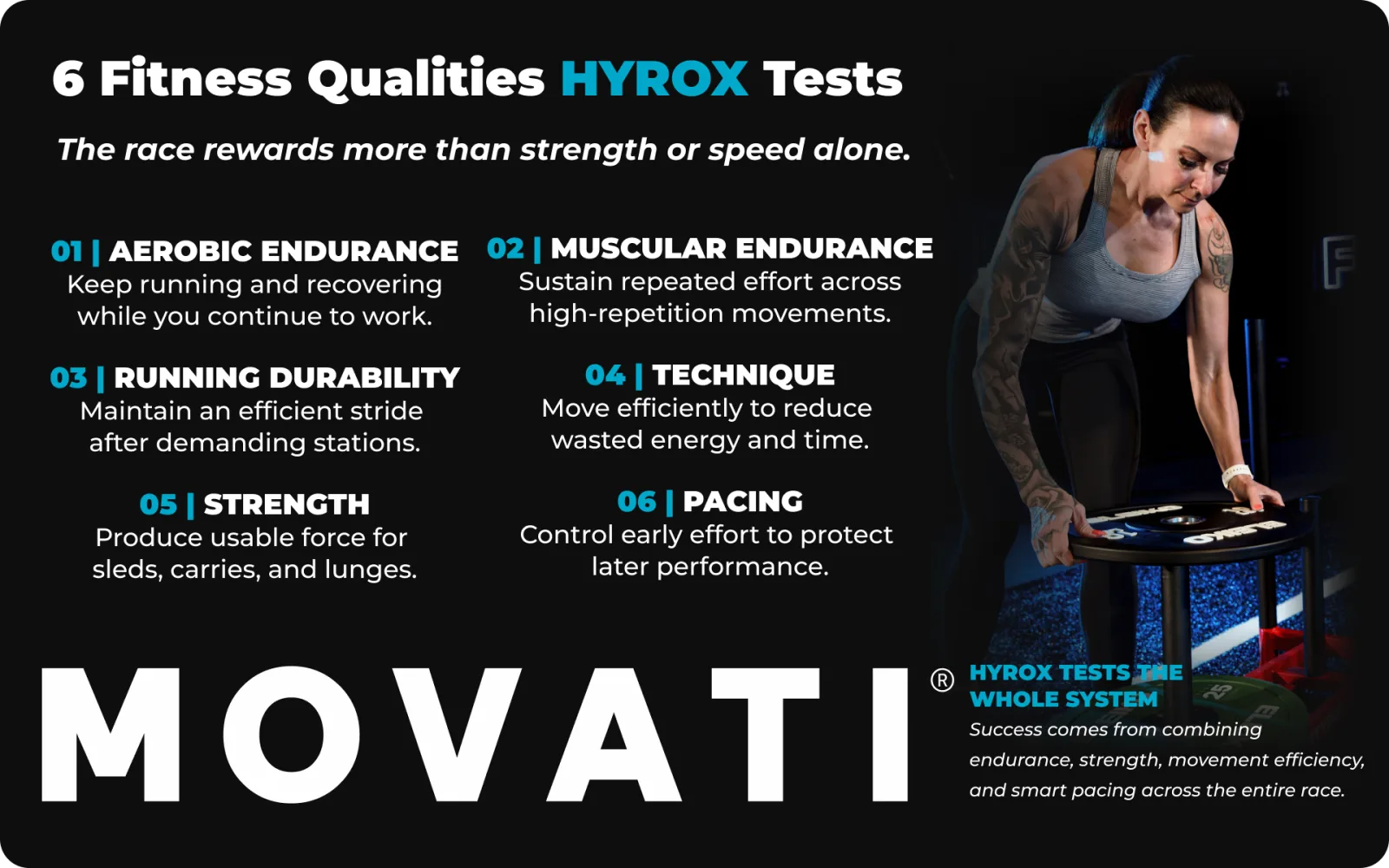
- Aerobic endurance: You need to continue running and recover while still moving.
- Running durability: Your stride must remain effective after loaded or high-repetition work.
- Strength: Sleds, carries, and lunges require usable force.
- Muscular endurance: Wall balls, burpees, and repeated station work demand sustainable output.
- Technique: Efficient movement can reduce wasted time and energy.
- Pacing: Early restraint often protects later performance.
- Decision-making: You must adjust set sizes, transitions, and effort while tired.
How should a beginner train?
Build consistent running first
Start from your current capacity. Use easy running or a walk-run approach to build tolerance, then add controlled faster work when you have a stable base. Avoid turning every run into a race.
Develop general strength
Squats, hinges, lunges, pushes, pulls, and carries create a useful foundation. Progress gradually and learn to control the movements before adding speed or large amounts of fatigue.
Learn each station while fresh
Practise the SkiErg and rower sequence, safe sled positions, burpee broad-jump rhythm, carry turns, lunge mechanics, and wall-ball timing. Technical practice is easier to evaluate before a demanding circuit.
Add compromised running in small doses
Pair one controlled station effort with a short, steady run. Later, link two or three blocks. You do not need to complete a full simulation every week; shorter combinations often teach the transition with less recovery cost.
What should you expect on event day?
Events use start waves, so your race begins at an assigned time with other competitors. Arrive early enough to complete check-in, understand the venue flow, and prepare without rushing. Read the athlete information sent for your event because procedures can vary by location.
During the race, follow course signage and official instructions. Count repetitions carefully, complete movement standards, and know the required station work for your division. A fast transition helps, but not if rushing causes a navigation or equipment mistake.
The atmosphere is part of the experience. Competitors race their own clock while sharing the floor with others, and spectators can often see much of the action. That combination of personal benchmark and large-event energy helps explain the format’s popularity.
How is the race scored?
Your result is based on elapsed time from start to finish, including running, stations, and transitions. Split data can help identify where time was gained or lost. A slower station is not automatically a weakness if it allowed you to run better afterward; evaluate the whole race.
Rankings and qualification rules depend on division, age group, event, and season. Consult official results and the current rulebook for details.
What should you bring?
- Footwear tested for both running and station work
- Comfortable clothing you have worn in demanding sessions
- Registration and identification items required by the organizer
- Your familiar pre-race food and hydration plan
- A clear understanding of your division’s standards
Avoid debuting new shoes, supplements, or an aggressive pacing strategy on race day. Rehearse the practical details during training.
Is HYROX right for you?
Consider it if you enjoy measurable goals, running, functional training, and a fixed challenge that can be repeated. You may prefer another event if you dislike running or currently cannot tolerate the station movements safely. There is no need to force the format simply because it is popular.
The essential Hyrox competition overview is straightforward: eight runs, eight stations, one continuous timed race. The preparation is more nuanced. Build aerobic capacity and strength, learn the movements, practise transitions under controlled fatigue, and choose the division that makes the challenge appropriate for you.
