Lower Body Workouts are most effective when they match your current ability and leave room to progress. You do not need to fit a rigid beginner, intermediate or advanced label. Instead, select exercises that feel stable, use a manageable range of motion and increase the challenge when your repetitions remain consistent.
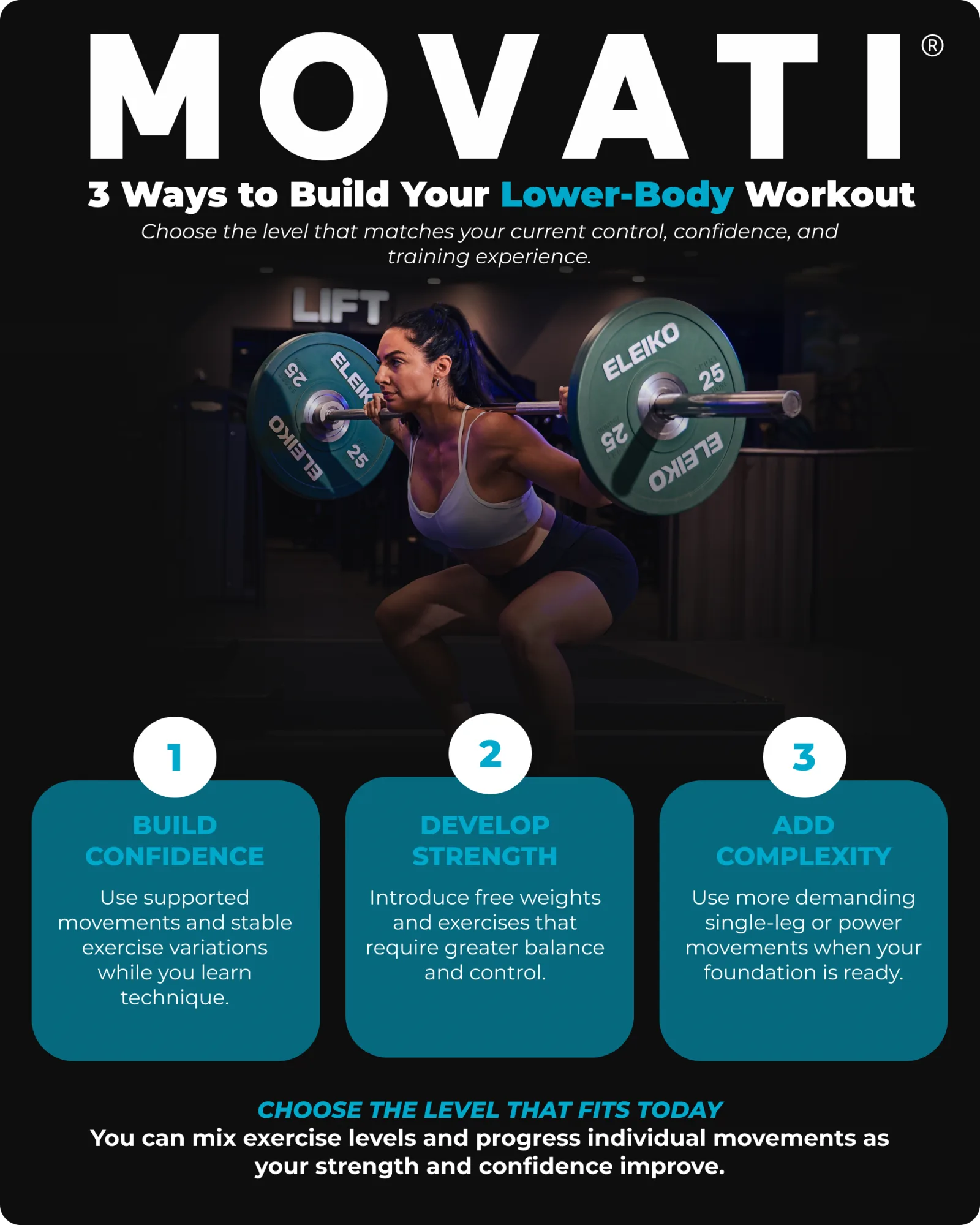
The three routines below use the same foundational patterns with different levels of complexity. Choose the one that best suits you today, and change individual movements whenever a supported option would improve your technique.
What should every lower-body session include?
A balanced workout trains the knees and hips, includes at least one unilateral or single-leg movement and addresses the lower legs. It should also begin with a gradual warm-up that rehearses the exercises ahead.
- Squat or press: trains the quadriceps and glutes.
- Hip hinge: emphasizes the hamstrings and glutes.
- Single-leg exercise: develops side-to-side control and balance.
- Accessory movement: adds focused work for the calves, hamstrings or hips.
There is no requirement to use a barbell. Bodyweight movements, dumbbells, cables and machines can all contribute to a productive program.
Workout 1: Build confidence with supported movements
This session uses stable variations that make it easier to focus on position and tempo.
- Box squat: Sit toward a bench or box, touch down lightly and stand with control.
- Dumbbell Romanian deadlift: Move the hips back while keeping the weights close to the legs.
- Supported split squat: Hold a rack or rail and lower within a comfortable range.
- Seated hamstring curl: Control both the bending and straightening phases.
- Standing calf raise: Rise smoothly, pause, then lower slowly.
Begin with two working sets of each movement. Select a resistance that allows consistent repetitions and gives you time to learn how each exercise feels.
Workout 2: Develop strength with free weights
Choose this session when you can maintain your positions confidently and want a greater stability challenge.
- Goblet squat: Hold one dumbbell close to your chest and keep the whole foot grounded.
- Dumbbell Romanian deadlift: Use a load that lets you maintain a controlled hinge.
- Reverse lunge: Step back, lower smoothly and drive through the front foot to return.
- Hip thrust: Extend the hips without overextending the lower back.
- Single-leg calf raise: Use support so balance does not limit the calf work.
Two or three sets per movement provide a useful framework. Rest until you can approach the next set with the same attention and control.
Workout 3: Add complexity and power thoughtfully
This option uses more demanding unilateral and power movements. Power exercises belong near the start of a session, after the warm-up, when you are fresh enough to move with precision.
- Low box jump or fast step-up: Choose the lower-impact step-up if jumping is not appropriate for you.
- Front squat or hack squat: Use the variation that allows a strong, comfortable position.
- Single-leg Romanian deadlift: Hold a support if needed and keep the hips level.
- Rear-foot-elevated split squat: Use a range you can control without losing balance.
- Hamstring curl and calf raise: Finish with focused accessory work.
Power training should feel crisp, not exhausting. Stop a set when speed or landing quality declines. Fewer high-quality repetitions are more useful than continuing through fatigue.
How do you choose the right workout?
Select the routine whose movements you can perform without rushing, straining or losing position. You can also combine levels. For example, use a goblet squat from Workout 2 and a supported split squat from Workout 1.
Your choice may change from day to day. Previous activity, sleep and stress can affect performance, so adjusting the load or variation is part of good training.
How should you progress?
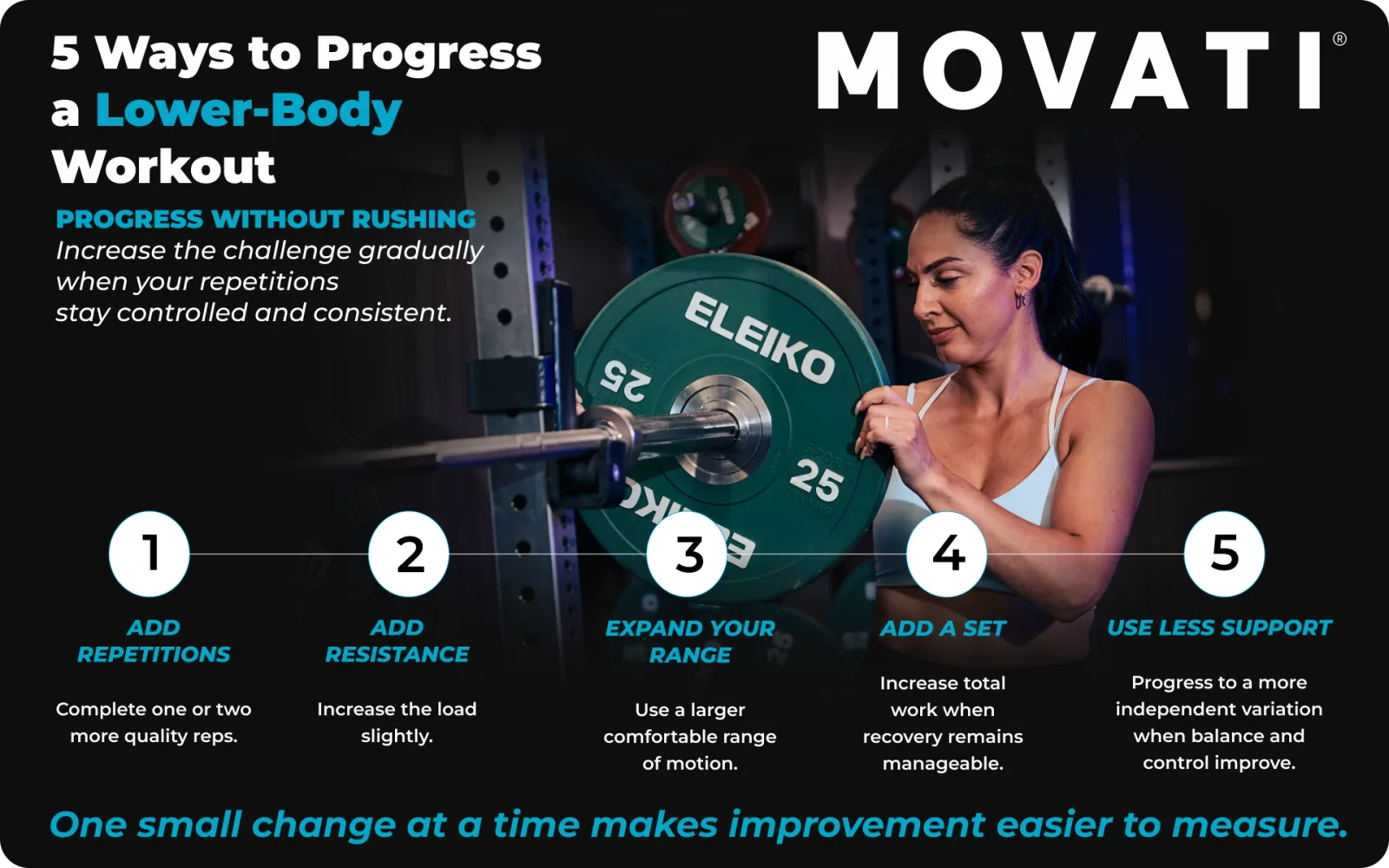
Keep a record of your exercises, sets, repetitions and resistance. When every repetition is consistent and the final set feels manageable, choose one small progression:
- add one or two repetitions;
- increase the resistance slightly;
- use a larger comfortable range of motion;
- add a set; or
- move to a less-supported variation.
Avoid increasing everything at once. Gradual changes make it easier to preserve technique and understand how your body responds.
Include mobility and recovery
Mobility work should reflect the movements you want to improve. Before training, use controlled, dynamic motions and lighter practice sets. Afterward or on another day, spend time on areas that feel restricted without forcing painful positions.
Recovery also includes regular meals, hydration, sleep and enough time between demanding sessions. Stop an exercise if you feel sharp pain or symptoms that worsen with each repetition. Seek appropriate health guidance for persistent concerns.
Create a plan that can grow with you
The best routine is not the hardest one on the page. It is the one you can repeat, measure and progress. A MOVATI Athletic trainer can help you learn unfamiliar equipment, refine exercise variations and build a program around your experience and goals.
