Beyond Squats, a complete lower-body program needs movements that challenge the hips, legs and ankles in different ways. Squats are valuable, but they are primarily one pattern. Adding hinges, single-leg exercises and side-to-side movement helps create a more varied routine without making it unnecessarily complex.
These five exercises complement squats rather than compete with them. Use the variation and resistance that allow you to move with control.
Why add other movements to your routine?
No single exercise trains every function of the lower body equally. A squat asks the hips and knees to bend together, but it does not provide the same challenge as a hip hinge or a movement performed on one leg. Variety can also make it easier to distribute training stress and work within your preferred ranges of motion.
You do not need to perform every exercise in every session. Select a few that address the patterns missing from your current plan.
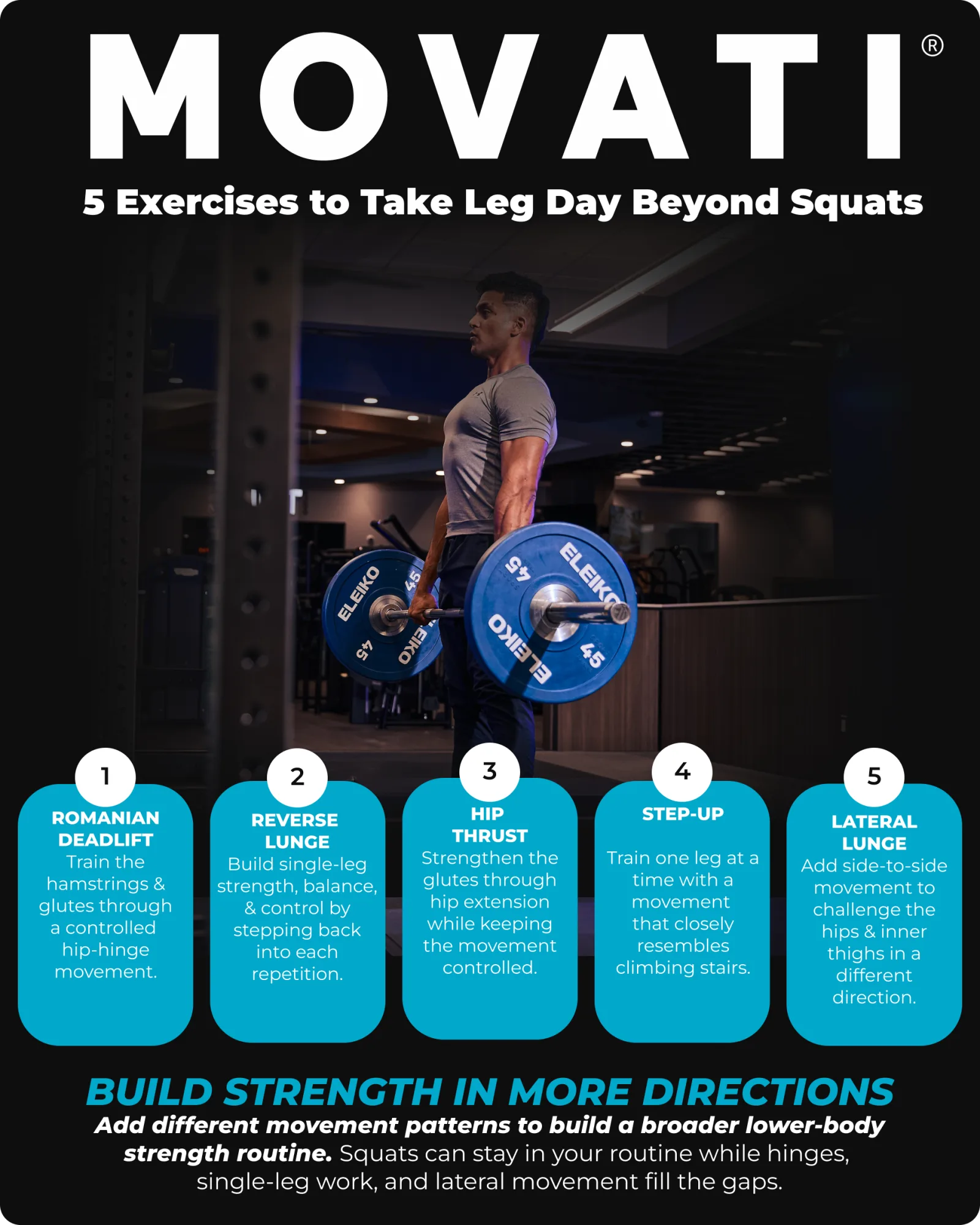
1. Romanian deadlift for the hamstrings and glutes
The Romanian deadlift is a hip hinge. It emphasizes the posterior chain while teaching you to move the hips independently of a deep knee bend.
- Stand tall with the weights close to your thighs and soften your knees.
- Brace your trunk and send your hips backward.
- Keep the weights close as you lower through a comfortable range.
- Press through your feet and bring the hips forward to stand.
Begin with dumbbells or a dowel if the pattern is new. The goal is hamstring tension and control, not reaching the weights to the floor.
2. Reverse lunge for single-leg control
Stepping backward into a lunge challenges the front leg while asking the body to remain balanced. Keep the front foot planted and lower only as far as you can control.
If the step creates too much instability, use a supported split squat. Hold a stable surface, set your feet in a staggered position and move straight down and up without stepping between repetitions.
3. Hip thrust or glute bridge for hip extension
Hip thrusts and glute bridges train the glutes through hip extension with the upper body supported. For a floor bridge, lie on your back with your knees bent and feet planted. Brace gently, press through your feet and lift the hips without forcing the lower back to arch.
Pause briefly at the top, then lower with control. Progress from bodyweight to a band, dumbbell or machine only when the movement feels stable.
4. Step-up for practical, unilateral strength
A step-up trains one leg at a time and resembles the action of climbing stairs. Platform height makes a large difference, so begin lower than you think you need.
- Place the whole working foot on the platform.
- Shift your weight onto that leg and drive through the foot.
- Stand with control instead of pushing hard from the floor leg.
- Lower slowly and reset before the next repetition.
Use a rail for balance or hold dumbbells when you are ready for more resistance.
5. Lateral lunge for side-to-side movement
Many workouts take place almost entirely forward and backward. A lateral lunge adds side-to-side movement and trains the hips and inner thighs in a different position.
Step to one side, send the hips back over the stepping leg and keep the other leg comfortably extended. Push through the stepping foot to return. Start with a small range and increase it only while the foot, knee and hip remain controlled.
How should you program these exercises?
If your workout already includes squats, choose two or three complementary movements. A simple session could look like this:
- Squat variation
- Romanian deadlift
- Reverse lunge or step-up
- Hip thrust
- Calf raise or lateral lunge
Start with two or three working sets of each selected exercise. Use repetitions you can perform consistently and stop the set before fatigue changes your technique. Rest periods should be long enough to restore your control and effort.
Progress by adding a repetition, a small amount of resistance or a more demanding variation. Avoid changing several variables at once, since that makes it difficult to know what is working.
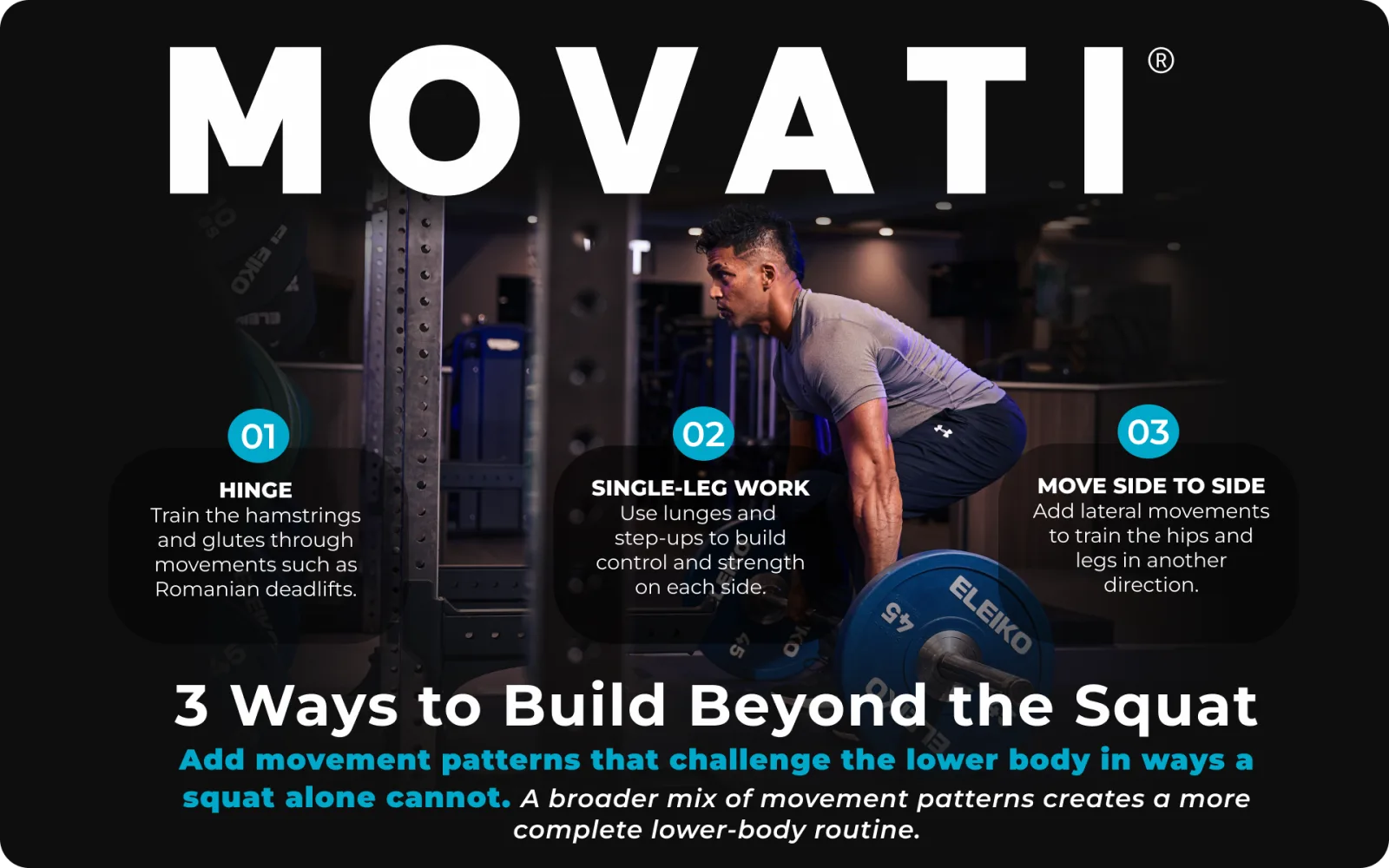
Build a broader strength foundation
Squats can remain part of your program while other patterns fill the gaps. Hinges train the posterior chain, single-leg movements develop control and lateral work introduces another direction. A MOVATI Athletic trainer can help you choose appropriate variations and combine them into a plan that fits your goals.
