The Hyrox fitness trend has turned a straightforward formula—running plus standardized workout stations—into a widely recognizable fitness-racing format. Its rise is not only about the difficulty of the event. It reflects a broader appetite for measurable goals, hybrid training, social competition, and challenges that recreational athletes can understand before they enter.
HYROX offers a finish line for people whose training already blends cardio and strength. Instead of asking whether someone is a runner or a lifter, it asks how well those qualities work together under fatigue.
What makes HYROX different?
The standard race alternates eight one-kilometre runs with eight workout stations in a fixed order: SkiErg, sled push, sled pull, burpee broad jumps, rowing, farmer’s carry, sandbag lunges, and wall balls. Results are based on total elapsed time, including transitions.
That consistency makes the event easy to explain and difficult to master. Competitors know the sequence, but pacing, equipment, venue flow, and accumulated fatigue make every race a genuine test. A familiar format also gives athletes a benchmark they can revisit.
Why has the Hyrox fitness trend resonated?
It gives general fitness a specific purpose
Many people enjoy strength training and cardio but do not identify with a single sport. HYROX turns that broad fitness into a concrete project. A race date encourages consistency, while the known stations make preparation feel practical.
The goal is specific enough to guide training without requiring years of technical specialization. Running, carrying, lunging, rowing, and moving a sled are demanding skills, but they are recognizable to many gym members.
Progress is easy to measure
A finishing time provides an obvious result, while splits can reveal where the race changed. Athletes can track running consistency, station times, and transitions rather than relying on appearance as the primary sign of progress.
That measurement can be motivating, but context matters. Venues, equipment, division requirements, and race execution can affect results. A personal best is meaningful without making every training session a test.
There are several ways to participate
Events may offer individual, Pro, Doubles, Relay, and Adaptive options. Doubles partners share station work under the rules while completing the running requirements, and Relay distributes the race among team members. Availability varies, so participants should review the current event information before registering.
These formats create different entry points. Someone may begin in a team environment, develop confidence, and later pursue an individual race—or decide that shared competition is what they enjoy most.
The spectator experience is easy to follow
A road race can spread competitors across a long course. A fitness race brings much of the action into one venue. Spectators can often see repeated stations, transitions, and finish-line moments, while competitors feel the energy of a large shared floor.
That visibility also translates naturally to short videos and training content. Sled pushes, wall balls, and burpee broad jumps communicate effort immediately, even to someone who does not know the detailed rules.
It fits the growth of hybrid training
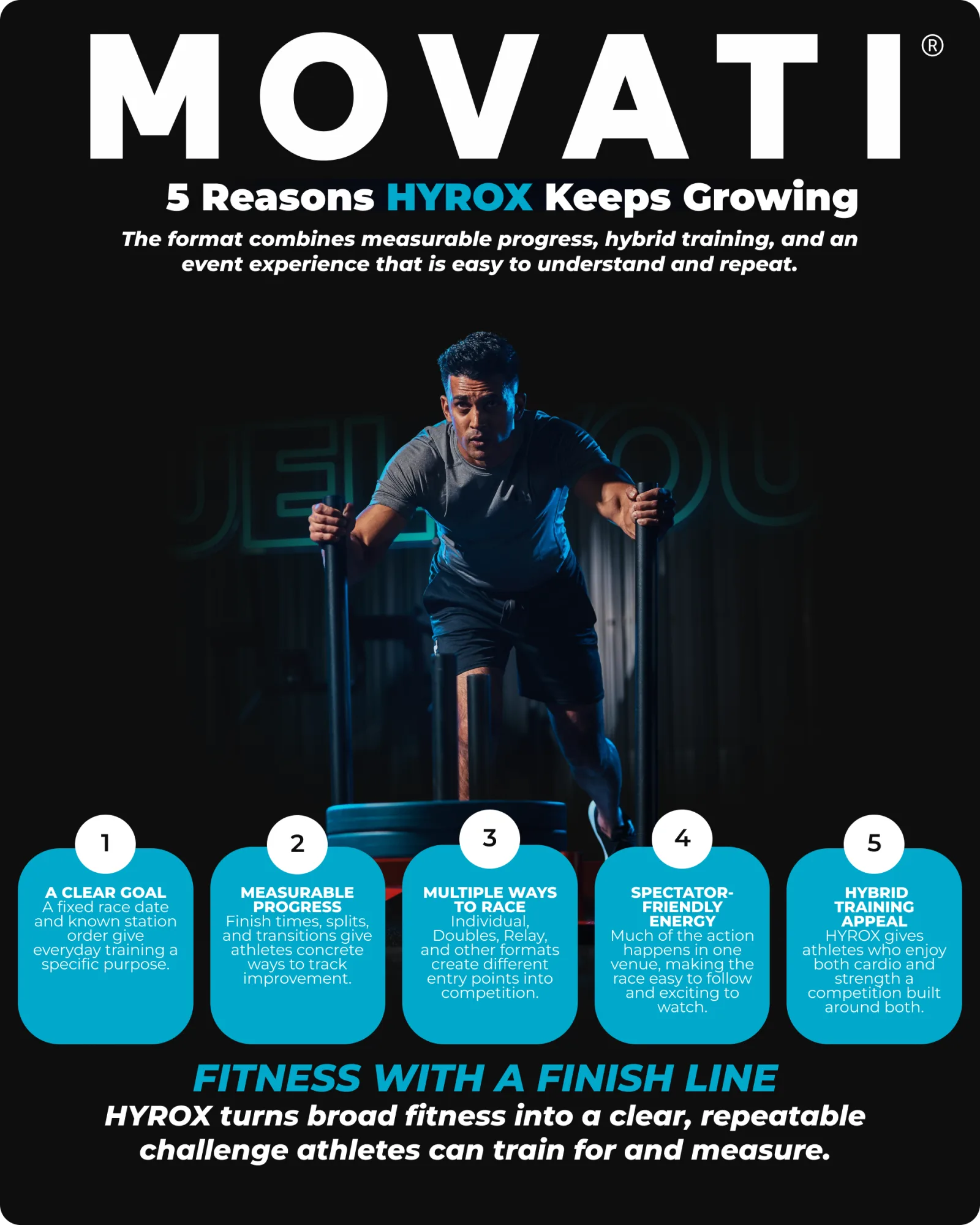
Hybrid training combines endurance and strength rather than treating them as opposing identities. HYROX provides a competition for that approach. Training plans must consider running volume, strength, station technique, and recovery together.
This creates an appealing puzzle. Improving one quality cannot come at the expense of everything else. Strong athletes need running durability, runners need enough force for the stations, and both need pacing discipline.
How is the format influencing gyms and classes?
A fixed event creates demand for equipment practice, run-to-station transitions, and coaching around race strategy. Fitness facilities can respond with hybrid conditioning sessions, sled areas, erg training, and progressive race-preparation programs.
The most useful programs do more than imitate the race at full intensity. They teach movement skills, build aerobic capacity and strength, then introduce race-specific fatigue gradually. Constant simulations may look relevant while leaving little room for technical improvement or recovery.
What does good HYROX preparation involve?
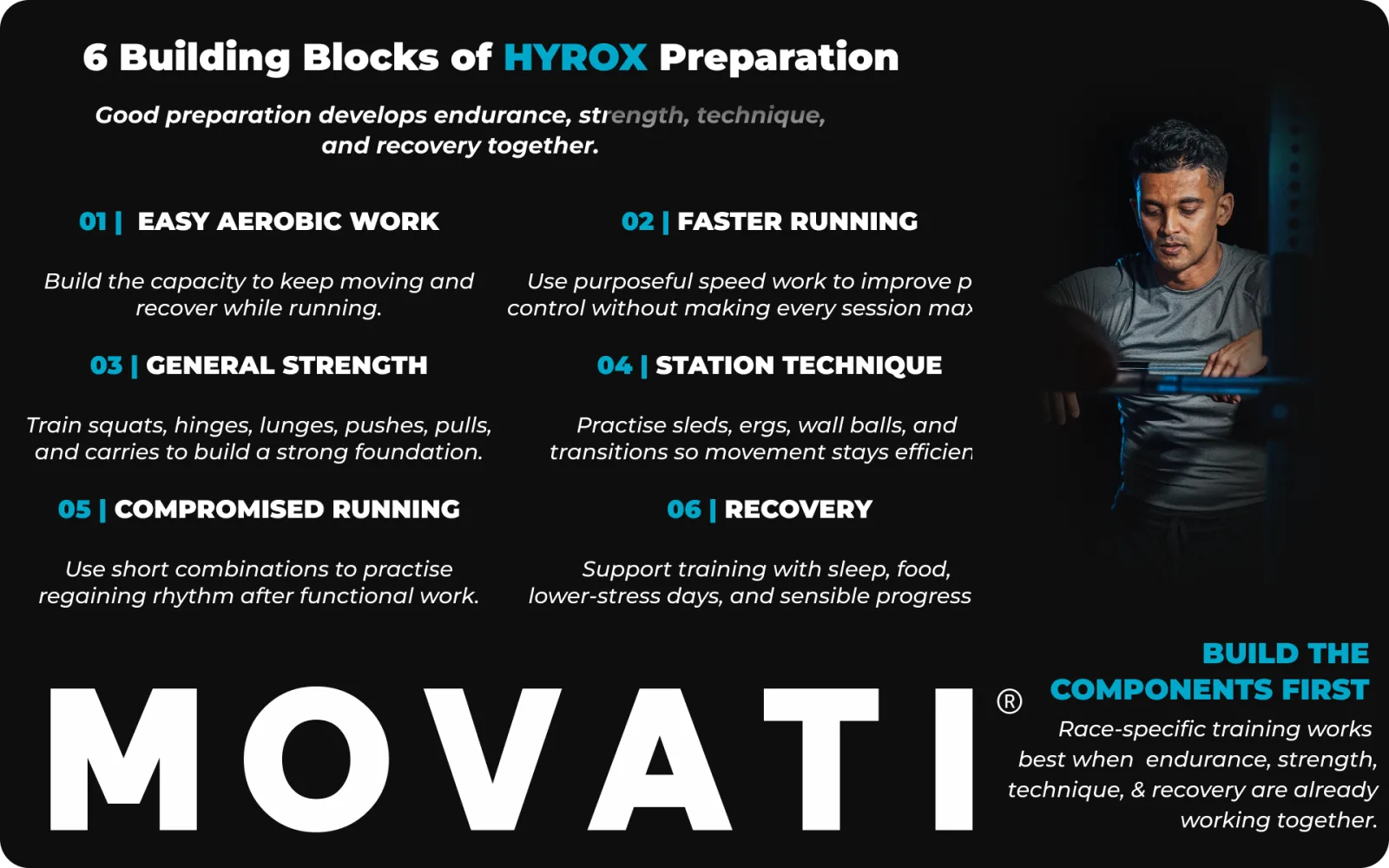
- Easy aerobic work: Builds the capacity to keep moving and recover while running.
- Purposeful faster running: Develops pace control without making every session maximal.
- General strength: Squats, hinges, lunges, pushes, pulls, and carries create a foundation.
- Station technique: Efficient sled, erg, wall-ball, and transition skills reduce wasted effort.
- Compromised running: Short combinations teach athletes to regain form after functional work.
- Recovery: Sleep, food, lower-stress days, and sensible progression keep the plan sustainable.
Preparation should match experience. A new athlete may need months of consistent running and basic strength before race-specific work becomes the priority. An experienced hybrid athlete may spend more time refining pace, transitions, and set strategy.
Is HYROX accessible to everyone?
Accessible does not mean easy or suitable without preparation. The event has a clear structure and multiple participation formats, but it still includes eight kilometres of running and substantial functional work. Participants need to assess their current capacity honestly.
People managing an injury, health condition, pregnancy, or a long break from exercise should seek appropriate guidance before building toward the event. Movement standards and division rules also change the demands, so the current official rulebook matters.
Could the trend have downsides?
Popularity can encourage people to skip foundational training and rush into high-volume race simulations. Social comparison may also turn easy sessions into competitions. Neither tendency improves preparation.
A race-specific workout is not automatically a good workout. Quality depends on timing, purpose, technique, and recovery. Athletes benefit from keeping easy work easy, building load progressively, and resisting the urge to copy an advanced competitor’s schedule.
Is HYROX a passing fad?
No one can guarantee the future of any competition format. HYROX does, however, align with durable interests: running, strength, measurable performance, group training, and event-based goals. Its standardized structure gives participants a reason to return and compare their preparation.
The more useful question is whether the format fits you. If you enjoy combining endurance and functional strength, want a clear benchmark, and are willing to prepare for the running, it may be a compelling challenge. If you dislike the core movements or prefer another sport, popularity alone is not a reason to enter.
The Hyrox fitness trend succeeds because it makes broad fitness visible. It turns months of training into one understandable sequence and lets recreational and high-level athletes meet the same basic problem at different speeds. That blend of clarity, difficulty, and community is the real engine behind its rise.
