
Wall Balls look simple: squat with a medicine ball, stand powerfully, and send the ball to a target. The challenge is repeating that sequence without letting your posture, timing, or accuracy unravel. Better performance comes from making every phase efficient—not from throwing harder with tired arms.
Whether you are preparing for a fitness event or adding a full-body conditioning movement to your training, begin with a load and target you can control. The goal is a repeatable rhythm that lets your legs produce the power while your upper body guides the ball.
What does good Wall Balls technique look like?

A strong repetition is one continuous cycle. You receive the ball close to your chest, descend into a balanced squat, drive through the floor, release the ball as your body reaches full extension, and prepare to receive it again. Each phase sets up the next.
Choose the right distance from the wall
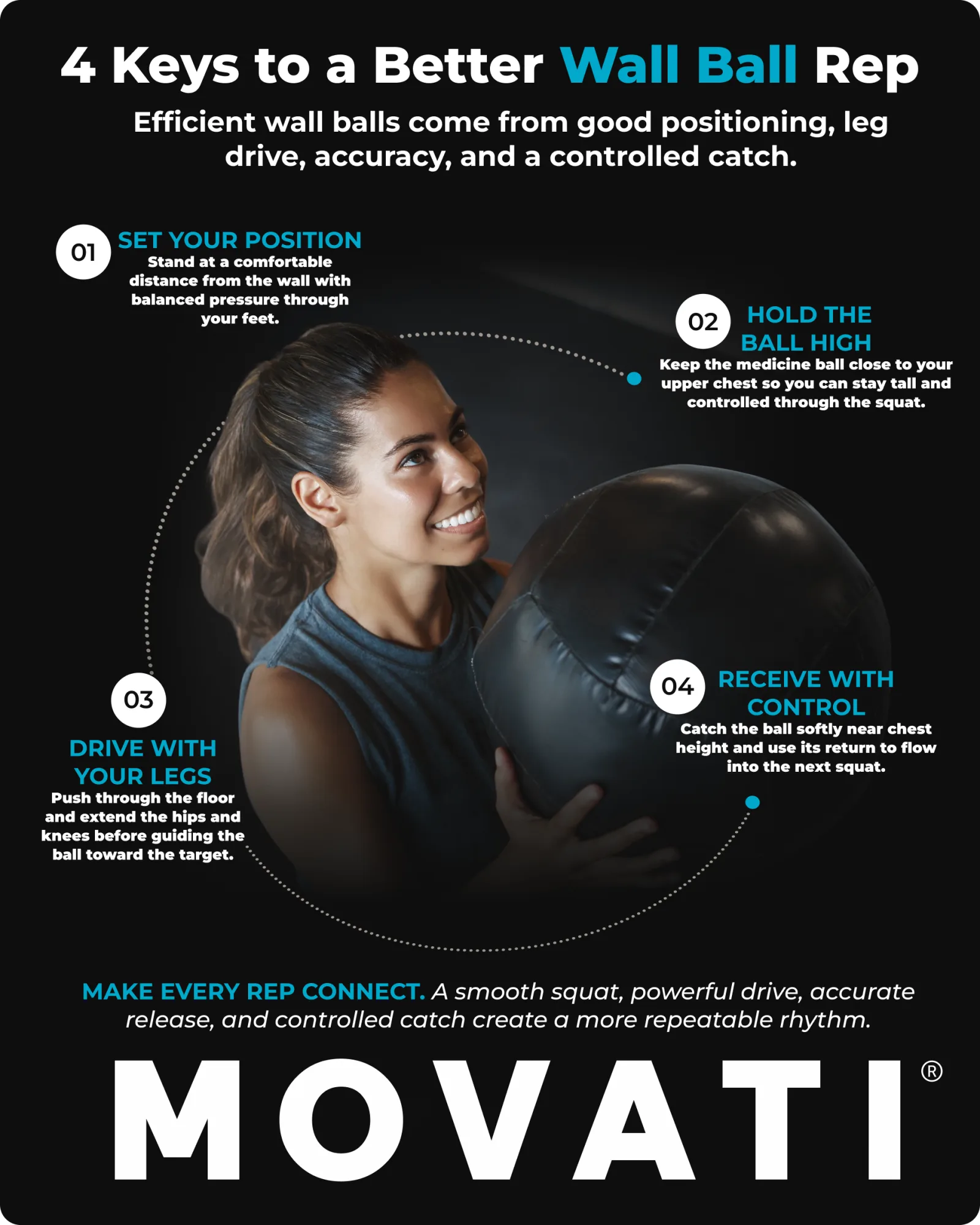
Stand far enough away that the ball can travel upward to the target without forcing you to lean back, but not so far away that you must throw it forward. A useful starting position is one in which your extended arms can nearly reach the wall. Adjust from there according to your height, the ball, and the target.
Your stance will usually be around shoulder width, with the toes turned out slightly if that supports a comfortable squat. Keep the whole foot connected to the floor. If your heels lift or your weight rolls to the outside edges, reduce the load and refine your position.
Hold the ball where you can stay tall
Cradle the ball in front of your upper chest rather than pressing it into your face or letting it drop toward your stomach. Elbows can point slightly down, leaving room for your knees as you squat. Keep your gaze near the target and your ribs stacked over your pelvis.
The ball adds load in front of the body, so it may tempt your chest to collapse. Think about sitting between your hips while maintaining a long spine. Squat only as deeply as you can while keeping your feet grounded and your knees tracking in line with your toes.
Let the legs launch the ball
The throw should begin with the floor. Drive up through your feet and extend your knees and hips before finishing with your arms. When the sequence is timed well, the medicine ball feels lighter because your lower body has already created its upward momentum.
Release the ball just after the strongest part of the leg drive, directing it upward rather than pushing it straight at the wall. Aim for a consistent point on the target. Excessive spin, a looping flight, or repeated misses often indicates that the hands are trying to correct a poorly timed drive.
Receive the ball instead of waiting for it
Keep your hands ready and watch the ball return. Receive it softly near chest height, then use its downward momentum to begin the next squat. Avoid catching it with locked elbows or letting it crash into your body. A controlled catch protects your rhythm and reduces unnecessary effort.
There is no need to rush beneath a badly placed rebound. If the ball falls too low or pulls you out of position, reset it safely and start again. One deliberate reset costs less energy than several unstable repetitions.
How can you breathe and pace more efficiently?
Endurance improves when breathing and movement follow a predictable pattern. Many athletes exhale during the throw and inhale as the ball returns and they descend. The exact pattern matters less than avoiding long breath holds.
Start a set at a pace you believe you can maintain after fatigue arrives. A fast opening burst may feel productive, but it often creates longer breaks later. Smooth repetitions, accurate throws, and short planned pauses generally outperform frantic movement followed by an extended stop.
Use planned breaks before technique fails
If a workout calls for a large set, decide in advance whether to work continuously or divide the repetitions. Small, disciplined sets can protect accuracy and keep rest periods brief. Place the ball securely during a break, take a few controlled breaths, and resume before your body cools down.
Count quality repetitions rather than chasing an unbroken set at any cost. When squat depth changes, catches become uncontrolled, or several throws miss the target, the set is already deteriorating.
What common mistakes waste energy?
- Throwing mostly with the arms: This tires the shoulders quickly. Finish the leg drive before guiding the ball to the target.
- Holding the ball away from the body: A long lever makes the load feel heavier. Keep it close during the squat and catch.
- Standing too close: The rebound may drop behind you or force an awkward lean. Step back until the flight path is comfortable.
- Standing too far away: The movement becomes a forward throw, making accuracy and timing harder. Move closer and aim upward.
- Dropping before the catch is secure: Descending too early can pull the chest forward. Receive the ball first, then move smoothly into the squat.
- Chasing misses: Twisting or lunging after the ball adds risk. Let a poor rebound fall, reset your feet, and continue.
How should you practise for better endurance?
Build capacity gradually enough that technique remains recognizable from the first repetition to the last. One session might emphasize skill with a lighter ball and comfortable target. Another might use short work intervals with generous recovery. As consistency improves, extend the work periods or add repetitions before increasing the load.
Practise the movement in layers
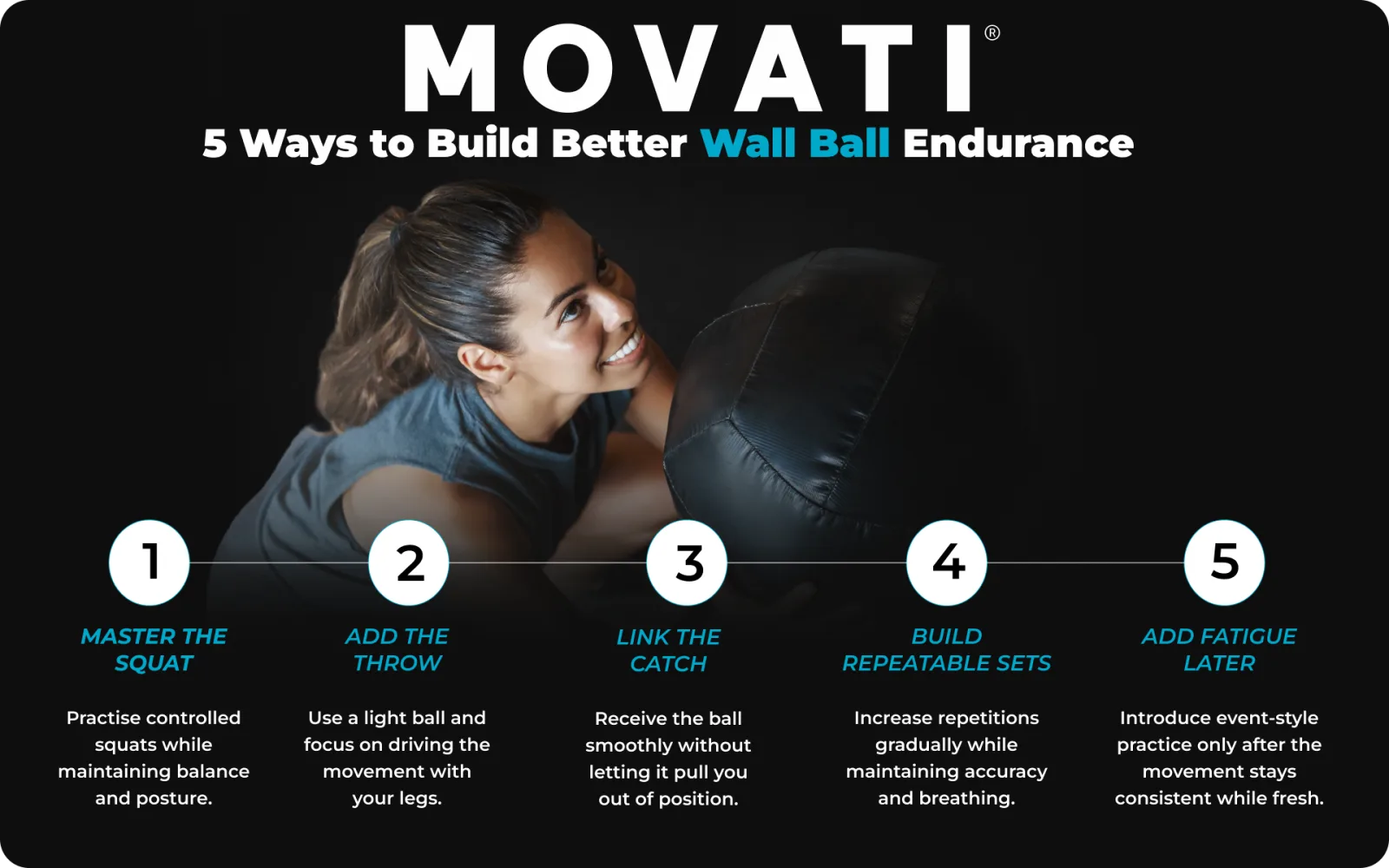
- Squat pattern: Practise controlled bodyweight or goblet squats while maintaining balance and posture.
- Leg-driven throw: Use a light ball for a small number of accurate repetitions, focusing on full-body timing.
- Catch and transition: Link repetitions smoothly without allowing the ball to pull you forward.
- Repeatable sets: Add volume in small steps while preserving target accuracy and breathing.
- Event-specific practice: If you are preparing for competition, occasionally practise after other movements so you learn to regain control while fatigued.
More weight is not automatically better. A load that changes your squat, strains the catch, or makes the target inconsistent is too heavy for productive practice that day. Select the version that supports the purpose of the session.
When should you modify or stop?
Muscular effort and heavy breathing are expected during conditioning, but sharp pain, dizziness, or a sudden loss of control is a reason to stop. Shoulder, knee, hip, or back discomfort may also signal that the load, depth, target, or volume needs to change.
A qualified coach can help you adjust stance, squat depth, ball weight, and target height. If pain persists or you are returning from an injury, seek guidance from an appropriate health professional before progressing.
Build consistency before intensity
The best Wall Balls repetitions are economical: balanced squat, powerful leg drive, accurate release, soft catch, and steady breath. Practise those details at a manageable intensity, then build volume or speed without abandoning them. When technique sets the pace, endurance has room to improve.
