
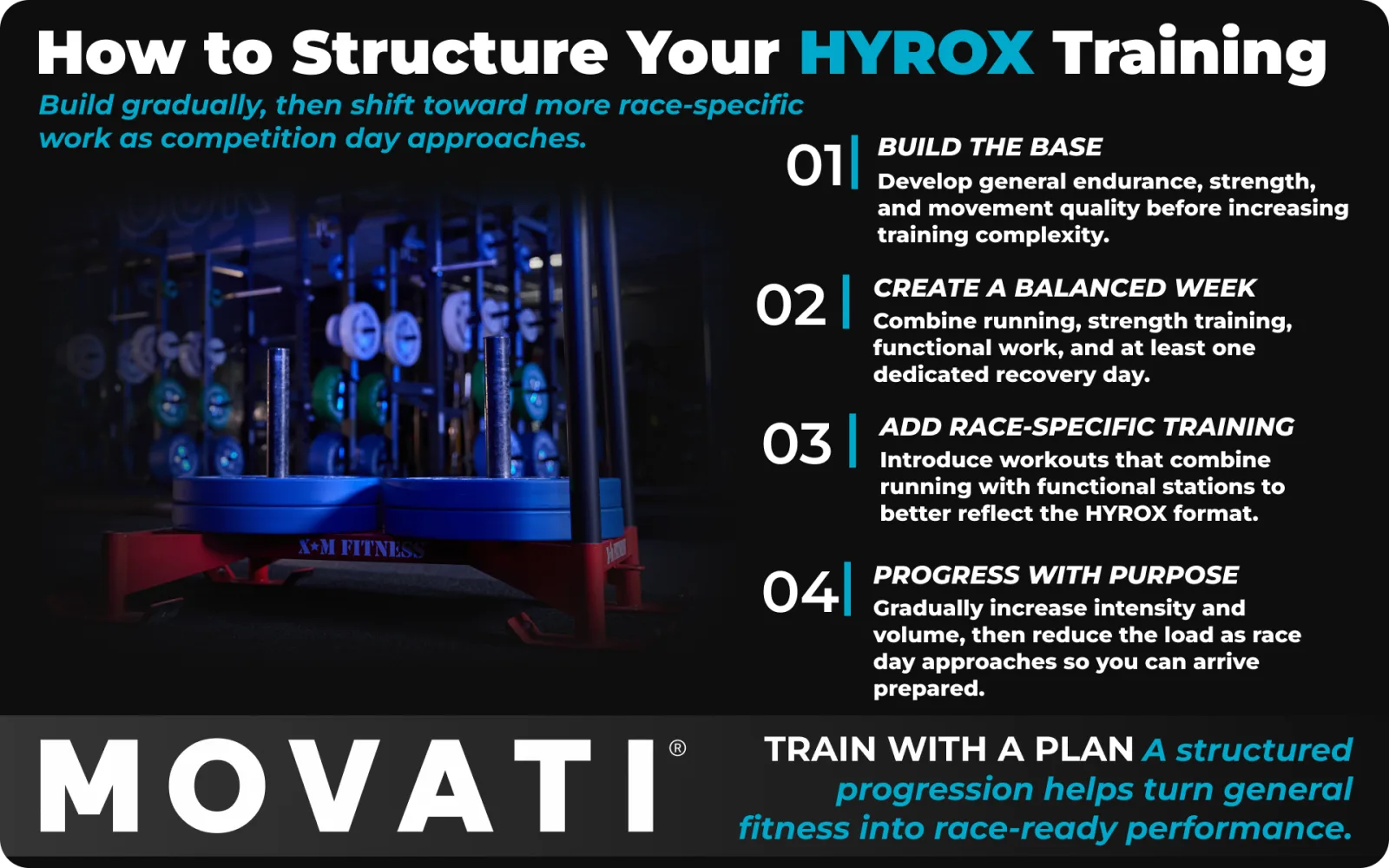
A strong HYROX Training Plan prepares you to run well after demanding functional work—not simply to run and lift in separate workouts. HYROX alternates eight one-kilometre runs with eight workout stations, so success depends on aerobic fitness, usable strength, movement efficiency and the ability to control your effort under fatigue. Your plan should develop those qualities gradually, then bring them together as race day approaches.
What does HYROX training need to develop?
HYROX rewards balanced preparation. A fast runner can lose time at the stations, while a strong athlete can struggle to regain pace after heavy work. The goal is to build a fitness base broad enough to support the entire event.
- Aerobic capacity: The ability to sustain work and recover while continuing to move.
- Running durability: The strength and consistency to complete repeated kilometres as fatigue builds.
- Functional strength: The ability to push, pull, carry, lunge and throw with efficient technique.
- Muscular endurance: The capacity to repeat movements without a sudden breakdown in pace or form.
- Race judgement: The discipline to pace the early stages and make useful decisions later.
You do not need to train every quality at maximum intensity each week. Progress comes from choosing a clear emphasis, recovering from it and adding specificity over time.
Assess your starting point
Before building the schedule, take an honest look at your recent training. Consider how consistently you run, your comfort with the race movements, any injury history and how many sessions you can recover from each week.
A simple baseline can include an easy run, a controlled faster effort and technique work on the main station patterns. The purpose is not to exhaust yourself or simulate the full race immediately. It is to identify obvious gaps. You may discover that your aerobic pace is steady but your running form changes after lunges, or that your strength is sufficient but your sled technique wastes energy.
If you are new to running, returning after injury or managing a health concern, get appropriate professional guidance before increasing training load.
Phase 1: Build an aerobic and strength foundation
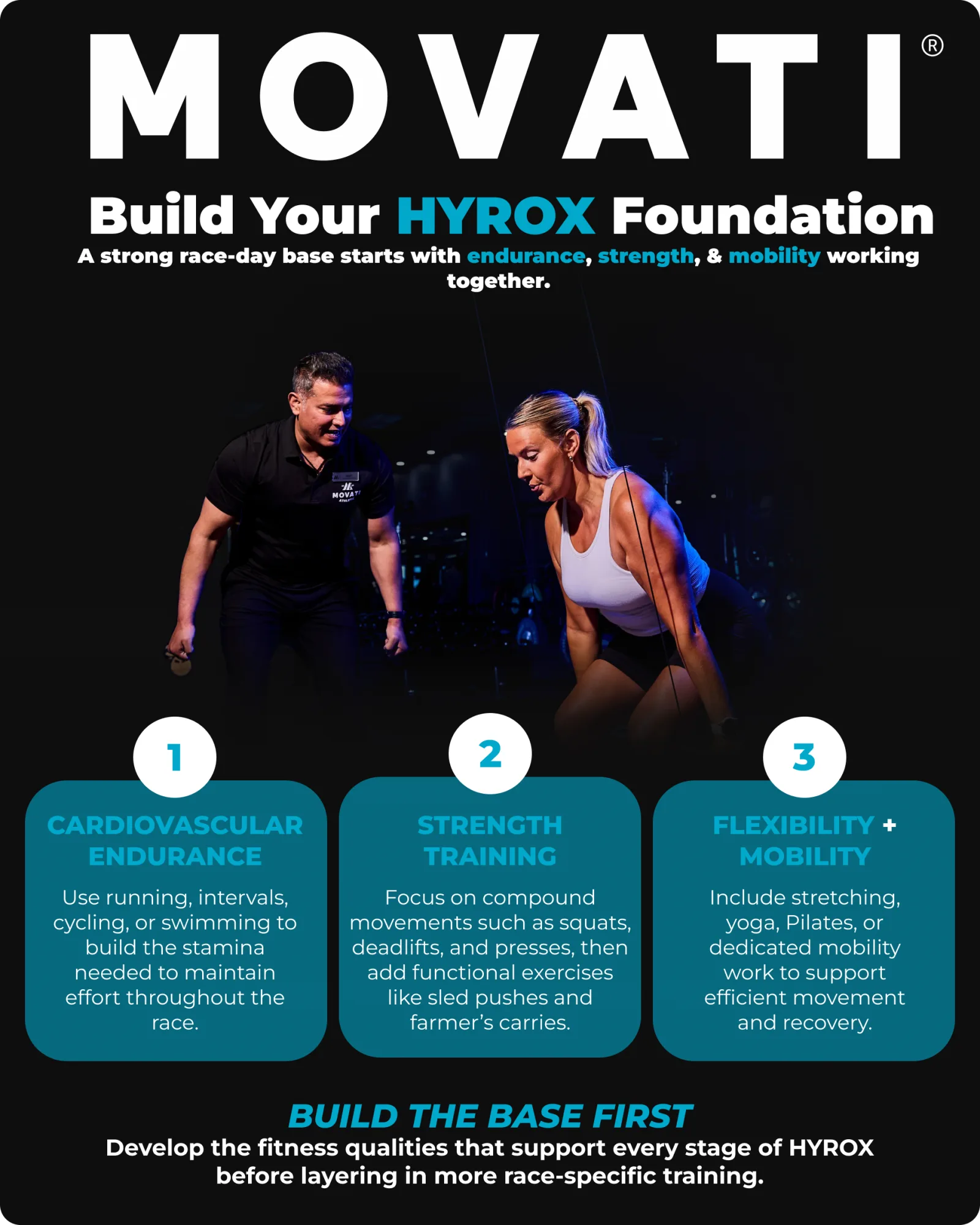
The first phase should make later race-specific work possible. Develop consistent easy running, sound lifting technique and tolerance for regular training. Keep most sessions controlled enough that you can repeat them week after week.
Build easy running volume gradually
Easy running supports aerobic development and prepares your legs for repeated impact. Increase duration conservatively and avoid turning every run into a time trial. A conversational effort is useful for much of this work because it builds capacity without creating the same recovery cost as frequent hard intervals.
Develop basic strength
Use movements that build force through the legs, hips, upper body and trunk. Squats, hinges, lunges, presses, rows and loaded carries can form the base. Select loads that allow controlled repetitions and stable positions. General strength creates capacity; race-specific sessions will later teach you to express it while breathing hard.
Learn station technique early
Practise the patterns before fatigue becomes the main challenge. Learn how to use the SkiErg and rower efficiently, establish safe sled positions and refine burpee broad jumps, farmer’s carries, sandbag lunges and wall balls. Technical improvement can reduce wasted effort without requiring you to become dramatically fitter.
Phase 2: Add speed and muscular endurance
Once your routine is consistent, add carefully dosed harder work. One session might develop running speed or threshold control, while another builds repeated effort on functional movements. Keep easier days genuinely easy so the quality sessions remain productive.
Use running intervals with a clear purpose
Intervals can improve pace control and your ability to handle faster running. The exact distance matters less than matching the session to your current level. Shorter repetitions can develop speed and mechanics; longer repetitions can help you sustain a demanding pace. Recover enough to preserve form rather than turning every interval session into survival.
Build repeatable station sets
Muscular-endurance sessions should teach you to choose sustainable sets. Instead of completing one enormous set of wall balls and then stopping for a long recovery, practise smaller repeatable sets with planned breaths. Apply the same thinking to lunges, carries and machine work.
Phase 3: Practise compromised running
Compromised running means running immediately after functional work. It is one of the most important differences between ordinary run training and HYROX preparation. Your legs may feel heavy after sleds or lunges, and your breathing may be unsettled after the SkiErg or rower. Training this transition teaches you to find an efficient pace without panicking.
Start with short combinations rather than full simulations. For example, pair a controlled station effort with an easy-to-moderate run. As your conditioning improves, extend the combination or add another station. Keep the movements technically sound.
- Machine effort followed by a steady run.
- Loaded carry followed by a steady run.
- Lunges followed by a short controlled run.
- Two or three race-style blocks with generous recovery between rounds.
A compromised session is demanding because it combines stresses. Schedule it when you are prepared to perform well and allow adequate recovery afterward.
Phase 4: Increase race specificity
As the event approaches, training should resemble the decisions and transitions you will face on race day. This does not mean completing a full race simulation every week. Frequent simulations can create unnecessary fatigue and reduce the quality of your other training.
Use selected race-specific sessions to practise pacing, footwear, station strategy, transitions and pre-session nutrition. Decide where you will break sets, how you will respond if a station takes longer than expected and what running effort you can regain afterward.
How often should you simulate the race?
Use simulations sparingly and scale them to your experience. A partial simulation can answer most practical questions with less recovery cost. Newer athletes may benefit from rehearsing several blocks at controlled effort, while experienced competitors may occasionally complete a longer session to test strategy. Stop the session if movement quality deteriorates or pain changes how you move.
How should a training week look?
Your schedule should reflect your experience, available time and recovery. The examples below show useful ingredients rather than a rigid prescription.
Three-session foundation week
- Session 1: Easy run with a few relaxed faster strides.
- Session 2: Full-body strength and station technique.
- Session 3: Mixed conditioning at a controlled effort.
Five-session balanced week
- Session 1: Easy aerobic run.
- Session 2: Strength training with sled or carry practice.
- Session 3: Running intervals or a controlled tempo session.
- Session 4: Easy strength, mobility or recovery work.
- Session 5: Compromised running or a race-specific combination.
Place rest or easy days between the hardest sessions when possible. Athletes with more training history may tolerate additional work, but more sessions only help when you can recover and maintain quality.
How do you progress the plan?
Change one major variable at a time. You might add a small amount of running, increase a load, extend an interval or reduce recovery. Increasing everything at once makes it difficult to identify what caused excessive fatigue.
Track a few practical indicators: session quality, easy-run effort, sleep, soreness, motivation and whether your technique stays stable. A single difficult day is normal. A persistent drop across several areas suggests that the plan needs adjustment.
Recovery, mobility and nutrition
Recovery is part of training, not time away from it. Sleep, adequate food and lower-intensity days support adaptation. Eat enough to meet the demands of running and strength work, include protein across your regular meals and use carbohydrates to support harder sessions. Hydration needs vary with the person, environment and workload, so use your training to develop a routine that works for you.
Mobility work should address movements you need rather than becoming another exhausting session. Ankles, hips, upper back and shoulders often influence positions used in running, squatting, lunging and overhead wall-ball work. A few consistent, targeted exercises are usually more practical than occasional long routines.
How should you taper before race day?
A taper reduces fatigue while preserving readiness. In the final stretch before the event, lower your overall training volume and avoid hard sessions that create lingering soreness. Keep some short, controlled intensity so race pace still feels familiar, but finish sessions feeling capable of more.
Do not use the final week to compensate for missed training. Extra fitness cannot be forced at the last minute, but unnecessary fatigue can easily follow you to the start line.
Signs you are ready to race
- You can run consistently without each session becoming a maximal effort.
- You understand the standard movement patterns and can maintain safe technique.
- You have practised running after several types of station work.
- You know how you intend to pace the opening stages.
- Your footwear, clothing and pre-race routine have been tested.
- You can adjust a session when fatigue or discomfort calls for a change.
The best plan is not the one that looks hardest on paper. It is the one you can execute consistently, recover from and adapt as your fitness changes. Build the base, add intensity with purpose, practise race-specific transitions and arrive rested enough to use the fitness you have earned.
