
The most visible strength training benefits may be stronger muscles and changes in body composition, but the deeper value is practical: everyday tasks can feel easier, joints can become better supported, movement skills can improve, and physical capacity can be preserved over time. Resistance training changes what your body is prepared to do, not just how it looks.
Those changes are gradual and depend on the exercises, loads, frequency, nutrition, recovery, and your starting point. A useful program does not have to revolve around maximal weights. It needs enough challenge to encourage adaptation and enough consistency to let that adaptation accumulate.
What changes when you begin strength training?

In the first weeks, progress often comes from learning. Your nervous system becomes more efficient at coordinating a movement, and you become more confident with the equipment and technique. You may lift more without having added a large amount of muscle because you are using your existing capacity more effectively.
With continued training, muscle tissue can adapt to repeated resistance. Connective tissues and bones also respond to appropriate loading, although each tissue changes at its own pace. This is one reason sensible progression matters: motivation can increase faster than the body’s tolerance for a sudden jump in work.
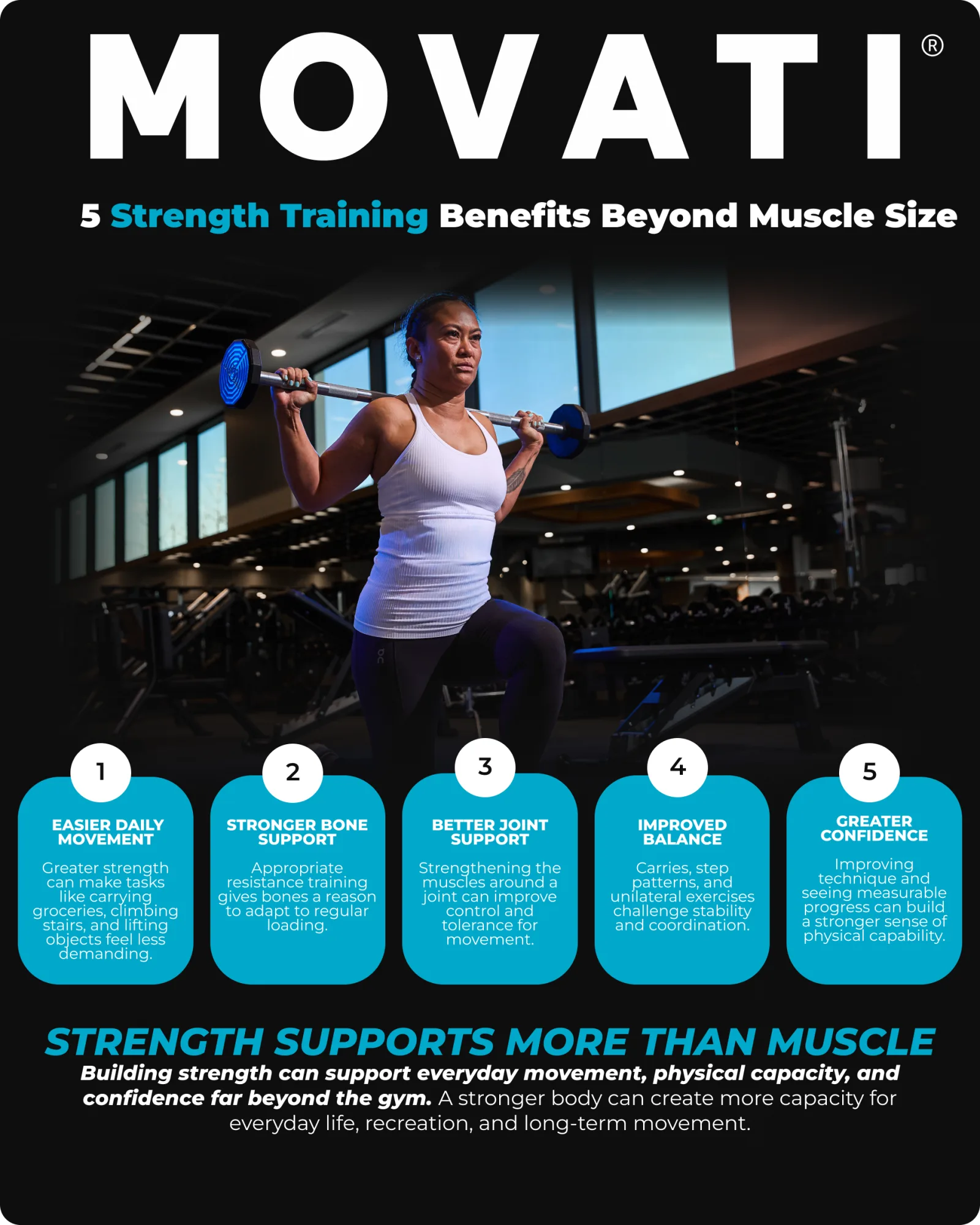
Strength training benefits that reach beyond muscle size
Daily tasks require a smaller share of your capacity
Carrying groceries, lifting luggage, climbing stairs, getting up from the floor, and moving furniture all require strength. When your capacity grows, the same task represents a lower relative effort. That reserve can make daily life feel less demanding and help you maintain independence as you age.
This benefit is highly specific. If you want to become more capable at lifting objects from the floor, practise safe hinge and squat patterns. If carrying is difficult, loaded carries and upper-body pulling work may be useful. Training becomes more meaningful when exercises connect to the activities you value.
Bones receive a reason to adapt
Muscles pull on bones during resistance exercise, and weight-bearing movements place load through the skeleton. Over time, appropriately selected strength work can support bone health. The most suitable exercises and loading strategy depend on your experience, health history, and any diagnosed bone condition.
If you have osteoporosis, a history of fractures, or concerns about balance, seek guidance from a qualified health professional and a knowledgeable fitness professional. The goal is to create a useful training stimulus without taking unnecessary risks.
Joints can become better supported
Strengthening the muscles that act around a joint can improve control and tolerance for activity. Well-chosen exercises can also expose you to useful ranges of motion under control. This is different from assuming that every person needs the same depth, stance, or exercise.
Joint comfort is influenced by technique, load, volume, recovery, and individual anatomy. Pain is not proof that you need to push harder. Modify the range or resistance, choose another movement, and get appropriate assessment when symptoms persist.
Balance and coordination can improve
Resistance training asks the body to create and control force. Unilateral exercises, step patterns, carries, and free-weight movements can challenge stability as well as strength. Even machine-based exercises build coordination within a defined path and can be a useful starting point.
Better balance is not about making every exercise unstable. A stable setup often allows you to produce force safely and learn the movement. Specific balance work can then be added according to your needs.
Sports and recreational activities gain a stronger foundation
Running, cycling, racquet sports, skiing, hiking, and group fitness all depend on the ability to produce and absorb force. Strength work can develop qualities that support these activities, including force production, trunk control, and tolerance for repeated movement.
The gym program should complement the activity rather than compete with it. A runner preparing for an event may use a different volume and exercise selection than someone whose main goal is lifting performance. The best plan leaves enough energy for the sport or recreation it is meant to support.
Training can build confidence and competence
Learning to use equipment, improving technique, and seeing measurable progress can create a sense of capability. The feedback is concrete: a movement feels smoother, a load becomes manageable, or an everyday task is easier. That experience can strengthen confidence without requiring appearance to be the main measure of success.
Exercise can also support general well-being, but it is not a substitute for mental-health care. If anxiety, depression, or another concern is affecting daily life, reach out to an appropriate professional.
Does strength training automatically make you bulky?
No. Significant muscle growth requires time, consistent training, sufficient nutrition, and a program designed to create that adaptation. People also respond differently. Resistance exercise can increase strength without producing the dramatic change in size that some beginners fear.
Your program can reflect your priorities. Lower or moderate training volumes may support strength and function, while higher volumes targeted to particular muscles are more commonly used when muscle growth is a primary goal. A coach can help match the plan to the outcome you want.
What about metabolism and body composition?
Strength training can contribute to body-composition goals by helping build or preserve lean tissue and by adding meaningful activity to your week. However, claims that muscle causes an enormous increase in resting calorie use are often exaggerated. Changes in body weight and composition are influenced by training, nutrition, sleep, stress, health, and individual circumstances.
A scale cannot show every useful adaptation. Consider performance, consistency, energy, how clothing fits, and changes in everyday function alongside body weight. If you have a medical condition or a history of disordered eating, seek individualized support rather than following a restrictive generic plan.
How does strength training support healthy ageing?
Ageing is commonly accompanied by reductions in muscle mass, strength, power, and bone density. Resistance exercise gives the body a reason to maintain more of those qualities. It can also help people continue practising essential skills such as standing, lifting, carrying, and controlling a step.
It is never necessary to imitate someone else’s program to benefit. Beginners and older adults can start with machines, bands, bodyweight movements, free weights, or a combination. The appropriate version is one that can be performed with control and progressed gradually.
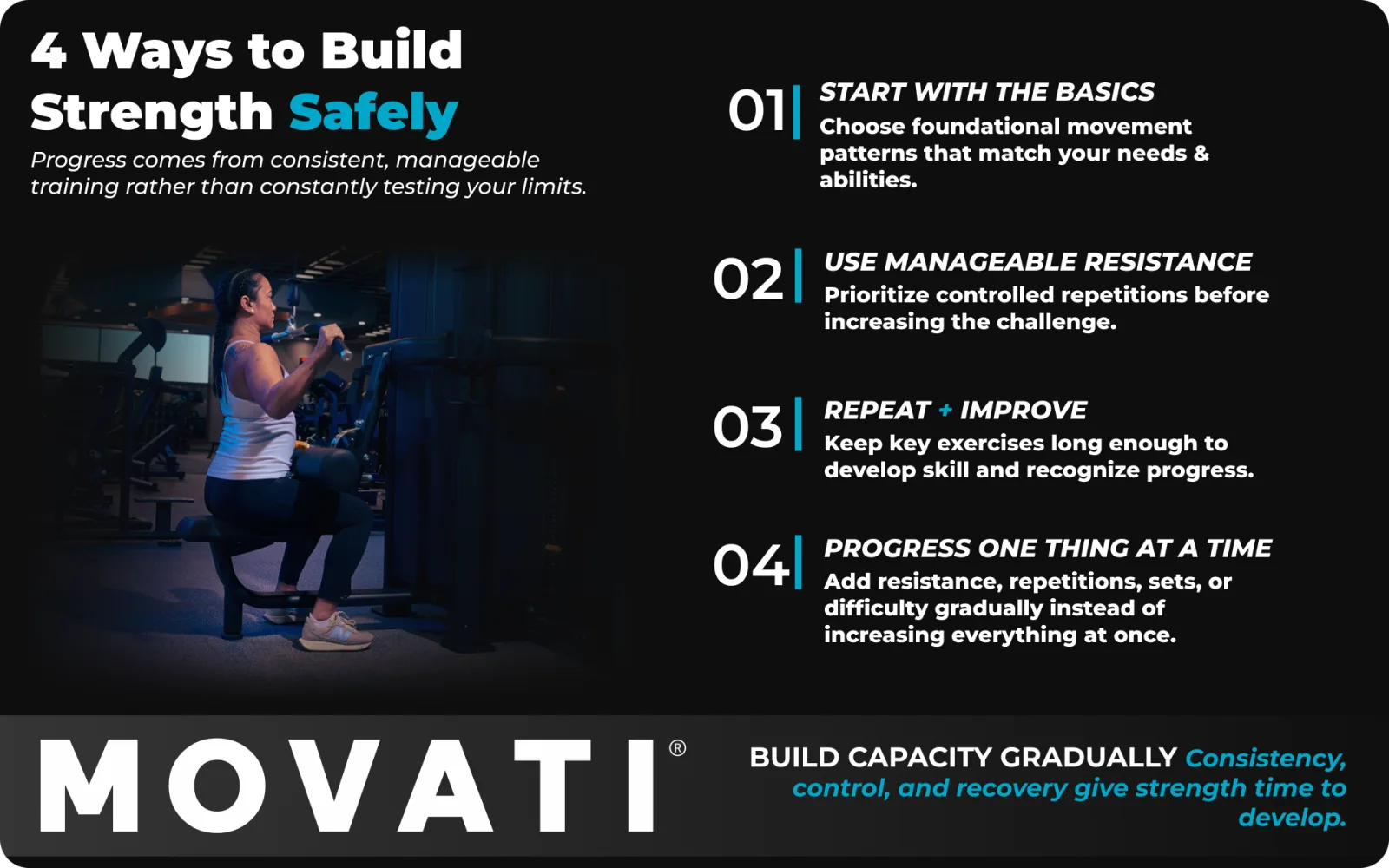
How can you begin safely and make progress?
- Start with the movement patterns you need. A balanced routine may include a squat or step, a hinge, an upper-body push and pull, a carry, and trunk work, but exercises should be adapted to the individual.
- Choose manageable resistance. Finish most early sets with the sense that you could complete another controlled repetition. Technical consistency matters more than testing your limit.
- Repeat the basics. Changing every workout makes progress difficult to judge. Keep key movements long enough to improve your skill and track how they feel.
- Progress one variable at a time. Add a small amount of resistance, an extra repetition, another set, or a more challenging variation—not all of them at once.
- Recover between demanding sessions. Muscles need time, food, and sleep to adapt. Persistent soreness, declining performance, or unusual fatigue may mean the plan needs adjustment.
What should count as progress?
More weight is only one measure. You may use the same load with better control, complete more repetitions without losing form, move through a comfortable range, recover more quickly, or perform daily tasks with less effort. These are meaningful results.
The most valuable strength training benefits emerge from a program you can sustain. Train with purpose, adjust the work to your body, and let capability—not comparison—guide the process. Over time, strength becomes more than a gym result; it becomes a larger reserve for sport, work, and everyday life.
