How Mobility, Flexibility, and Movement Training Can Support Better Alignment and Everyday Comfort
Posture is something most people consider only when it becomes a problem. Whether it’s neck tension after a long day at a desk, rounded shoulders from hours spent looking at a screen, or persistent lower back discomfort, poor posture can affect how we feel, move, and function throughout the day.
Many assume posture is simply about standing up straighter or remembering to sit properly. While awareness certainly plays a role, achieving a performance stretch posture involves addressing deeper factors, including muscle tightness, mobility restrictions, movement habits, strength imbalances, and lifestyle patterns.
This is where Performance Stretch can make a meaningful difference.
By focusing on mobility, flexibility, movement quality, and body awareness, Performance Stretch can help address many of the underlying factors that contribute to poor posture. While it is not a medical treatment and cannot instantly “fix” posture, it can be a valuable tool for improving alignment, reducing stiffness, and helping the body move more efficiently.
What Is Performance Stretch?
Performance Stretch is a guided mobility and flexibility training program designed to improve how the body moves and functions.
Unlike basic stretching routines that focus only on flexibility, Performance Stretch often combines:
- Mobility training
- Assisted stretching
- Dynamic stretching
- Static stretching
- Recovery-focused movement
- Breathing techniques
- Postural awareness exercises
- Movement assessments
The goal is to improve range of motion, reduce restrictions, and support more efficient movement patterns.
Because posture is closely connected to mobility and movement quality, many participants notice postural improvements as a natural result of consistent training.
Understanding Performance Stretch Posture
Posture refers to the way the body is positioned when sitting, standing, walking, or performing daily activities.
Good posture allows the body to maintain alignment with minimal strain on muscles, joints, and connective tissues.
When posture becomes compromised, certain muscles may become overworked while others become underactive.
Over time, this can contribute to:
- Neck discomfort
- Shoulder tension
- Upper back stiffness
- Lower back pain
- Reduced mobility
- Fatigue
- Movement inefficiencies
Modern lifestyles often make maintaining good posture more challenging than ever.
Why Posture Problems Are So Common Today
Many daily activities encourage positions that place the body in less-than-ideal alignment.
Common contributors include:
Prolonged Sitting
Office work and remote work often require people to sit for hours at a time.
This can contribute to:
- Tight hip flexors
- Reduced hip mobility
- Weak glute muscles
- Lower back tension
Did You Know?
Researchers tracking more than 15,000 adults across five countries found participants spent an average of 10.4 hours per day sitting. This is roughly eight times longer than they spent in moderate-to-vigorous physical activity (1.3 hours daily). (European Heart Journal, 2023)
Screen Time
Looking at phones, tablets, and computers often encourages a forward head position and rounded shoulders.
Over time, these habits can create muscular imbalances and postural stress.
Lack of Movement
The body is designed to move regularly.
When movement becomes limited, muscles and joints may lose mobility and flexibility, making it harder to maintain healthy posture.
Repetitive Movement Patterns
Performing the same movements repeatedly can contribute to restrictions and asymmetries that affect alignment.
How Performance Stretch Can Improve Posture
Performance Stretch addresses many of the factors that influence posture rather than focusing solely on posture itself.
Improving Mobility
One of the most common reasons posture suffers is limited joint mobility.
When joints cannot move through their intended range of motion, the body often compensates by adopting inefficient positions.
Performance Stretch can help improve mobility in key areas such as:
- Hips
- Shoulders
- Thoracic spine (upper back)
- Ankles
- Neck
As mobility improves, maintaining better posture often becomes easier and more natural.
Reducing Muscle Tightness
Certain muscles frequently become tight due to prolonged sitting or repetitive activities.
Common areas include:
- Hip flexors
- Chest muscles
- Hamstrings
- Calves
- Upper trapezius muscles
When these muscles remain chronically tight, they can pull the body into less efficient positions.
Targeted stretching can help reduce tension and improve overall alignment.
Increasing Body Awareness
Many people are unaware of their postural habits until someone points them out.
Performance Stretch often includes coaching that helps participants develop greater awareness of:
- Standing posture
- Sitting posture
- Shoulder position
- Head alignment
- Breathing patterns
- Movement habits
This increased awareness often carries over into everyday activities.
Addressing Common Postural Issues
1. Rounded Shoulders
Rounded shoulders are common among people who spend significant time at desks or using electronic devices.
Performance Stretch may help by:
- Improving chest flexibility
- Increasing shoulder mobility
- Enhancing upper back movement
- Promoting better shoulder positioning
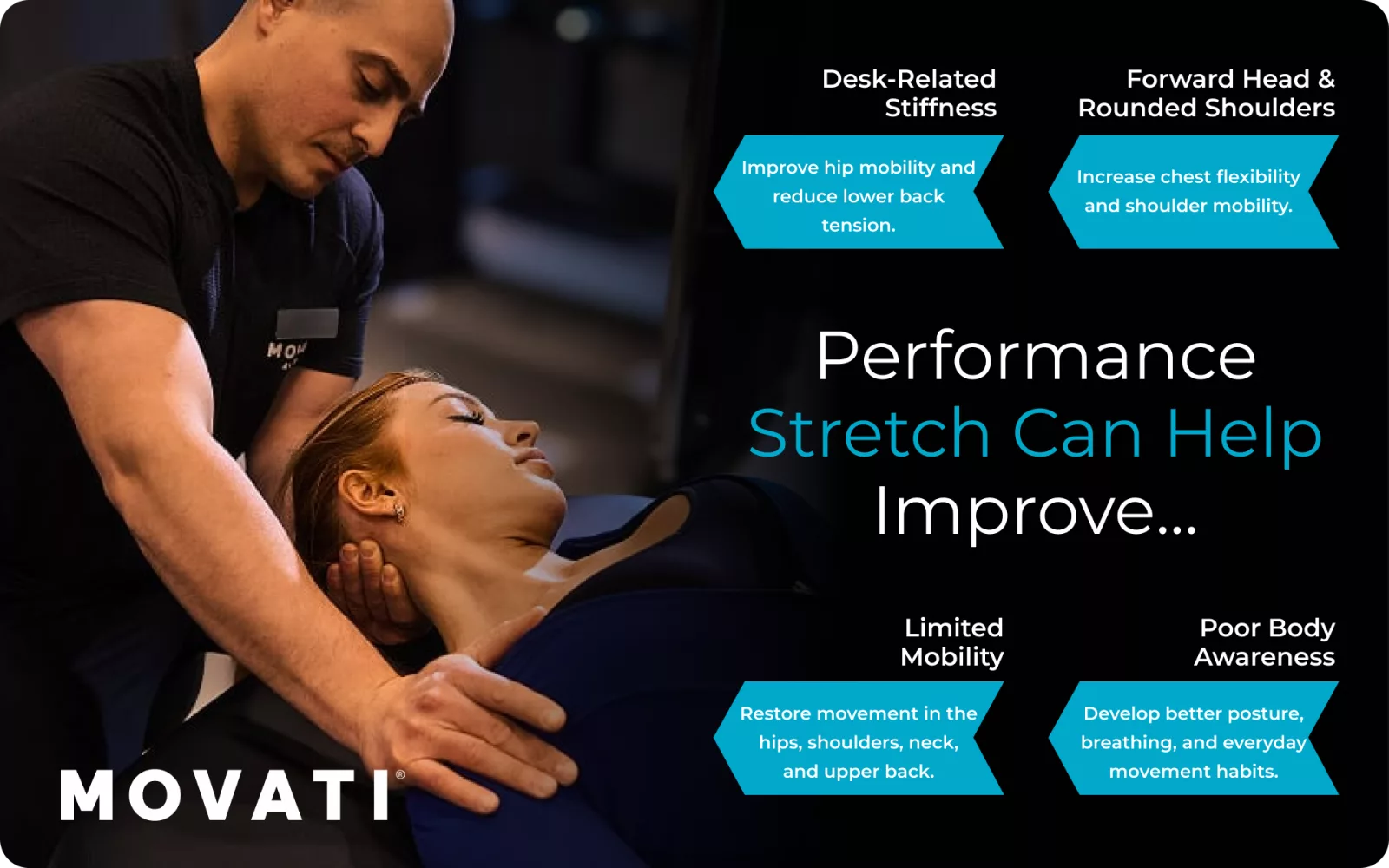
As these areas improve, the shoulders may naturally rest in a more balanced position.
2. Forward Head Posture
Forward head posture occurs when the head shifts in front of the body’s center of alignment.
This position can increase strain on the neck and upper back.
Performance Stretch may support improvement through:
- Neck mobility exercises
- Upper back mobility work
- Postural awareness training
- Breathing techniques
- Stretching of surrounding tissues
3. Tight Hips and Pelvic Position
Extended periods of sitting often lead to tight hip flexors and reduced hip mobility.
This can affect pelvic positioning and contribute to lower back discomfort.
Performance Stretch commonly includes:
- Hip mobility drills
- Hip flexor stretches
- Glute activation strategies
- Pelvic movement exercises
Improved hip mobility can have a positive effect on overall posture and movement quality.
4. Upper Back Stiffness
Many people experience limited mobility in the thoracic spine, or upper back.
When the upper back becomes stiff, the body may compensate through the neck or lower back.
Performance Stretch often focuses on restoring movement in this area through targeted mobility exercises and stretching techniques.
The Connection Between Mobility and Posture
One reason Performance Stretch can be effective for posture is that mobility and posture are closely related.
Imagine trying to stand tall when:
- Your chest muscles are extremely tight
- Your shoulders cannot move properly
- Your hips are restricted
- Your upper back lacks mobility
Even with perfect posture awareness, physical restrictions can make proper alignment difficult.
Mobility Matters
Regular mobility and stretching sessions can produce measurable improvements in flexibility and range of motion. Some research suggests that consistent stretching programs may improve flexibility by 10–30% within 6–8 weeks, making it easier to move comfortably and maintain healthier posture.
By improving mobility, Performance Stretch helps remove some of the barriers that prevent the body from moving and positioning itself efficiently.
Can Performance Stretch Replace Strength Training?
Not entirely.
While mobility and flexibility are important components of posture, strength also plays a critical role.
Strong muscles help support the body’s alignment and maintain proper positioning throughout the day.
For the best results, Performance Stretch is often most effective when combined with:
- Strength training
- Functional movement exercises
- Postural awareness
- Regular physical activity
Together, these elements create a more comprehensive approach to improving posture.
Benefits Beyond Appearance
Many people seek better posture because they want to stand taller or appear more confident.
While these are valid goals, postural improvements can offer benefits beyond appearance.
Participants often report:
- Reduced stiffness
- Improved comfort during daily activities
- Better movement quality
- Increased range of motion
- Enhanced exercise performance
- Reduced muscular tension
- Greater body awareness
These functional benefits can have a meaningful impact on overall well-being.
How Long Does It Take to Notice Improvements?
The timeline varies depending on factors such as:
- Current mobility levels
- Consistency
- Lifestyle habits
- Activity levels
- Individual goals
Some people notice improvements in comfort and movement after just a few sessions.
More significant postural changes generally occur gradually through consistent practice over weeks and months.
Posture is shaped by years of movement habits, so lasting improvements require patience and ongoing effort.
Who Can Benefit Most?
Performance Stretch can benefit a wide range of individuals, but I have found it to be especially valuable for people who spend much of their day sitting. As someone who works at a desk for most of the day, I have experienced firsthand how long hours in front of a computer can lead to tight hips, stiff shoulders, poor posture, and reduced mobility.
Supporting Desk Workers and Remote Professionals
One of the biggest lessons I have learned is that regular exercise alone does not always offset the effects of prolonged sitting. After incorporating stretching and mobility work into my routine, I noticed improvements in posture, flexibility, and overall comfort throughout the workday. Performance Stretch helps target areas that are commonly affected by desk work, making it an excellent option for office workers and remote professionals.
Benefits for Every Fitness Level
Performance Stretch can also be highly beneficial for:
Athletes looking to improve movement efficiency and recovery.
Older adults seeking to maintain mobility and functional independence.
Fitness enthusiasts who want to complement strength training with mobility work.
Beginners looking for an accessible way to improve flexibility, movement quality, and body awareness.
Building Better Movement for Everyday Life
What I appreciate most about Performance Stretch is that its benefits extend beyond the gym. Through consistent participation, I have found it easier to move comfortably throughout the day, recover from workouts more effectively, and reduce the stiffness that comes with a sedentary lifestyle. For anyone looking to improve mobility, posture, and overall quality of movement, Performance Stretch can be a valuable addition to a well-rounded wellness routine.
Final Thoughts
Yes, Performance Stretch can enhance posture by addressing several underlying factors that contribute to poor alignment, such as tight muscles, mobility restrictions, movement limitations, and postural awareness.
Rather than simply reminding you to “stand up straight,” this method helps create the physical capacity needed to move and position your body more efficiently. Through targeted mobility work, flexibility training, assisted stretching, and expert guidance, participants often experience improved posture, reduced stiffness, better movement quality, and greater overall comfort.
While lasting postural improvements require consistency and a comprehensive approach, this technique can be a powerful tool for helping you move better, feel better, and maintain healthier alignment in everyday life.
