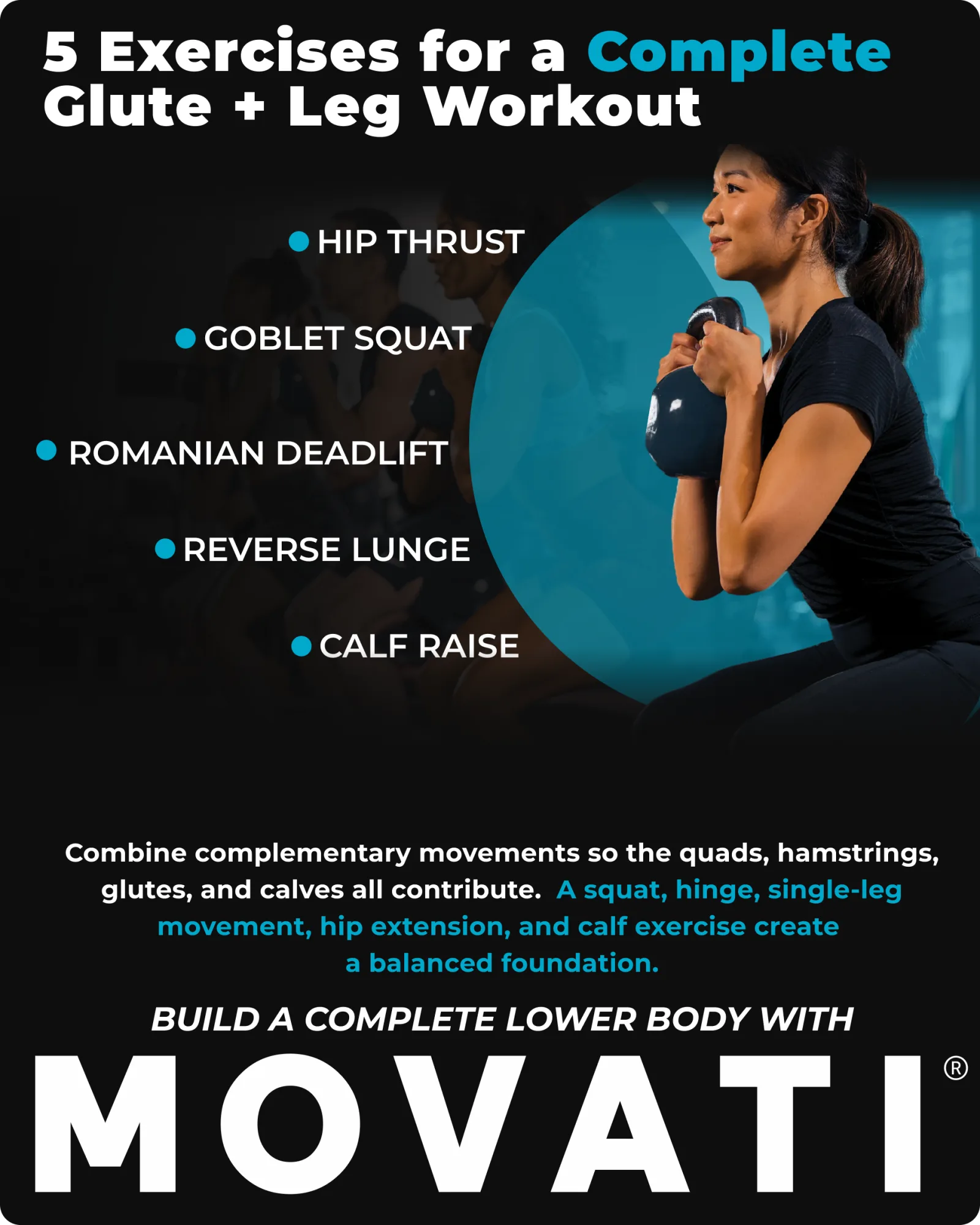
A well-designed glute and leg workout trains several lower-body patterns without burying the same muscles under redundant volume. This session combines a squat, hip hinge, single-leg movement and targeted accessories so the quads, hamstrings, glutes and calves all contribute.
Warm up for the movements ahead
Spend five to ten minutes increasing your body temperature, then rehearse the session with bodyweight squats, hip hinges and reverse lunges. Complete one or two lighter sets of the first lift. The goal is preparation, not fatigue.
The complete workout
1. Goblet squat
Perform three controlled sets. Keep the weight close to your chest, maintain pressure through the whole foot and choose a depth that lets you stay balanced.
2. Romanian deadlift
Perform three sets. Push the hips back, keep the weights close and stop when you reach a strong hamstring stretch without losing your spinal position.
3. Reverse lunge
Complete two or three sets per side. Step back softly and use the front leg to return. Hold onto a stable support if balance limits your strength.
4. Hip thrust or glute bridge
Complete two or three sets. Finish by extending the hips rather than arching the lower back. Pause briefly at the top.
5. Seated or standing calf raise
Complete two or three sets through a comfortable range. Lower slowly and avoid bouncing out of the bottom.
Choose the right effort
Select a resistance that leaves one to three good repetitions available at the end of most sets. Newer lifters can begin with two sets per movement. Experienced lifters may use heavier loads on the first two exercises while keeping accessory work controlled.
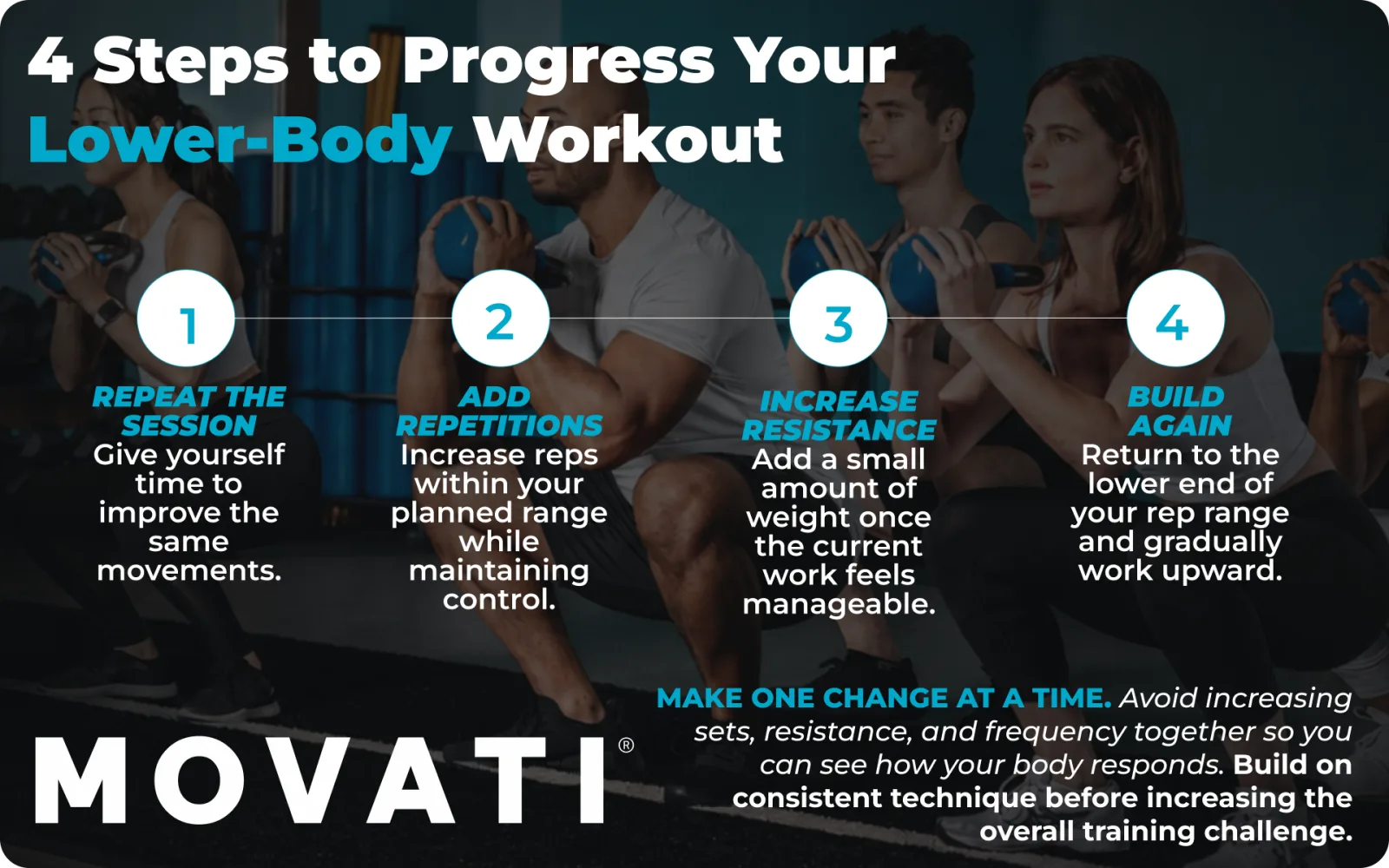
How to progress the workout
- Repeat the session with consistent technique.
- Add repetitions within your planned range.
- Increase resistance in a small increment.
- Return to the lower end of the repetition range and build again.
Do not increase sets, load and frequency at the same time. A single change makes your response easier to assess.
How often should you train?
One or two lower-body sessions per week is a practical starting point for many people. If you train twice, leave recovery time between sessions and vary the emphasis. One day might begin with squats; the other might begin with a hinge or hip thrust.
Make the session your own
Machines and free weights can both build strength. Swap the goblet squat for a leg press, the Romanian deadlift for a cable pull-through or the lunge for a step-up when those choices better suit your comfort and skill.
A complete lower-body session should feel challenging while preserving control. Track your exercises, give your body time to recover and let gradual progress—not exhaustion—be the measure of success.
