Whether you’re new to the gym or looking to improve your workouts, one of the most common questions you’ll face is free weights vs machines. Both are valuable training tools, and each offers unique advantages depending on your experience level, fitness goals, and personal preferences.
The truth is, neither option is universally better. The best choice depends on what you’re trying to achieve. Many well-rounded fitness programs incorporate both free weights and machines to build strength, improve movement quality, and reduce the risk of injury.
What Are Free Weights?
Free weights are portable pieces of equipment that are not attached to a machine. They require you to control the movement throughout each exercise.
Common examples include:
Dumbbells
Barbells
Kettlebells
Weight plates
Medicine balls
Because you are responsible for balancing the weight, free weights recruit additional stabilizing muscles while allowing your body to move through natural movement patterns.
What Are Weight Machines?
Weight machines guide your movements along a fixed path using cables, pulleys, levers, or weight stacks.
Examples include:
Leg press
Chest press
Lat pulldown
Leg extension
Seated row
Shoulder press machine
Machines are designed to isolate specific muscle groups while providing support and stability throughout the exercise.
Free Weights vs Machines: Key Differences
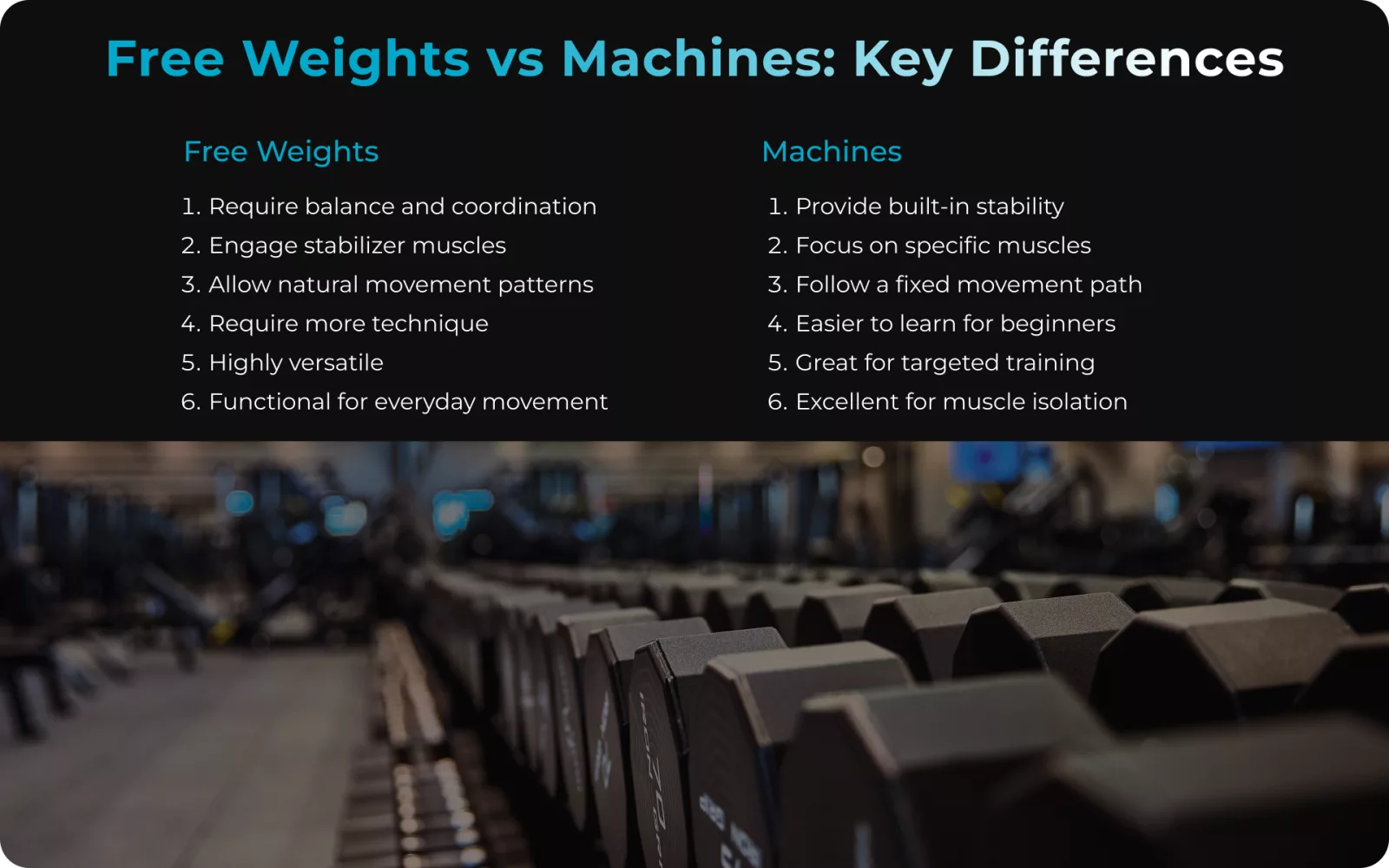
| Free Weights | Machines |
|---|---|
| Require balance and coordination | Provide built-in stability |
| Engage stabilizer muscles | Focus on specific muscles |
| Allow natural movement patterns | Follow a fixed movement path |
| Require more technique | Easier to learn for beginners |
| Highly versatile | Great for targeted training |
| Functional for everyday movement | Excellent for muscle isolation |
Benefits of Free Weights
Free weights are often recommended for building functional strength because they closely mimic real-life movements.
Improve Functional Strength
Everyday activities such as lifting groceries, carrying children, climbing stairs, or moving furniture require multiple muscles to work together.
Exercises like squats, lunges, deadlifts, and overhead presses train these natural movement patterns while strengthening the body as a whole.
Activate More Muscles
Since free weights require balance, your stabilizing muscles remain active throughout each repetition.
For example, a dumbbell bench press challenges your chest, shoulders, triceps, and core simultaneously because each arm works independently.
Increase Coordination
Controlling free weights improves:
Balance
Body awareness
Coordination
Joint stability
These qualities are valuable both inside and outside the gym.
Greater Exercise Variety
Free weights allow nearly endless exercise variations and movement planes, making workouts more engaging and adaptable as your fitness improves.
Benefits of Machines
Machines offer a controlled training environment that can be particularly helpful for beginners and individuals recovering from injuries.
Easier to Learn
Most machines include:
Adjustable seats
Clear movement patterns
Instructional diagrams
This makes them approachable for individuals who are still learning exercise technique.
Safer for Isolation
Because the machine stabilizes the weight, you can focus entirely on the working muscle.
Examples include:
Leg extensions for quadriceps
Hamstring curls
Pec fly machine
Biceps curl machine
These exercises are useful when targeting specific muscles or addressing muscular imbalances.
Build Confidence
Many new gym members feel intimidated by free weights.
Machines provide a comfortable introduction to resistance training, allowing beginners to learn proper movement patterns before progressing to more complex lifts.
Helpful During Rehabilitation
Healthcare providers and fitness professionals often use machines during rehabilitation because they allow controlled movement with less demand on balance and stabilization.
Which Builds More Muscle?
Both free weights and machines can effectively build muscle when combined with:
Progressive overload
Proper nutrition
Adequate recovery
Consistent training
Research suggests that muscle growth depends more on training intensity and volume than on whether you use free weights or machines.
Machines may make it easier to isolate individual muscles, while free weights often recruit more muscle groups during compound movements.
Many experienced lifters use both to maximize muscle development.
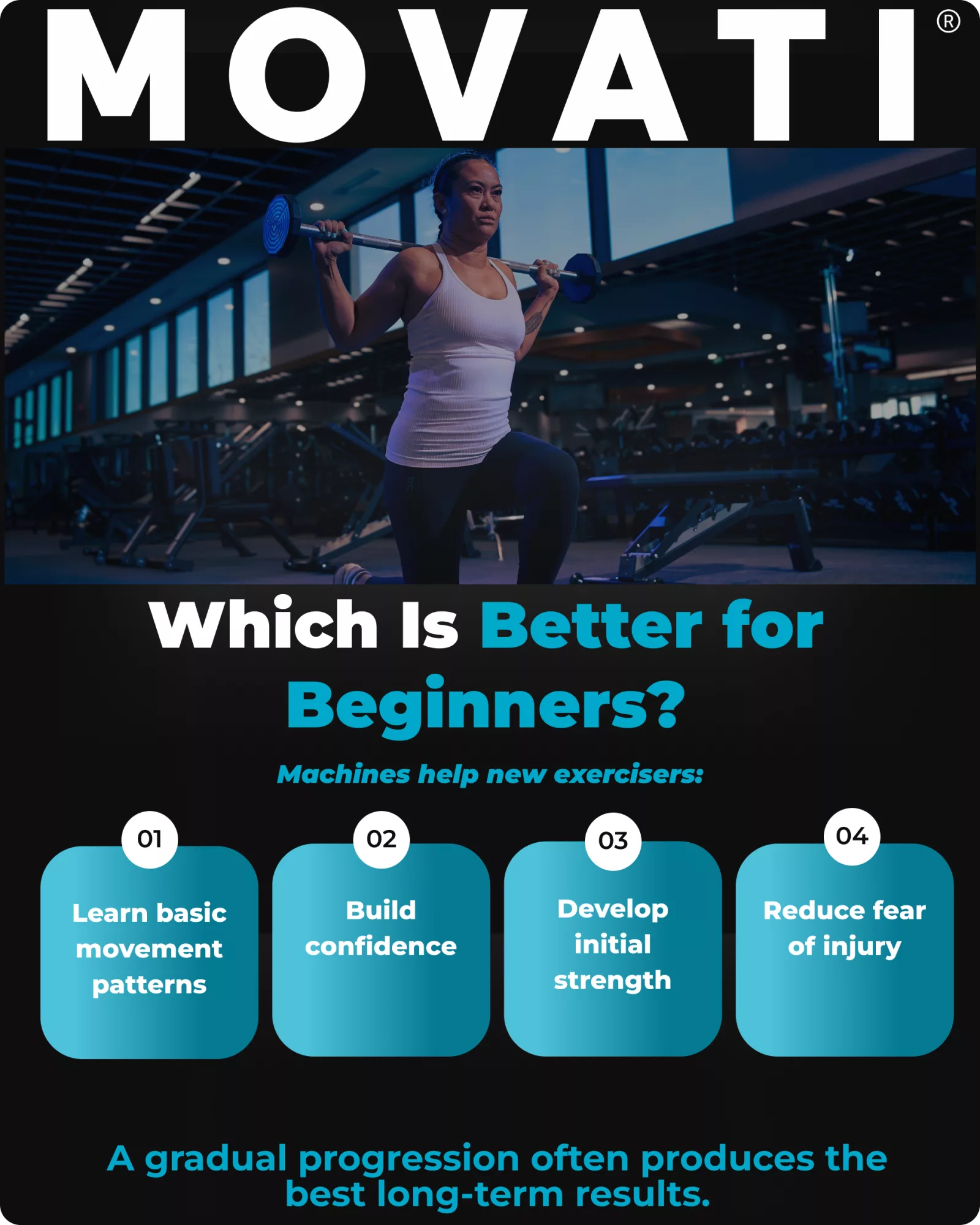
Which Is Better for Beginners?
For beginners, the answer is usually both.
Machines help new exercisers:
Learn basic movement patterns
Build confidence
Develop initial strength
Reduce fear of injury
Once comfortable, adding free weight exercises helps improve coordination, stability, and overall functional fitness.
A gradual progression often produces the best long-term results.
Which Is Better for Weight Loss?
Weight loss ultimately depends on maintaining a calorie deficit, but resistance training plays an important role by preserving lean muscle while increasing calorie expenditure.
Both free weights and machines contribute to:
Increased muscle mass
Higher daily calorie burn
Improved metabolism
Better overall body composition
Free weight compound exercises may burn slightly more calories because they engage multiple muscle groups simultaneously.
Can You Use Both in the Same Workout?
Absolutely.
Many effective strength programs combine both training styles.
For example:
Start with compound free weight exercises:
Barbell squat
Dumbbell bench press
Romanian deadlift
Then finish with machine exercises:
Leg extension
Cable row
Chest fly
Hamstring curl
This combination allows you to develop functional strength while also targeting specific muscles.
My Experience Using Both
Over time, I’ve found that combining free weights and machines keeps workouts both effective and enjoyable. Free weights challenge my balance and coordination while helping me feel stronger during everyday activities. Machines, on the other hand, allow me to safely focus on individual muscle groups, especially toward the end of a workout when fatigue starts to set in. Rather than viewing them as competing options, I’ve found they complement each other well and create a more balanced training routine.
Should You Choose Free Weights or Machines?
The answer depends on your goals.
Choose free weights if you want to:
Improve functional strength
Increase balance and coordination
Perform natural movement patterns
Build total-body strength
Choose machines if you want to:
Learn resistance training safely
Isolate specific muscles
Recover from injury
Build confidence in the gym
For most people, combining both methods delivers the greatest benefits.
Train Smarter at MOVATI Athletic
At MOVATI Athletic, you’ll have access to a wide range of free weights, modern strength machines, and knowledgeable Performance Coaches who can help you build a personalized program based on your goals. Whether you’re learning your first exercises or refining advanced lifting techniques, you’ll receive expert guidance to help you train safely, efficiently, and with confidence.
Explore our strength training spaces, join a Group Personal Training session, or book a complimentary Game Plan Session to discover the training approach that works best for you. By learning how to effectively use free weights vs machines, you’ll be better equipped to build strength, improve your fitness, and achieve lasting results.
