Many people enter the gym with goals like building muscle, getting stronger, losing body fat, or improving athletic performance. Reaching those goals takes more than simply working harder. It requires a structured training program that progresses through different phases of training, each designed to build upon the last.
At MOVATI Athletic, trainers use progressive programming to help members improve safely and efficiently. Instead of repeating the same workouts week after week, each phase develops a specific aspect of fitness while preparing the body for the next stage.
Whether you’re new to strength training or looking to overcome a plateau, understanding these phases can help you train with greater purpose and achieve better long-term results.
Why Training in Phases Matters
Repeating the same workout for months at a time eventually leads to diminishing returns. As your body adapts, improvements begin to slow unless new challenges are introduced.
Periodized training addresses this by organizing workouts into distinct phases, each with a clear objective. This approach helps you:
Improve movement quality
Build strength progressively
Increase muscular endurance
Reduce the risk of injury
Prevent training plateaus
Support long-term progress
Rather than trying to improve every fitness quality at once, each phase focuses on a specific goal while building a foundation for the next.
Phase One: Building a Strong Foundation
Every effective strength program begins by developing proper movement patterns.
Before increasing resistance, it’s important to establish good technique, improve posture, and address weaknesses that may affect performance later. This phase focuses on:
Learning proper exercise form
Improving posture and stability
Developing body awareness
Correcting muscular imbalances
Building joint control
Exercises are typically performed with lighter resistance so attention can remain on movement quality instead of the amount of weight being lifted.
Why Technique Matters
Proper technique allows muscles to work efficiently while reducing unnecessary stress on the joints.
Learning movement patterns correctly from the beginning creates a solid foundation for exercises such as:
Squats
Deadlifts
Presses
Rows
Taking the time to master these movements helps prevent poor habits that can limit progress or increase the risk of injury.
Correcting Movement Imbalances
Daily activities, previous injuries, and long hours spent sitting can all create muscular imbalances.
Common examples include:
Tight hips
Weak glutes
Limited shoulder mobility
Poor core stability
Uneven strength between sides
Addressing these issues early improves movement efficiency and prepares the body for heavier lifting in later phases.
Phase Two: Developing Basic Strength
Once movement quality has been established, the focus shifts to building strength.
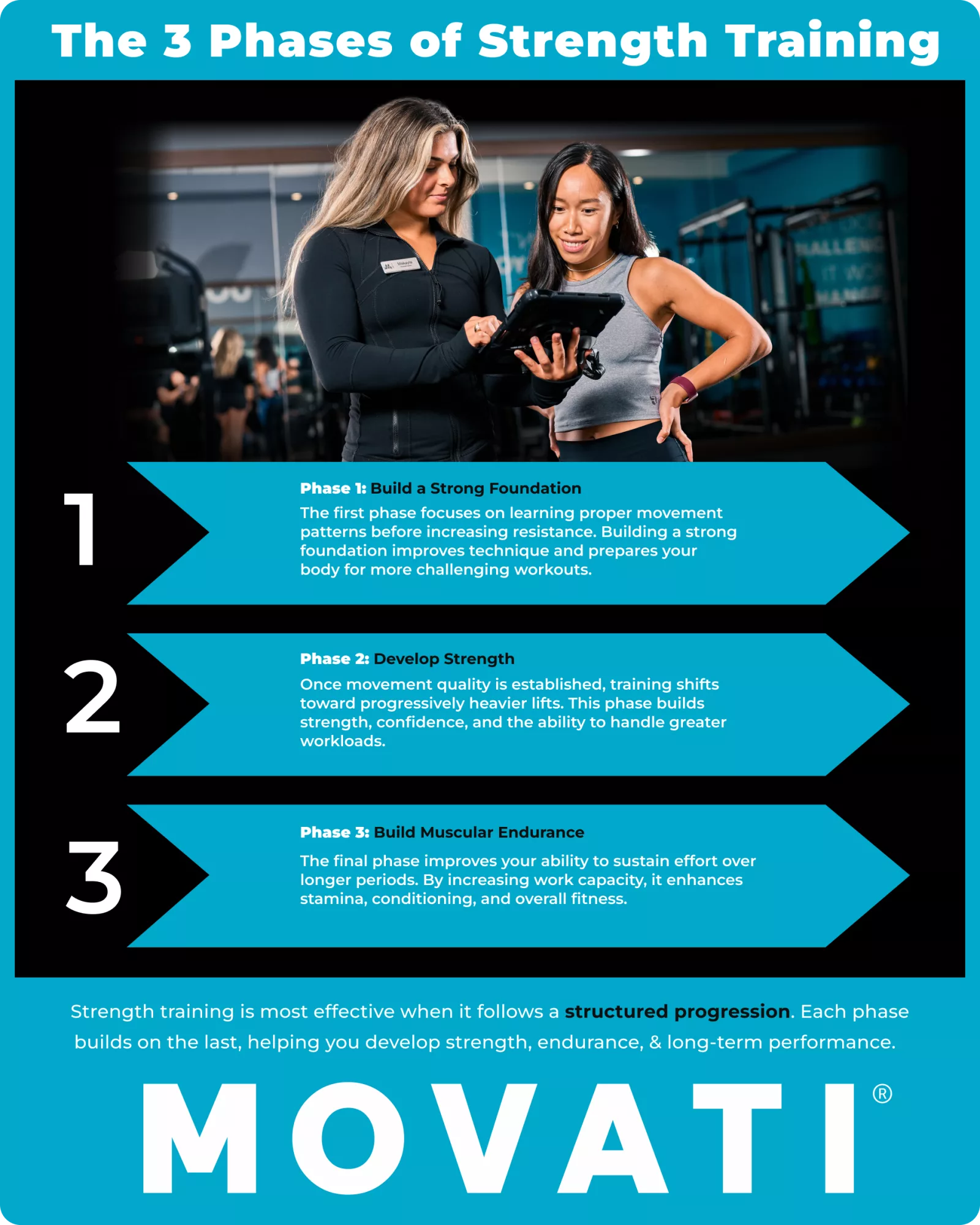
This phase emphasizes compound exercises that train multiple muscle groups simultaneously, including:
Squats
Deadlifts
Presses
Pulling movements
Loaded carries
These exercises develop total-body strength while reinforcing the movement patterns learned during the foundation phase.
Lower Repetitions for Greater Strength
Strength training typically uses lower repetition ranges with heavier resistance.
Depending on experience and skill level, workouts generally include:
1 to 6 repetitions per set
Multiple working sets
Longer recovery periods between sets
The objective is to produce maximum force while maintaining excellent technique.
Maintaining Proper Form
As weights increase, maintaining proper posture becomes increasingly important.
During every lift, focus on:
Keeping the weight close to the body
Maintaining a neutral spine
Moving with control
Avoiding unnecessary momentum
Strong technique allows you to lift more efficiently while minimizing stress on the lower back and shoulders.
Benefits of the Strength Phase
By the end of this phase, many people notice improvements both inside and outside the gym, including:
Increased overall strength
Greater confidence with compound lifts
Improved movement efficiency
Better preparation for higher-volume training
Phase Three: Building Muscular Endurance
After developing strength, the next step is improving muscular endurance.
Instead of producing maximum force for only a few repetitions, this phase challenges muscles to continue performing quality work over longer periods. The goal is to increase work capacity while maintaining good technique.
Higher Volume Training
Muscular endurance workouts typically involve:
More repetitions
Moderate resistance
Shorter rest periods
Continuous movement
Rather than focusing on lifting the heaviest weight possible, the emphasis shifts to sustaining consistent effort throughout the workout.
Functional Conditioning
Sled training is an excellent example of muscular endurance work.
A backward sled drag, performed using suspension straps attached to a weighted sled, challenges the lower body while remaining relatively low impact.
Many MOVATI Athletic clubs include sleds in their turf areas, making this exercise a valuable conditioning tool.
To perform the movement effectively:
Stay upright.
Take short, controlled steps.
Keep constant tension through the legs.
Backward sled drags place significant emphasis on the quadriceps and create the muscular fatigue needed to improve endurance.
The Importance of Muscular Fatigue
One characteristic of this phase is the burning sensation that develops in the working muscles during higher-repetition sets.
This localized fatigue is a normal response to endurance training and indicates that the muscles are being challenged.
The focus is not on lifting the heaviest weight possible. Instead, it’s on maintaining quality movement while accumulating enough work to improve muscular endurance and conditioning.
Supporting Overall Fitness
When combined with proper nutrition, muscular endurance training can contribute to:
Increased calorie expenditure
Improved cardiovascular fitness
Better muscular stamina
Enhanced recovery between activities
Greater overall conditioning
Because these workouts require sustained effort, they can also increase energy expenditure during recovery after exercise.
Why Progressive Programming Works
Each phase has a distinct purpose.
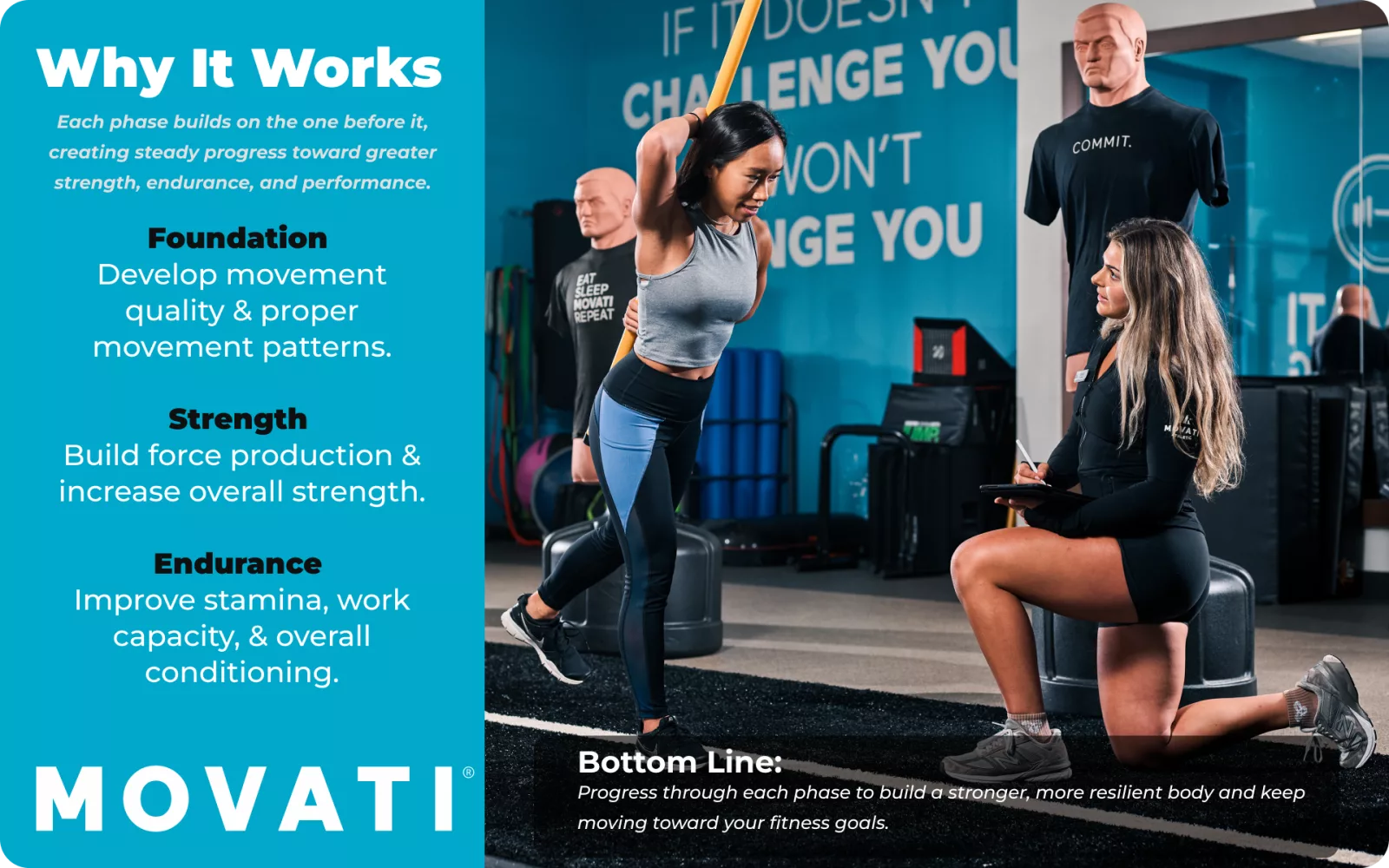
The foundation phase develops movement quality.
The strength phase builds force production.
The endurance phase improves stamina and work capacity.
Progressing through these stages allows each phase to support the next, creating steady improvements while reducing the likelihood of injury or stalled progress.
| Training Phase | Primary Focus |
|---|---|
| Foundation | Movement quality, posture, and stability |
| Basic Strength | Strength and force production |
| Muscular Endurance | Stamina and conditioning |
Watch the Full Programming for Success Video
Understanding the different phases of training is one thing, but seeing these concepts demonstrated by a MOVATI Athletic trainer can help bring them to life. In the video, you’ll see examples of proper lifting technique, learn why repetition ranges change throughout each phase, and discover how exercises like sled drags fit into a well-rounded training program.
Whether you’re just beginning your fitness journey or looking to train more effectively, this expert guidance can help you build a stronger foundation and progress with confidence.
*MOVATI’s trainers and/or consultants are not health care providers, and do not provide any medical diagnosis, treatment or advice, and any trainer and/or consultant tips are not intended to replace the advice of a health care professional.
