To Strengthen lower body muscles effectively, train more than one favourite exercise. A balanced plan includes knee-dominant, hip-dominant and single-leg movements, along with work for the calves and hips. Together, these patterns develop the strength and control used in daily life, sport and recreational activity.
The best plan is not necessarily the most complicated. It is one you can perform consistently, recover from and progress over time.
Which muscles should a lower-body plan train?
The quadriceps straighten the knee, while the hamstrings and glutes help extend the hips. The calves contribute at the ankle, and muscles around the hips help stabilize the pelvis and control the position of the legs. Most lower-body exercises involve several of these areas at once.
Rather than trying to isolate every muscle, build your workout around movement patterns. This keeps the program practical and helps avoid unnecessary overlap.
Use four movement patterns for balanced training
1. A squat pattern
Squats and leg presses emphasize the quadriceps and glutes. Bodyweight squats, goblet squats and machine variations can all be effective. Choose the option that lets you maintain a stable foot position and a controlled range of motion.
2. A hip-hinge pattern
Romanian deadlifts, cable pull-throughs and similar hinges focus on the glutes and hamstrings. The key is to move the hips backward while keeping the weights close and the trunk steady.
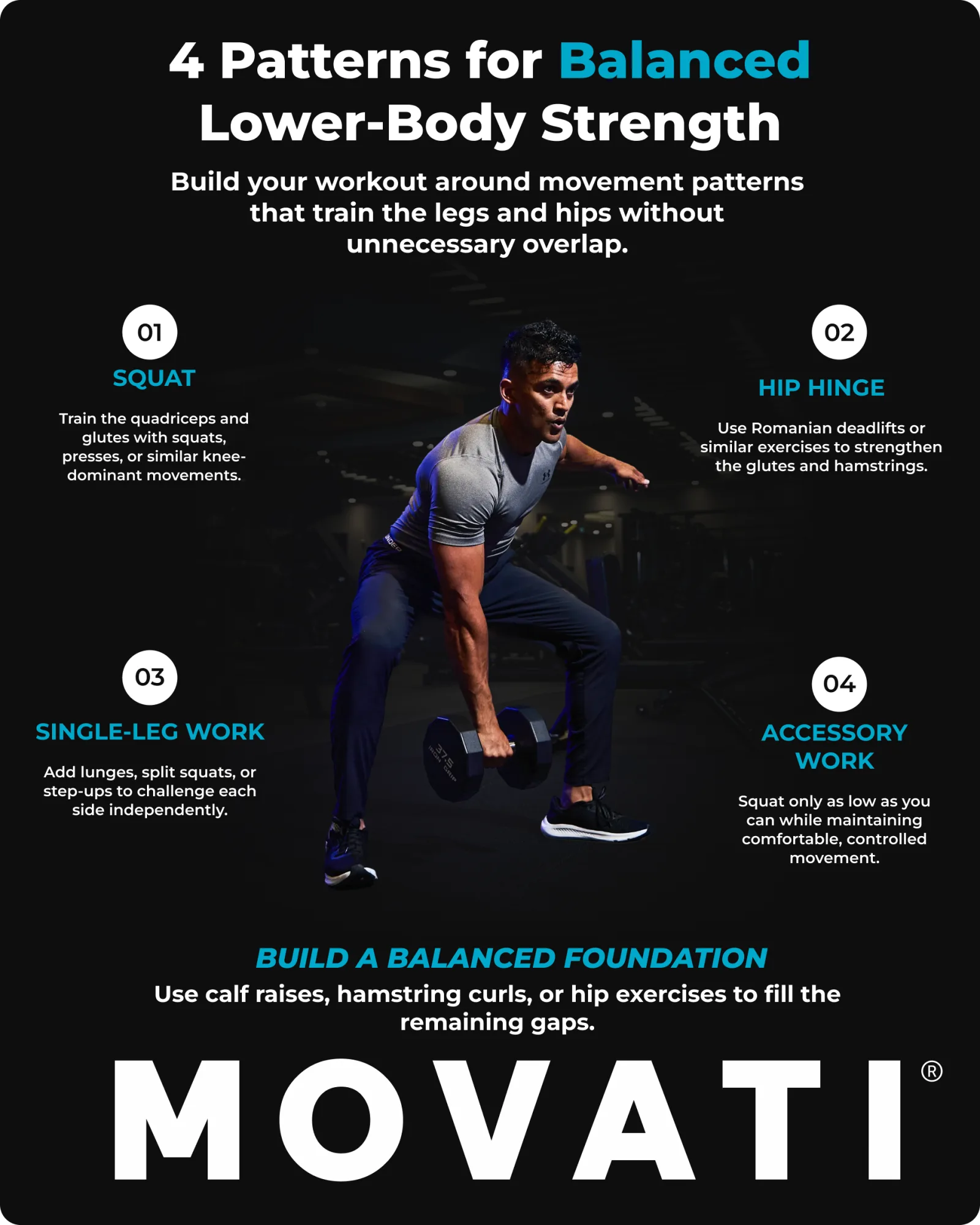
3. A single-leg pattern
Split squats, reverse lunges and step-ups train one side at a time. These exercises challenge balance and can reveal differences in control between sides. Use support when necessary; stability is a tool, not a test.
4. An accessory pattern
Calf raises, hamstring curls and hip abduction exercises can fill gaps after the larger movements. Accessories work best as a complement to the session rather than its entire foundation.
How do you design a complete workout?
Begin with the exercise that requires the most attention and coordination, then move toward supported or single-joint exercises. A straightforward session might include:
- Goblet squat or leg press
- Dumbbell Romanian deadlift
- Reverse lunge or step-up
- Seated hamstring curl
- Standing or seated calf raise
Perform a gradual warm-up first, including lighter sets of the exercises you plan to train. For the working sets, select a resistance that is challenging without changing your technique. Two or three well-executed sets can be an appropriate starting point for many people.
How often should you train your lower body?
Frequency depends on your schedule, training history, total workload and recovery. Some people prefer one focused session each week, while others divide the work across two sessions. When training twice, you can vary the emphasis: one day might feature squats and lunges, while the other prioritizes hinges and step-ups.
Allow enough time between demanding sessions for your performance to recover. More is not automatically better if soreness or fatigue interferes with movement quality.
Progress without sacrificing form
Progressive training means gradually asking your body to do more. Adding weight is only one method. You can also:
- complete an additional repetition with the same load;
- add a set when the current volume feels manageable;
- use a slightly larger, comfortable range of motion;
- slow the lowering portion of an exercise; or
- improve balance and consistency at the same resistance.
Change one element at a time and keep a training log. Small, repeatable increases are easier to evaluate than frequent changes to the entire workout.
Support training with recovery
Strength develops between workouts as well as during them. Regular meals that suit your needs, sufficient fluids and consistent sleep all support recovery. Light movement on non-training days can feel helpful, but recovery does not need to become another intense workout.
Muscle fatigue is expected during challenging training. Sharp pain, sudden swelling or symptoms that alter how you move are signals to stop and seek appropriate guidance.
When should you adjust your plan?
Review the program if your technique repeatedly breaks down, soreness affects your next session or you no longer feel challenged. Sometimes the right adjustment is less weight, a different variation or more recovery. At other times, you may be ready for a gradual increase.
A MOVATI Athletic trainer can help you assess your movement, learn unfamiliar equipment and organize exercises around your goals. The result should be a plan that challenges you while remaining sustainable.
