
A good Hyrox event day guide should do more than repeat the workout order. It should help you manage the hours around the race: when to arrive, what to eat, how to warm up, where athletes often lose time and how to stay composed when the plan changes. HYROX combines eight one-kilometre runs with eight functional workout stations, so the best event-day strategy is controlled, efficient and familiar.
What should you do before event day?
Use the final days before the race to reduce uncertainty. Confirm your start time, travel arrangements and venue requirements through your official event information. Avoid introducing new shoes, equipment, supplements or an aggressive workout at the last minute. The work that builds fitness is already done; your priority is arriving rested and organized.
Pack the evening before so your morning does not begin with a search for missing gear.
- Race clothing you have already worn during training.
- Running shoes suited to both running and functional stations.
- Required identification and registration information.
- Water bottle and familiar pre-race food.
- Warm layers or a change of clothes for before and after the event.
- Any personal items permitted by the event rules.
Check the current athlete guide for your specific event. Timings, venue access, bag policies and operational details can vary, so official race communication should always take priority over a general checklist.
What should you eat before a HYROX race?
Choose food you know sits well during training. A familiar meal with carbohydrates, some protein and relatively easy-to-digest ingredients is generally more useful than a complicated race-day menu. The amount and timing depend on your start time, appetite and usual routine.
Avoid testing unfamiliar foods or dramatically increasing your intake because it feels like a special occasion. Practise your pre-training meal before harder sessions so you know how it affects your energy and digestion. Hydrate normally in the lead-up rather than trying to make up for poor hydration immediately before the start.
When should you arrive?
Arrive early enough to complete check-in, learn the venue layout, use the washroom and warm up without rushing. Your official event instructions will provide the timing you need. Build in extra time for transportation, queues and finding the correct areas inside a busy venue.
Once you arrive, locate the athlete entrance, registration or check-in area, warm-up zone, start area and finish exit. If there is an athlete briefing or event-specific instruction, give it your full attention. Small procedural details are easier to absorb before your heart rate is elevated.
How should you warm up?
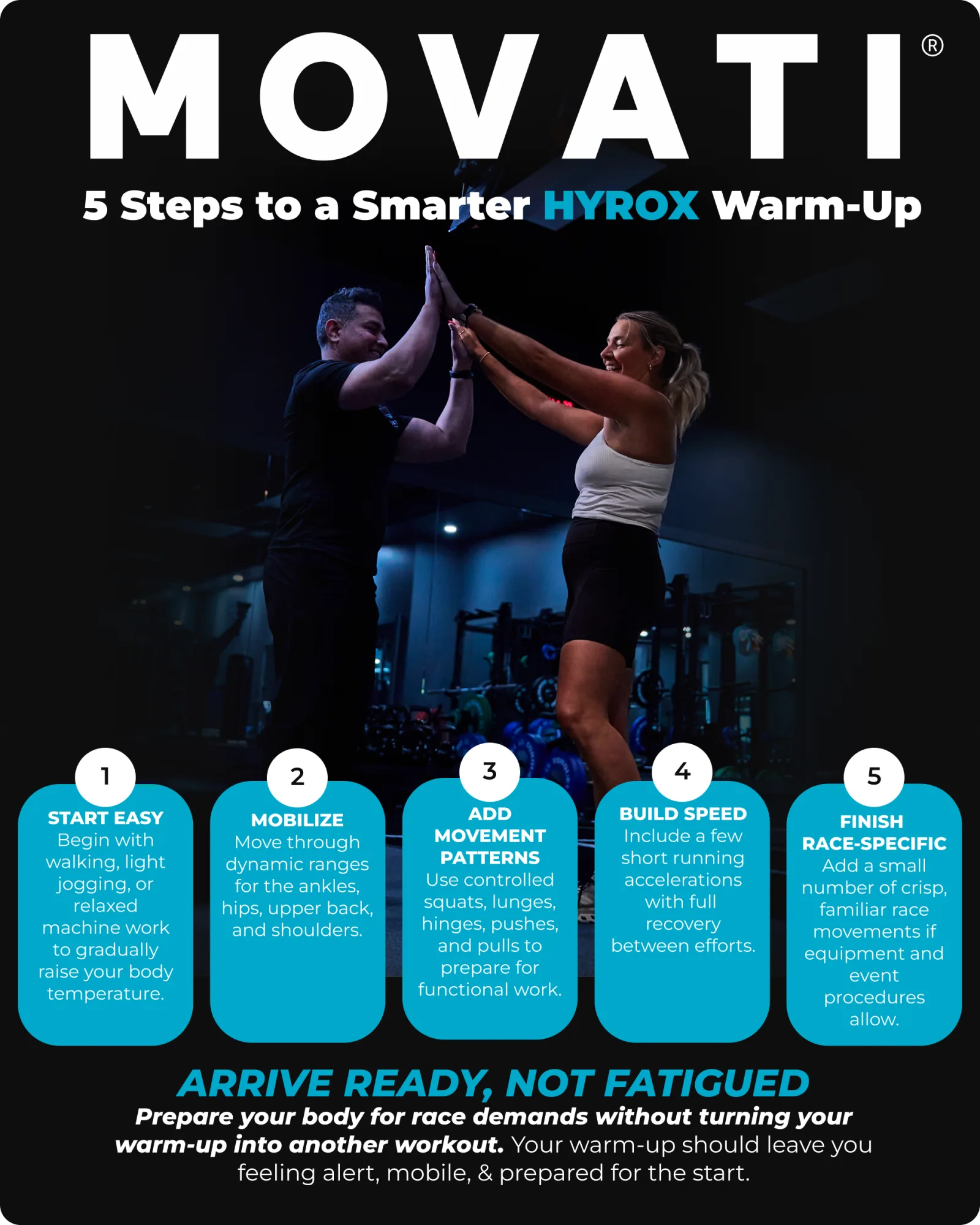
Your warm-up should prepare you to run and move efficiently without becoming a workout of its own. Start gently, raise your body temperature and progress toward movements that resemble the demands of the race.
- Begin with easy movement such as walking, light jogging or relaxed machine work.
- Move through dynamic ranges for the ankles, hips, upper back and shoulders.
- Add controlled squats, lunges, hinges, pushes and pulls.
- Include a few short running accelerations with full recovery.
- Finish with a small number of crisp, race-relevant movements if equipment and event procedures allow.
Keep the final portion specific but brief. You want to reach the start alert and mobile, not fatigued or overheated.
What happens during the race?
The standard HYROX sequence alternates a one-kilometre run with a functional station. The stations progress through SkiErg, sled push, sled pull, burpee broad jumps, rowing, farmer’s carry, sandbag lunges and wall balls. Follow the course markings and officials at your event, because correct movement standards and completed distances matter.
The transition area between the running course and workout stations is commonly called the Roxzone. It is part of your total race, which makes navigation and steady movement important. Know where you are going, but do not turn every transition into a sprint that disrupts your breathing.
How should you pace the opening kilometres?
Start at an effort you can repeat after demanding stations. The energy of the venue can make a sustainable pace feel too easy in the first few minutes. That restraint is useful. A fast opening kilometre has little value if it forces you to walk later or turns every station into a recovery period.
Use breathing, perceived effort and your training experience to settle into a rhythm. Your pace will naturally change as fatigue accumulates. The objective is not to make every kilometre identical; it is to avoid dramatic swings caused by starting beyond your current capacity.
How do you approach the workout stations?
Efficiency is more important than spectacle. Enter each station knowing how you plan to divide the work, where you tend to lose form and what cue helps you stay organized.
- SkiErg and row: Establish a repeatable rhythm instead of chasing an unsustainable opening split.
- Sled push and pull: Set your position before applying force. Use the technique you practised rather than improvising under pressure.
- Burpee broad jumps: Keep the pattern consistent and avoid unnecessary steps.
- Farmer’s carry: Brace before lifting, take controlled turns and use planned breaks if grip is a limitation.
- Sandbag lunges: Find a stable position and protect movement quality as your legs fatigue.
- Wall balls: Choose manageable sets before missed repetitions dictate your rest.
Listen to judges and officials. If you receive a correction, respond immediately rather than arguing or repeating the same error.
How do you manage the Roxzone?
Move through transitions with purpose. Look ahead for signage, stay aware of other competitors and use the first moments after a station to regain control of your breathing. This is not wasted time; it is part of managing the next kilometre.
Practising station-to-run transitions in training helps. The first steps after sleds, lunges or wall balls can feel awkward even when your overall fitness is strong. Familiarity makes that sensation less alarming on race day.
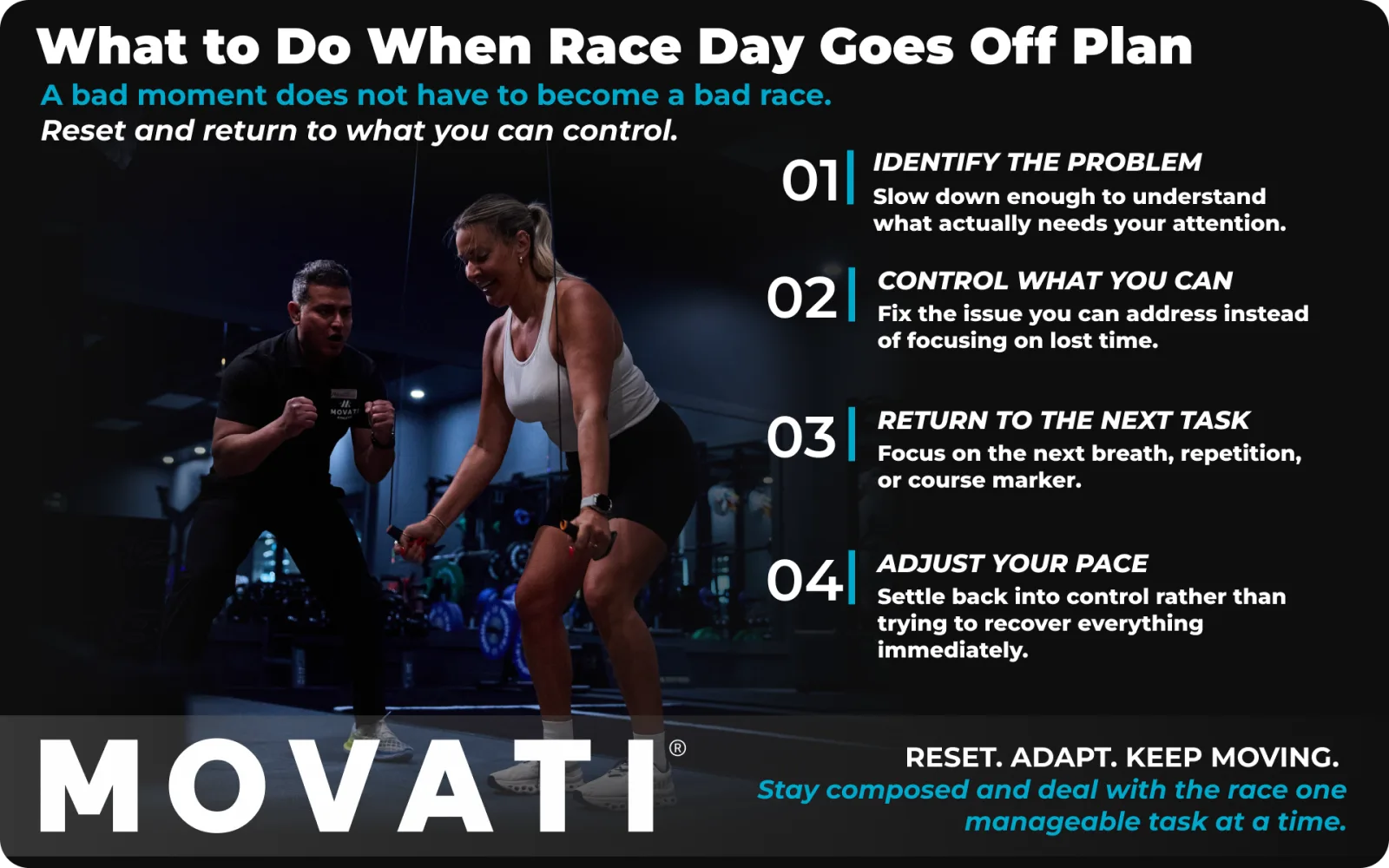
What if something goes wrong?
Expect at least one moment that does not match the plan. A congested area, a missed repetition, a poor station, a loose lace or a sudden wave of fatigue does not need to define the entire race.
- Slow down enough to identify the actual problem.
- Address what you can control.
- Return to the next simple task: the next breath, repetition or course marker.
- Adjust your pace rather than trying to recover lost time immediately.
Stop and seek assistance if you experience concerning symptoms, feel unsafe or cannot maintain control of your movement. Finishing is never more important than your health.
What should you do after finishing?
Keep moving gently as you leave the finish area, then follow event instructions. Replace fluids gradually, eat familiar food when you are ready and change into dry clothing if needed. Your appetite and energy may take time to settle.
Later, note what worked while the experience is fresh. Record your pacing, station strategy, transitions, equipment choices and any unexpected issues. That short review gives your next training block a clear purpose.
Your event-day checklist
- Confirm the official schedule, rules and venue information.
- Pack tested clothing, shoes, identification, hydration and familiar food.
- Arrive with enough time for check-in, orientation and a progressive warm-up.
- Begin at a sustainable effort.
- Use practised station strategies and listen to officials.
- Move deliberately through transitions.
- Adapt calmly when the race does not go perfectly.
- Recover, reflect and celebrate the work that brought you to the start line.
Competition day should feel like the clearest version of your training, not a collection of new decisions. Prepare the practical details early, respect your pacing plan and focus on the section directly in front of you. That approach gives you the best chance to perform well and enjoy the event from check-in to the finish line.
