
Pilates for runners can be a valuable addition to a well-rounded training routine. Running and Pilates share several benefits, including improved muscular endurance, movement control, and overall physical well-being, but they place very different demands on the body.
Running is a repetitive, weight-bearing activity. Over the course of a run, the muscles and joints repeatedly absorb and produce force through the feet, ankles, knees, hips, and lower body. Pilates, by comparison, uses controlled, lower-impact movement to build strength, stability, mobility, and body awareness. That contrast is what can make Pilates for runners especially useful.
A well-rounded Pilates routine can help strengthen the muscles that support your stride, improve control through the hips and core, encourage better mobility, and introduce movement patterns that differ from the repetitive demands of running. Whether you are preparing for your first 5K or simply want more variety in your weekly training, Pilates can complement the kilometres you are already putting in.
Why Is Pilates for Runners Worth Adding to Your Routine?
Running requires much more than cardiovascular endurance. Each stride depends on coordination between the feet, ankles, knees, hips, core, and upper body, and those movements are repeated thousands of times over the course of longer runs.
Pilates focuses on many of the qualities that support those repeated movements, including trunk control, hip stability, mobility, balance, and muscular endurance. It does not need to replace running or traditional strength training. Instead, it can fill a different role within a balanced training week.
Research on endurance runners also supports the broader value of strength-based training. A 2024 systematic review and meta-analysis found that strength training can improve running performance and running economy in middle- and long-distance runners, particularly when heavier resistance, plyometric training, or combined methods are used.
Pilates is not identical to traditional strength training, but its emphasis on controlled resistance and stability makes it a useful way to develop several complementary movement qualities.
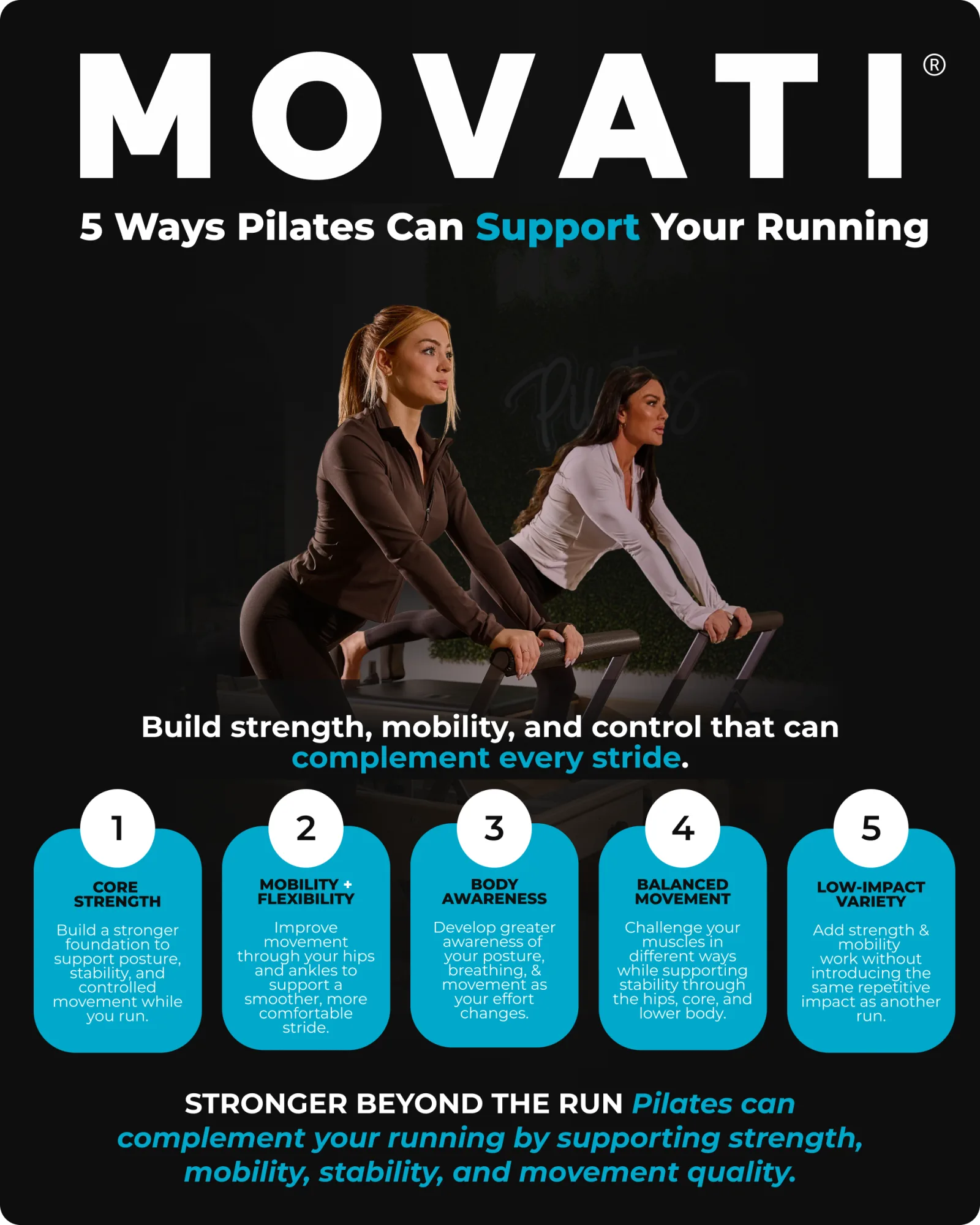
5 Benefits of Pilates for Runners
1. Builds Core Strength and Stability
A strong core does much more than help with abdominal exercises. The muscles around the pelvis, spine, and torso help stabilize the body while the arms and legs move.
Pilates places a strong emphasis on controlled core engagement, including the deeper abdominal and stabilizing muscles that support the torso. For runners, greater core control can create a stronger foundation for movement through the hips and legs.
As fatigue builds during a run, posture and movement mechanics can begin to change. Maintaining better control through the torso may help reduce unnecessary movement through the upper body and make it easier to keep your stride feeling coordinated.
That does not mean runners need to hold their core rigidly. The goal is to develop enough stability to support movement while still allowing the body to rotate and move naturally.
2. Supports Mobility and Controlled Range of Motion
Running requires repeated movement through the hips, knees, and ankles. If mobility feels limited in one area, the body may begin to compensate elsewhere.
Pilates combines strength with controlled movement through a comfortable range of motion. Instead of focusing only on passive flexibility, many Pilates exercises ask you to maintain control while the joints move.
For runners, that combination can be useful through the hips, ankles, spine, and hamstrings. Greater mobility does not automatically create a faster stride, but having enough range of motion to move comfortably can help support smoother, more coordinated movement.
The goal is not to become as flexible as possible. It is to develop enough mobility and control to move efficiently through the range your running requires.
3. Develops Better Body Awareness
One of the defining features of Pilates is its focus on intentional movement. Rather than simply completing repetitions, you are encouraged to notice posture, breathing, alignment, muscle engagement, and how different parts of the body work together.
That awareness can transfer naturally to running.
During a run, you may notice your shoulders creeping upward as you fatigue, your posture beginning to change, or your breathing becoming less controlled. Becoming more aware of those changes can help you adjust your pace or movement before the entire run begins to feel uncomfortable.
Pilates for runners can therefore be useful not only as physical training, but also as an opportunity to become more familiar with how your body moves.
4. Adds Strength and Movement Variety
Running involves repeating a relatively similar movement pattern over and over. That repetition is part of what makes running effective, but it also means some muscles and movement patterns receive far more attention than others.
Pilates for runners can introduces movements in different directions and positions, including rotation, side bending, hip extension, single-leg control, and slower stabilization work. Exercises targeting the glutes, hips, core, and smaller stabilizing muscles can help create more variety in a runner’s training.
Strength training has been studied extensively in runners. A systematic review published in 2024 found that adding strength training to endurance programs can improve measures of running performance and running economy without negatively affecting VO2max.
That reinforces a useful training principle: becoming a better runner does not mean every workout needs to involve more running.
5. Provides a Lower-Impact Training Option
Running is a high-impact activity, particularly when training volume begins to increase. Pilates provides a way to continue moving and challenging the muscles without adding the same repetitive impact.
This can make Pilates useful on lighter training days, between demanding runs, or during periods when you want to emphasize strength and mobility without scheduling another hard cardio session.
Some Pilates sessions can still be physically challenging, particularly when resistance, longer holds, or more advanced movements are involved. Lower impact does not necessarily mean easy.
Instead, Pilates gives runners another way to train while changing the type of stress placed on the body.
What Does Research Say About Strength Training for Runners?
While research specifically studying Pilates for runners is more limited, there is stronger evidence supporting the benefits of adding strength work to endurance training.
A 2024 systematic review and meta-analysis examining middle- and long-distance runners found that strength training can improve running performance and running economy. The review evaluated multiple training approaches, including high-load strength work, submaximal resistance, plyometric training, and combined programs.
Running economy matters because it describes how much oxygen a runner needs to maintain a given pace. Improving economy essentially means the body can perform the same running task with less energy demand.
Pilates should not be presented as identical to heavy resistance training or plyometrics, but exercises that develop core control, hip stability, muscular endurance, and single-leg strength can complement a broader strength program.
How Often Should Runners Do Pilates?
There is no single Pilates and running schedule that works for everyone. Some runners may include one or two Pilates sessions per week alongside their regular running, while others may use shorter Pilates sessions as mobility or recovery-focused work.
Your ideal frequency depends on running volume, experience, goals, recovery needs, and what else is included in your fitness routine. If you already complete several demanding runs each week, placing Pilates on an easier day may make more sense than adding another highly challenging session.
You can also change the intensity depending on where the session falls within your week. A more demanding Pilates workout may fit well alongside a strength-focused training day, while a gentler mobility session may feel better after a long run or harder interval workout.
Canadian movement guidelines recommend that adults accumulate at least 150 minutes of moderate-to-vigorous aerobic activity per week and complete muscle-strengthening activities involving major muscle groups at least twice weekly. Running can contribute to the aerobic portion of that target, while Pilates and resistance training can help create a more varied overall fitness routine.
Pilates Exercises for Runners
Ready to add Pilates-inspired strength and mobility work to your running routine? The following exercises target several muscle groups and movement patterns that play an important role in running, including the glutes, hamstrings, hips, core, and stabilizing muscles.
Move slowly, focus on control, and choose a range of motion that feels comfortable for your body.
1. Glute Bridges
Glute bridges strengthen the glutes and core, two areas that help support hip stability and force production during running. They also provide an opportunity to practise controlled hip extension, which is involved as the leg moves behind the body during each stride.
To perform a glute bridge:
- Lie on your back with your knees bent and your feet approximately shoulder-width apart.
- Keep your feet planted and gently engage your core.
- Press through your feet and slowly lift your hips from the floor.
- Continue until your shoulders, hips, and knees form a comfortable line.
- Pause briefly while engaging your glutes.
- Slowly lower your hips toward the floor.
- Repeat with controlled movement.
Focus on using your glutes rather than excessively arching through the lower back as you lift.
2. Single-Leg Deadlifts
Running is essentially a repeated series of single-leg movements, which makes balance and stability important. Single-leg deadlifts challenge the glutes, hamstrings, core, and stabilizing muscles while encouraging control through the hips and torso.
To perform a single-leg deadlift:
- Stand tall and shift your weight onto one leg.
- Keep a slight bend in your standing knee.
- Hinge forward from the hips while keeping your back long and controlled.
- Allow the opposite leg to extend behind you.
- Continue until you reach a comfortable range of motion.
- Pause briefly before pressing through your standing foot and returning upright.
- Complete your repetitions before switching sides.
Focus on moving slowly and keeping your hips as level as possible rather than trying to reach the floor.
3. Single-Leg Circles
Single-leg circles challenge the hips, core, and stabilizing muscles while encouraging controlled movement through the hip joint. For runners, learning to move one leg while maintaining a stable pelvis can reinforce control through the lower body.
To perform single-leg circles:
- Lie on your back with both legs extended.
- Bend one knee and extend that leg toward the ceiling.
- Keep the opposite leg relaxed on the floor.
- Engage your core and begin making small, controlled circles with the raised leg.
- Keep your pelvis as still as possible.
- Complete several circles in one direction.
- Reverse the direction.
- Lower the leg and repeat on the opposite side.
Start with small circles and gradually increase the range as your control improves.
4. Kneeling Hip Flexor Stretch
Running repeatedly moves the hip through flexion and extension, and the muscles through the front of the hip may feel tight after longer or harder training sessions.
A kneeling hip flexor stretch can provide a gentle stretch through the front of the rear hip while encouraging control through the pelvis.
To perform the stretch:
- Begin in a kneeling position with one foot planted in front of you.
- Keep your torso tall and gently engage your core.
- Slowly shift your hips forward until you feel a comfortable stretch through the front of the rear hip.
- Avoid excessively arching your lower back.
- Hold for approximately 15 to 30 seconds.
- Return to the starting position.
- Repeat on the opposite side.
The stretch should feel gentle and controlled. Avoid forcing yourself into a deeper range.
How to Combine Pilates and Running
Pilates for runners does not need to replace running workouts. Instead, think of it as complementary training that can support strength, mobility, stability, and movement quality.
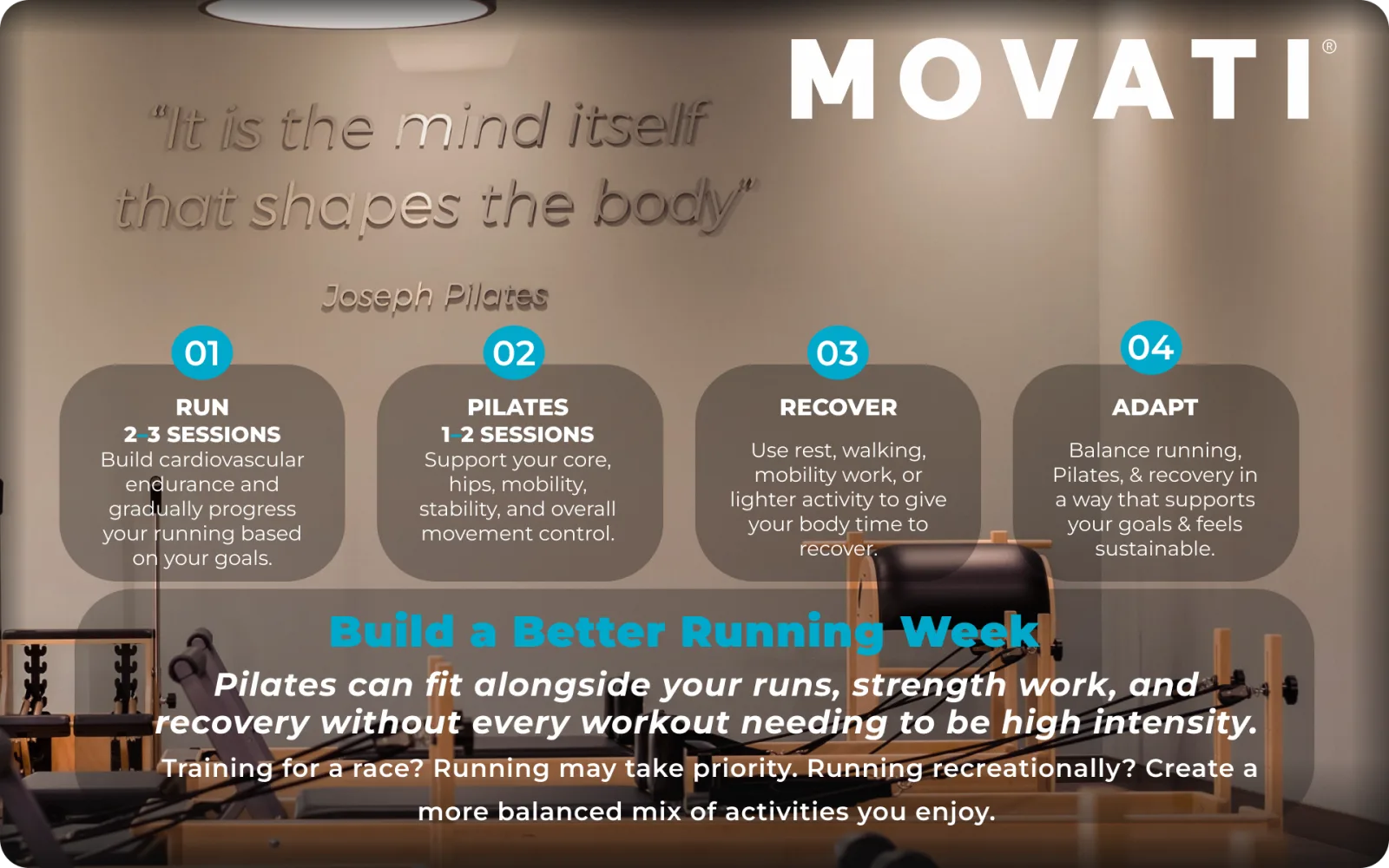
A simple week might include two to three running sessions, one or two Pilates or strength-focused sessions, and one or more easier recovery days. Walking, mobility work, or another lower-impact activity can also be included depending on your energy and goals.
If you are training for a race or increasing your running volume, your key running sessions will naturally take priority. Pilates can then be scheduled around those workouts rather than competing with them.
For recreational runners, the week can be more balanced between running, Pilates, strength work, and other activities you enjoy. There is no need to fit every form of exercise into every week.
Pilates Before or After Running?
Either can work, depending on the type of session.
A short mobility-focused Pilates routine before running may help you focus on posture, hip movement, and core engagement without creating significant fatigue. Keep the movements controlled and avoid turning the warm-up into a difficult workout.
After a run, gentler Pilates movements may be useful when you want to slow down and work through areas that feel stiff. A full or more demanding Pilates session may fit better on another day, especially after a long run or challenging interval workout.
Your schedule should ultimately leave you feeling prepared for your most important sessions rather than constantly fatigued.
Is Pilates Enough Strength Training for Runners?
That depends on the type of Pilates you practise and your goals.
Pilates can provide meaningful muscular endurance and strength challenges, especially through exercises involving resistance, single-leg control, longer holds, or Reformer work. However, runners who want to maximize strength or running performance may still benefit from including traditional resistance training.
Think of Pilates as one part of a broader training toolbox rather than something that must replace every other type of strength work.
A well-rounded routine can include running, Pilates, resistance training, mobility work, and adequate recovery.
Can Beginner Runners Do Pilates?
Yes. Pilates can be adapted to different levels of running and exercise experience.
Beginners may actually find Pilates useful because the slower pace provides time to practise coordination, alignment, balance, and core control without the pressure of moving quickly.
You do not need an advanced Pilates routine to benefit. Starting with exercises such as glute bridges, basic core work, hip mobility, and controlled single-leg exercises can provide a solid foundation.
Personal Experience: Why Pilates Can Complement Running
By adding Pilates-style strength and mobility work alongside running, I found it can make a noticeable difference in how controlled and balanced movement feels. Exercises that focus on the glutes, core, and hips are especially useful because they highlight areas that can be easy to overlook when most of your training is focused on simply getting the kilometres in.
Even a short session of Pilates for runners can be a helpful reminder that becoming a stronger runner is about more than running alone. Having another type of movement in the week can also make the overall routine feel more varied and sustainable.
Pilates for Runners: Build a More Balanced Training Routine
Running builds cardiovascular endurance and challenges the body through repeated, weight-bearing movement. Pilates offers something different by emphasizing controlled strength, stability, mobility, balance, and body awareness.
Whether you are preparing for your first 5K, building toward longer distances, or simply running because you enjoy it, Pilates for runners can provide another way to support your training without adding another repetitive running session.
Start with a few exercises, build gradually, and pay attention to how your body responds. Combine your running with strength, mobility, and adequate recovery, and create a routine that you can realistically sustain over time.
Pilates is great. Running is great. Together, Pilates for runners can create a stronger, more balanced approach to training.
Story Credit: Jayde Kabeya, National Manager, Group Fitness Education
MOVATI’s trainers and/or consultants are not health care providers and do not provide medical diagnosis, treatment, or advice. Trainer and consultant tips are not intended to replace the advice of a healthcare professional.
Join MOVATI Today and get started with this Special Offer.
Already a member? Get customized programming and improve your mobility while learning more about Pilates for runners by consulting with one of our Performance Coaches in club, completing your Game Plan Session, or joining seminars with one of our fitness professionals.
