 If you would like to know all about Hot Hatha vs Hatha yoga you are in the right place. Hatha yoga is one of the foundational styles of yoga, bringing together physical postures, controlled breathing, and mindful movement. For many people, it offers an approachable way to slow down, build strength and mobility, and become more aware of how the body moves.
Hot Hatha builds on many of those same principles but introduces one major difference: heat. Practised in a heated studio, Hot Hatha combines traditional Hatha yoga postures and breath work with the added intensity of a warm environment. While the two classes may share similar movements and pacing, the temperature can significantly change how the experience feels.
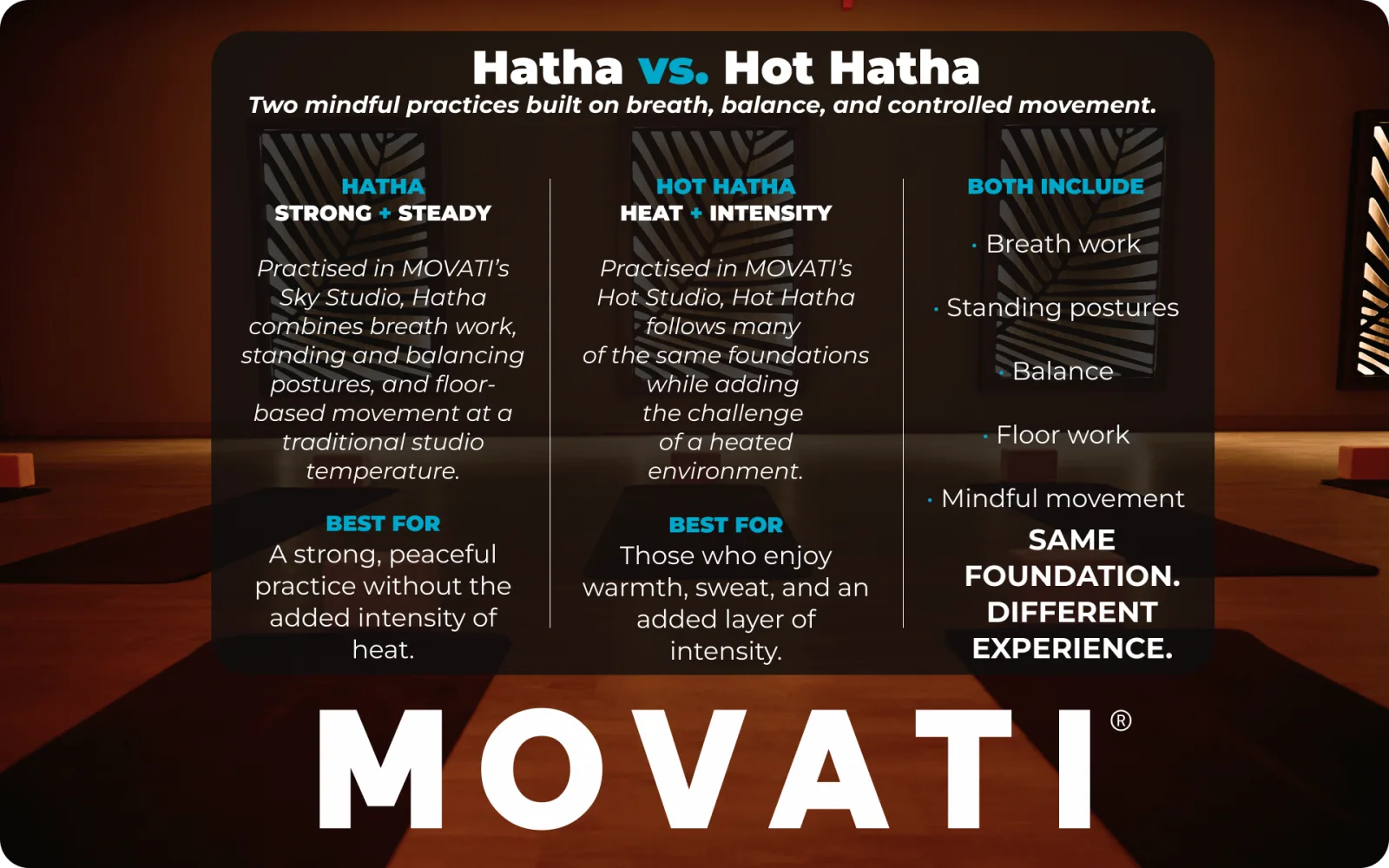
At MOVATI Athletic, both Hatha and Hot are 60-minute yoga classes designed around controlled movement, breath work, standing and balancing postures, and floor-based exercises. The best choice may simply depend on whether you prefer a traditional yoga environment or enjoy the additional challenge of practising in the heat.
What Is Hatha Yoga?
Hatha yoga is a broad style of yoga that emphasizes physical postures, or asanas, alongside breath control, or pranayama, and mindful awareness. Compared with faster-paced yoga styles, Hatha yoga often gives participants more time within individual postures, creating an opportunity to focus on alignment, breathing, balance, control, and how each position feels in the body.
At MOVATI, Hatha takes place in the Sky Studio and develops gradually through breath work, standing postures, balancing positions, and floor work. Postures are held long enough for participants to settle into them, explore the position, and work toward a balance between strength and ease.
The slower pace does not necessarily mean the class is easy. Holding a position with intention can challenge muscular endurance, stability, balance, and concentration.
What Is Hot Hatha Yoga?
Hot Hatha follows many of the same foundations as traditional Hatha yoga but takes place in MOVATI’s Hot Studio. The heated environment adds another element to the experience, making the class feel warmer and often more physically demanding.
MOVATI Hot Hatha incorporates breath work, standing and balancing static postures, and floor-based movement. As with Hatha yoga, each posture is held long enough for participants to establish their position and work on both control and relaxation within the pose.
For people who enjoy the sensation and intensity of exercising in the heat, Hot can provide a strong yet peaceful yoga experience. Because temperature changes how the body feels during exercise, hydration, pacing, and paying attention to your body become especially important.
Hatha Yoga vs. Hot Hatha: What Do They Have in Common?
Although the studio environment differs, Hatha yoga and Hot share many of the same foundations. Both emphasize controlled movement rather than rushing through a sequence, and both give participants time to focus on breathing, alignment, balance, and body awareness.
Breath Work
Breathing plays an important role in both classes. Participants are encouraged to connect breath with movement and use breathing as a way to stay present throughout the practice.
That steady breathing rhythm can also help you remain focused as postures become more challenging.
Standing Postures
Both Hatha yoga and Hot incorporate standing poses that challenge strength, coordination, mobility, and body awareness. Because postures may be held for longer periods, there is more time to explore positioning rather than immediately moving into the next exercise.
Balance
Balancing postures require concentration and muscular control. These movements challenge the muscles that help stabilize the ankles, legs, hips, and core while encouraging greater awareness of body position. Balance can vary from day to day, so the goal is not necessarily to hold every pose perfectly. Instead, focus on maintaining control and working within your own ability.
Floor Work
Both classes eventually move toward floor-based exercises designed to mobilize and stretch different areas of the body. This portion of the class provides a change of pace after standing and balancing work while allowing you to continue focusing on controlled movement and breathing.
Mindful Movement
One of the biggest similarities between the two classes is their emphasis on moving intentionally. Hatha yoga encourages participants to slow down, notice how the body feels, and explore the balance between effort and ease instead of simply trying to complete as many movements as possible.
7 Key Differences Between Hatha Yoga and Hot
The movements may be similar, but the overall experience can feel quite different.
1. Studio Temperature
The most obvious difference is the environment. Hatha yoga is practised in MOVATI’s Sky Studio, while Hot Hatha takes place in a heated studio.
That additional warmth changes the experience even when the postures themselves are familiar.
2. Perceived Intensity
Heat can make a class feel more demanding because the body is already working to regulate temperature while you move.
That does not necessarily mean Hot Hatha is more advanced, but it can feel more intense.
3. Sweat
You will generally sweat more in a heated environment. That makes hydration particularly important before, during, and after Hot Hatha.
4. Heat Tolerance
Some people genuinely enjoy warm training environments, while others find them uncomfortable or distracting.
Personal preference matters. Neither option is inherently better.
5. Pacing
Both formats use controlled pacing, but the heat may cause you to modify your effort or take additional breaks during Hot Hatha.
6. Preparation
Traditional Hatha yoga generally requires less planning around temperature, while Hot Hatha benefits from more attention to hydration, breathable clothing, and heat tolerance.
7. Overall Experience
Hatha yoga can feel calm, grounded, and traditional. Hot Hatha keeps those same foundations but adds an immersive heated environment that some participants find energizing or mentally challenging.
What Does Research Say About Yoga?
The Government of Canada recognizes yoga as an activity that can help strengthen muscles and bones while also supporting balance and stability. More broadly, regular physical activity can support physical and mental health, including improved mood, sleep, coordination, energy, and cardiovascular fitness.
Yoga styles and individual classes can vary significantly, so these broader physical-activity benefits should not be interpreted as guarantees from any single Hatha yoga session.
Benefits of Hatha Yoga
Hatha yoga can offer a combination of physical and mental benefits as part of a balanced fitness routine. Its slower pacing gives you time to focus on how you move while still challenging strength, mobility, stability, and concentration.
Build Strength
Holding standing, balancing, and floor-based postures requires muscular engagement. Depending on the pose, Hatha yoga may challenge the legs, glutes, core, shoulders, arms, and stabilizing muscles throughout the body.
Improve Mobility and Flexibility
Yoga moves the body through a variety of positions and ranges of motion. With regular practice, those controlled movements can support mobility and flexibility while helping you become more aware of areas that feel tight or restricted.
Challenge Balance
Balancing postures require coordination between multiple muscle groups while encouraging greater control through the feet, ankles, hips, and core. Research reviewed by NCCIH also suggests yoga may support balance and general wellness.
Develop Body Awareness
Slower movement gives you time to notice posture, breathing, muscle engagement, and positioning. That awareness can be useful both during yoga and in other types of physical activity.
Create Time to Slow Down
Fitness does not always need to involve moving faster or lifting heavier. Hatha yoga offers an opportunity to focus on deliberate movement and breathing while temporarily stepping away from the pace of everyday life.
Benefits of Hot Hatha
Hot Hatha offers many of the same movement benefits as Hatha yoga while adding the unique challenge of exercising in a heated studio.
A More Intense Environment
Heat can make a familiar yoga practice feel more demanding. Maintaining concentration, breathing steadily, and controlling movement may require additional focus in the warmer studio.
A Strong Mind-Body Challenge
Practising in heat can encourage you to pay closer attention to how your body responds. Learning when to continue, when to modify a posture, and when to rest becomes an important part of the experience.
A Different Way to Experience Yoga
For some participants, the heated environment creates an immersive atmosphere that feels very different from practising at room temperature. If you already know you enjoy warm environments and want a yoga class with an added layer of intensity, Hot Hatha may be worth exploring.
Is Hot Hatha Better for Flexibility?
It may feel easier to move through certain ranges of motion when your body is warm, but that does not necessarily mean you should push deeper into a pose.
Warm muscles can make movement feel different, which is one reason body awareness remains especially important in a heated class. Avoid assuming that feeling more flexible means you need to move farther than usual.
The goal should remain controlled, comfortable movement rather than maximum range.
Hatha Yoga or Hot Hatha: Which Should You Choose?
There is no universal answer. Your preference may depend on your experience, comfort with heat, fitness goals, and the type of environment you enjoy.
You may prefer Hatha yoga if you are new to yoga, prefer a more traditional room temperature, want to focus on learning postures without the added challenge of heat, or simply enjoy a strong but peaceful class environment.
You may prefer Hot Hatha if you already know you enjoy exercising in a heated space, want an additional challenge, enjoy sweating during workouts, or prefer the atmosphere of MOVATI’s Hot Studio.
You do not need to choose one permanently. Trying both can help you determine which environment feels best for your body and routine.
What to Expect in a MOVATI Hatha Yoga Class
Class Category: Yoga
Studio: Sky Studio
Class Length: 60 Minutes
MOVATI Hatha yoga begins with breath work before progressing through standing and balancing static postures. The class also includes floor work designed to move and stretch the muscles and connective tissues.
Each posture is held long enough for participants to establish themselves in the pose and explore both strength and ease within the position. The class is designed for anyone who enjoys a strong, peaceful yoga practice.
Bring your yoga mat. A yoga strap and blocks are also welcome if you use them in your practice.
What to Expect in a MOVATI Hot Hatha Class
Class Category: Yoga
Studio: Hot Studio
Class Length: 60 Minutes
MOVATI Hot Hatha follows a similar progression through breath work, standing and balancing static postures, and floor-based movement. The defining difference is the heated studio.
The added warmth creates a more intense environment for participants who enjoy incorporating heat into their yoga practice. As with Hatha yoga, postures are held long enough for you to settle into the position and explore strength, stability, breathing, and control.
Bring your yoga mat. A strap and yoga blocks are also welcome. Because you are exercising in a heated environment, arriving hydrated and bringing water to class can help you prepare for the session.
How to Prepare for Your First Hot Hatha Class
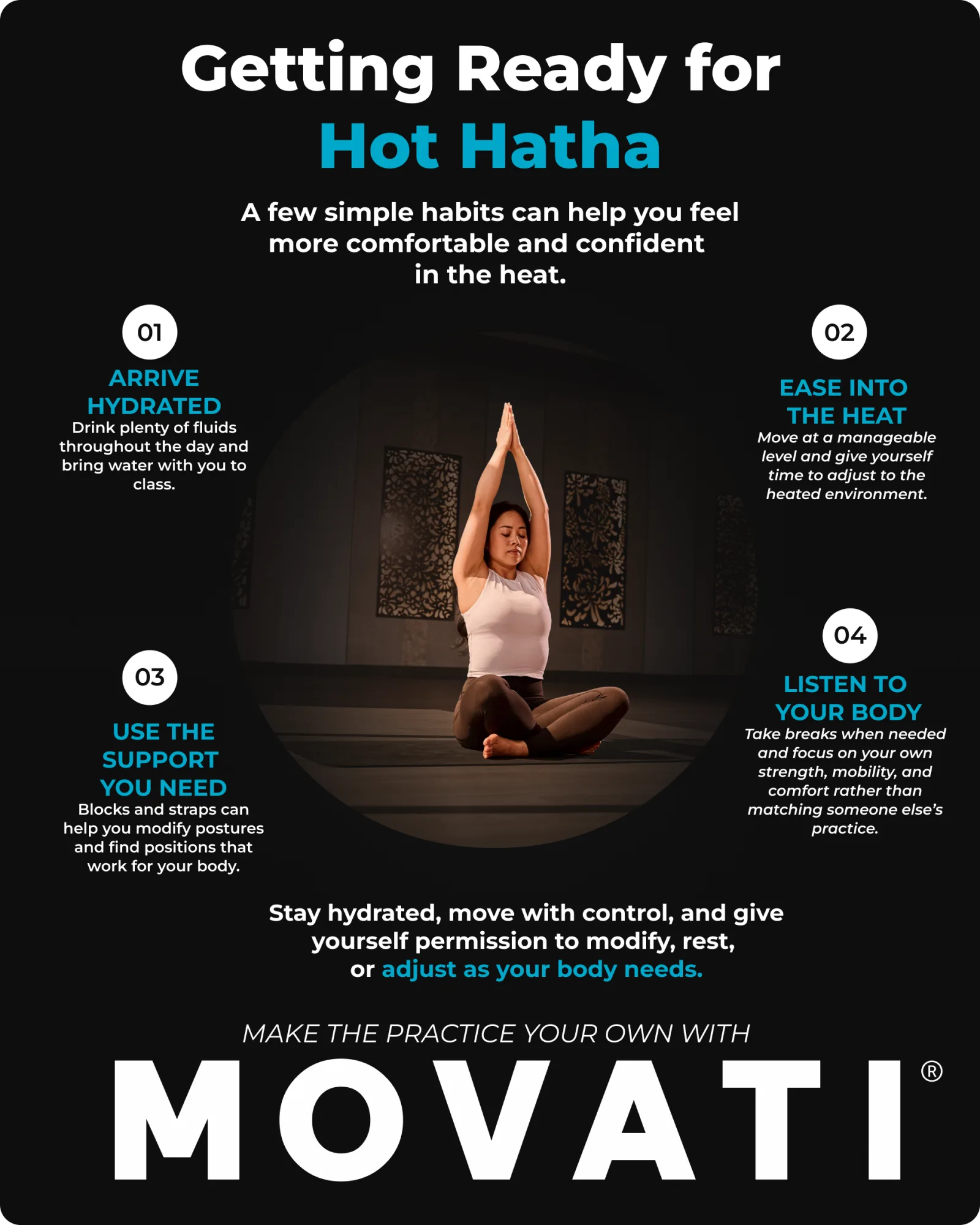
If you have never exercised in a heated studio before, the experience may feel quite different from a traditional Hatha yoga class. A few simple habits can help make your first session more comfortable.
Arrive Hydrated
Hydration matters whenever you exercise, but it becomes particularly important in a hot environment. Health Canada recommends drinking water before, during, and after physical activity in hot conditions and notes that people should not wait until they feel thirsty before thinking about hydration.
Drink fluids throughout the day before class and bring water into the studio so it is available when needed.
Give Yourself Time to Adjust
You do not need to match the pace or range of motion of someone who has been practising Hot Hatha for years. Move at a level that feels manageable and give yourself time to become accustomed to the environment.
Health Canada also recommends starting gradually when being active in hot conditions because the body needs time to adjust to heat.
Use Props
Yoga blocks and straps are not only for beginners. They can help you modify positions and find a variation that works better for your body.
Take Breaks When Needed
Rest is always an option. If the heat begins to feel overwhelming or you become dizzy, nauseated, unusually weak, confused, or faint, stop exercising and move somewhere cooler. Heat-related illness can include symptoms such as dizziness, nausea, weakness, heavy sweating, headache, rapid breathing, and fainting.
Focus on Your Own Practice
Yoga is highly individual. Your flexibility, balance, strength, and comfort may be completely different from the person beside you. Focus on what your body can comfortably do that day instead of trying to match someone else’s range of motion.
What Should You Bring to Hatha Yoga?
For both Hatha yoga and Hot Hatha, bring a yoga mat, comfortable clothing that allows you to move freely, and water. A yoga strap and blocks can also be useful if you prefer additional support or modifications. For Hot Hatha, lightweight and breathable clothing may feel more comfortable because of the warmer studio environment.
Can Beginners Try Hatha Yoga or Hot?
Yes. Traditional Hatha yoga can be an approachable place for beginners to become familiar with yoga postures, breathing, and mindful movement because the poses are generally held rather than rapidly transitioned through. That slower pace provides more time to understand each position and make adjustments. Beginners can also participate in Hot, but the heat creates an additional challenge. If you are completely new to yoga and are unsure how you respond to exercising in warm environments, beginning with a traditional Hatha yoga class may help you become familiar with the movement before adding heat. Regardless of which class you choose, let the instructor know if you are new so they can help explain the class flow and suggest modifications when appropriate.
How Often Should You Practise Hatha Yoga?
There is no single schedule that works for everyone. Some people may practise Hatha yoga once or twice per week as part of a broader routine, while others may attend more frequently. The right frequency depends on your overall training, recovery, experience, and goals. If you also strength train, run, cycle, or participate in other MOVATI classes, think about how yoga fits into the entire week rather than treating it as an isolated workout.
Consistency matters more than trying to force a specific number of sessions.
Listen to Your Body
Yoga is not about forcing your body into a particular shape. Some days you may feel more mobile, balanced, or energetic than others, and that variation is completely normal. Give yourself permission to modify poses, use props, or rest when needed. This becomes particularly important in Hot , where the heated environment can make the same movement feel substantially more challenging.
If you experience dizziness, faintness, confusion, chest discomfort, unusual shortness of breath, nausea, or another concerning symptom, stop exercising and seek appropriate medical guidance when necessary.
Personal Experience: Learning the Difference Between Effort and Ease
One thing I’ve learned through yoga is that a posture can look simple while still requiring a surprising amount of concentration and muscular control. Slowing down and holding a position makes it easier to notice where I am carrying tension, how my breathing changes, and whether I am actually moving comfortably.
That awareness has helped me appreciate that Hatha yoga is not about pushing deeper into every pose. Sometimes the most useful adjustment is backing off slightly, breathing, and finding a position I can control.
Hatha Yoga vs. Hot : Find the Practice That Fits You
Hatha yoga and Hot Hatha share the same foundation of breath work, controlled postures, balance, and mindful movement. The biggest difference is the environment.
Traditional Hatha yoga offers a strong, peaceful practice in MOVATI’s Sky Studio, while Hot adds the intensity and atmosphere of the Hot Studio. If you want to focus on mindful movement without added heat, Hatha may be the right place to start. If you enjoy exercising in warm environments and want an additional challenge, Hot Hatha may be more your style.
You can also try both. The best Hatha yoga practice is the one that allows you to move, breathe, build strength, and enjoy returning to your routine.
Story Credit: Jayde Kabeya, National Manager, Group Fitness Education & Kasia Kudzma, Yoga Lead & Education Specialist
*MOVATI’s trainers and/or consultants are not health care providers, and do not provide any medical diagnosis, treatment or advice, and any trainer and/or consultant tips are not intended to replace the advice of a health care professional.
As leaders in Group Fitness, we offer a wide range of classes for all levels, with up to 200 live classes per week. Included in all memberships, our in-person live group fitness classes are led by certified instructors in our purpose-built boutique studios. Join our supportive fitness community and discover the strength within you. Let’s move with MOVATI!
Join MOVATI Today and get Started with this Special Offer. Already a member? Get customized programming, learn more about hot hatha or our other classes by consulting with one of our Performance Coaches in club and complete your Game Plan Session or join seminars with one of our fitness professionals.
