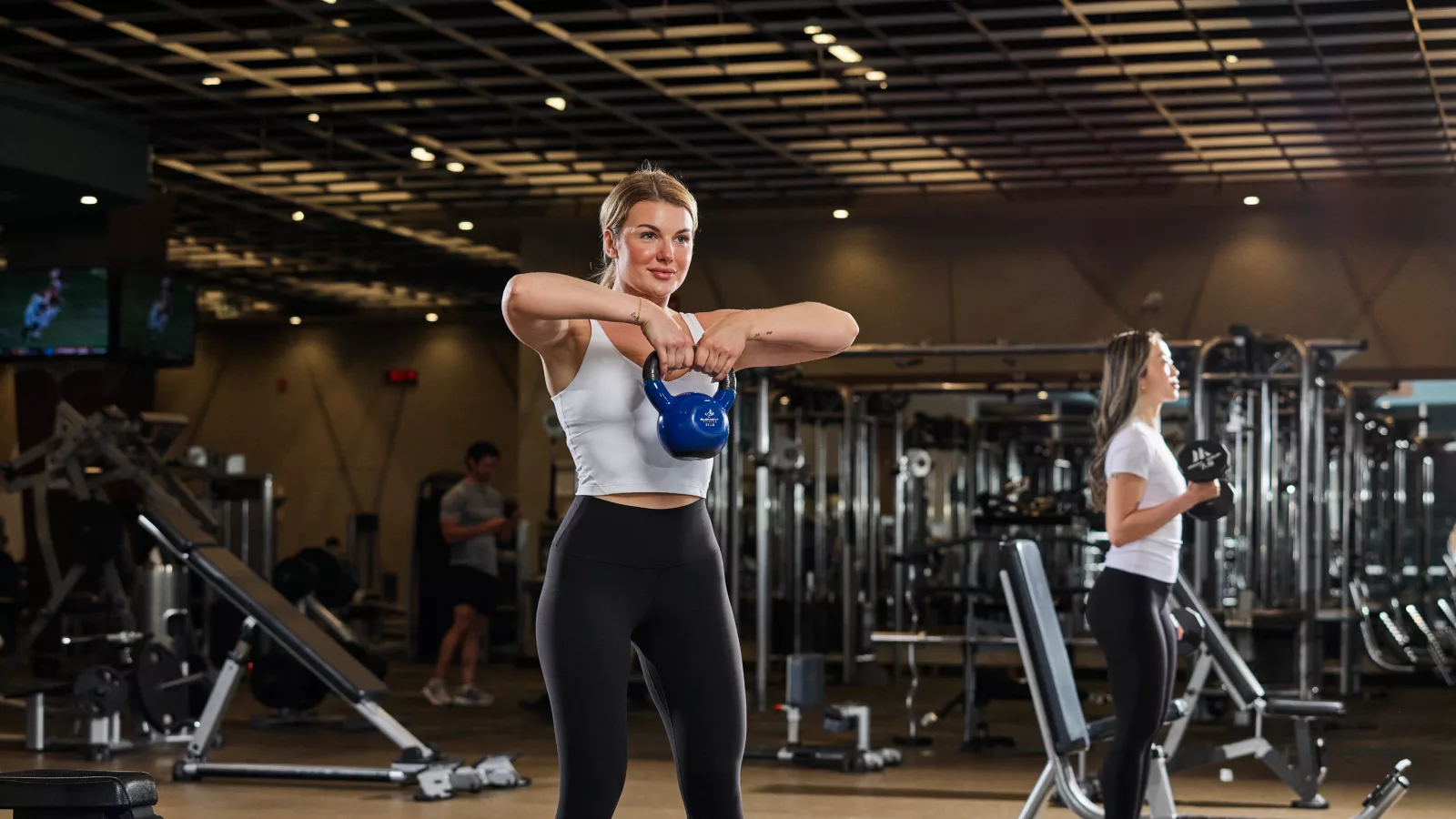
If you’re looking for a workout that challenges your entire body while maximizing results in a short amount of time, a Full Body HIIT Workout is one of the most effective training methods available. High-Intensity Interval Training (HIIT) combines bursts of intense exercise with short recovery periods, allowing you to improve cardiovascular fitness, build muscular endurance, and burn calories long after your workout has ended.
Whether you’re training at home or in the gym, a full HIIT workout requires minimal equipment and can be adapted for nearly every fitness level. By combining upper body, lower body, core, and cardio exercises into one session, you can achieve a balanced workout that delivers both strength and conditioning benefits.
What Is a Full Body HIIT Workout?
A Full Body HIIT Workout is a circuit-based training session that alternates between periods of maximum effort and brief rest intervals. Unlike traditional steady-state cardio, HIIT keeps your heart rate elevated throughout the workout while recruiting multiple muscle groups simultaneously.
A well-designed HIIT workout includes movements that target:
-
Lower body strength
-
Upper body endurance
-
Core stability
-
Cardiovascular conditioning
-
Balance and coordination
-
Explosive power
Because several muscle groups work together, you’ll complete an efficient, high-energy workout that improves both fitness and functional movement.
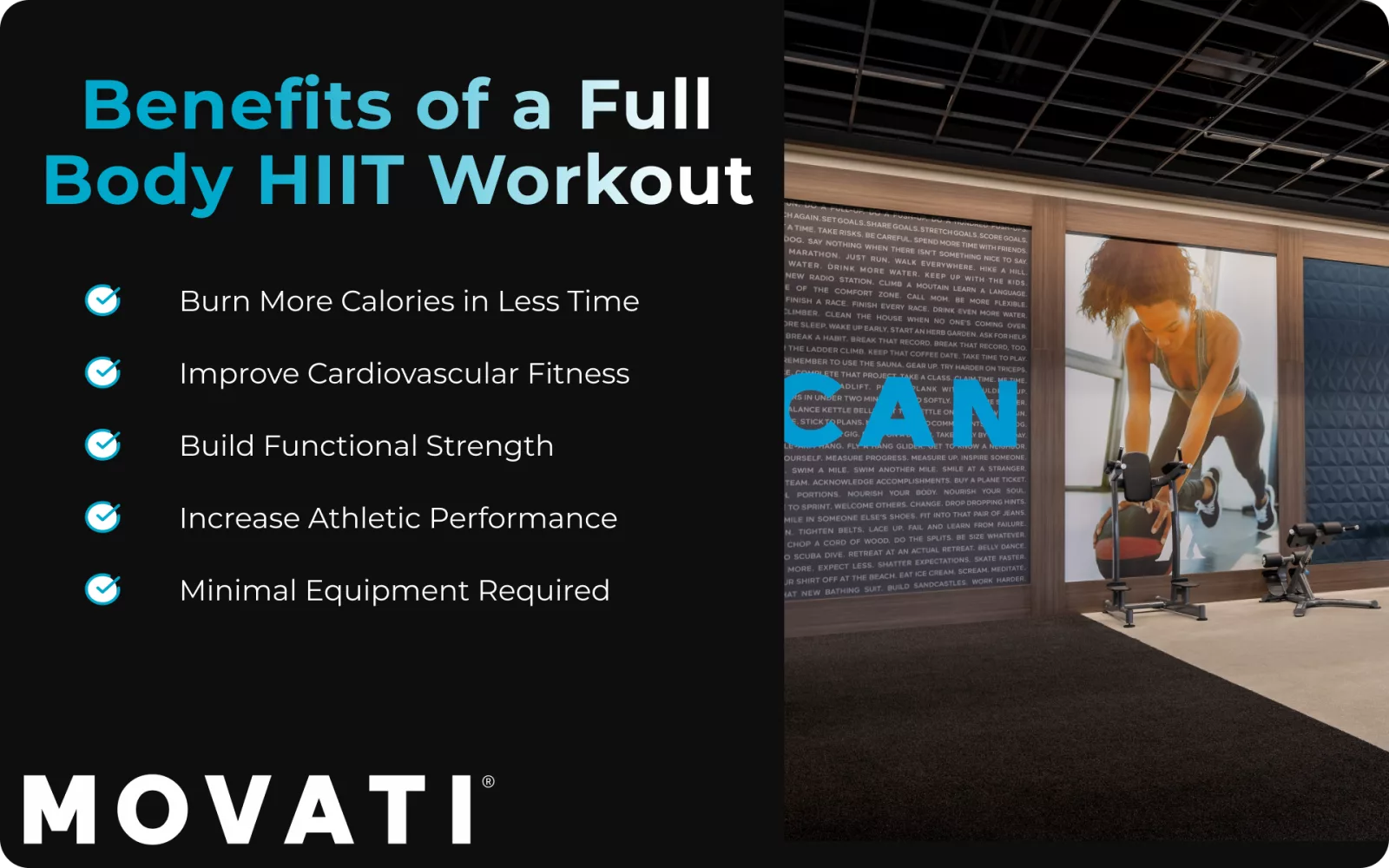
Benefits of a Full Body HIIT Workout
1. Burn More Calories in Less Time
One of the biggest reasons HIIT has become so popular is its efficiency. Many workouts can be completed in 20 to 40 minutes while still delivering significant calorie burn.
The combination of strength exercises and cardio intervals increases energy expenditure during the workout and can elevate calorie burn after exercise through excess post-exercise oxygen consumption (EPOC), often called the “afterburn effect.”
2. Improve Cardiovascular Fitness
Alternating between high-intensity work and recovery challenges your heart and lungs more effectively than steady-paced cardio alone.
With consistent training, many people experience:
-
Improved endurance
-
Better heart health
-
Increased aerobic capacity
-
Enhanced recovery between activities
3. Build Functional Strength
Unlike workouts that isolate individual muscles, full body HIIT emphasizes compound movements that mimic everyday activities.
Exercises such as squats, planks, push-ups, and skaters improve:
-
Stability
-
Coordination
-
Balance
-
Total-body strength
4. Increase Athletic Performance
Many HIIT exercises develop explosive power, agility, and speed, making them valuable for athletes participating in sports that require quick bursts of movement.
5. Minimal Equipment Required
Many effective HIIT workouts rely primarily on bodyweight exercises, allowing you to train almost anywhere.
A step platform or exercise bench can add variety, but many movements require nothing more than your own body weight.
How to Structure a HIIT Workout
A typical session includes:
Warm-Up (5–10 Minutes)
Prepare your muscles and joints before beginning the workout.
Warm-up ideas include:
-
Light jogging
-
Jumping jacks
-
Dynamic lunges
-
Arm circles
-
Hip mobility drills
-
Bodyweight squats
Once your heart rate is elevated, you’re ready to begin the workout.
Circuit 1: Lower Body and Core Focus
Perform each exercise for 1 minute.
Rest 15 seconds between exercises.
Rest 1 minute after completing the circuit.
Complete 4 rounds.
A1. Skaters
Skaters are an excellent lateral movement exercise that develops agility, balance, and lower-body power.
Primary muscles worked:
-
Glutes
-
Quadriceps
-
Hamstrings
-
Calves
-
Core
A2. Mountain Climbers
Mountain climbers combine cardio with core engagement while also challenging the shoulders and hip flexors.
Benefits include:
-
Increased heart rate
-
Improved coordination
-
Stronger core
-
Better shoulder stability
A3. Elevated Squats
Using a step platform increases range of motion and helps improve lower-body strength.
Muscles targeted:
-
Quadriceps
-
Glutes
-
Hamstrings
-
Core
A4. Bulgarian Jump
This explosive variation of the Bulgarian split squat develops single-leg strength while improving power and balance.
Benefits include:
-
Leg power
-
Athletic explosiveness
-
Balance
-
Stability
A5. Plank Side Steps
This dynamic plank variation strengthens the core while adding shoulder and hip stability.
Muscles worked:
-
Core
-
Shoulders
-
Chest
-
Glutes
Circuit 2: Full Body Conditioning
After completing Circuit 1, move into a second round of exercises that combine upper-body strength, core stability, and lower-body endurance.
Perform each exercise for 1 minute.
Rest 15 seconds between exercises.
Rest 1 minute after completing the circuit.
Complete 4 rounds.
B1. Two-Point Plank
The two-point plank challenges core stability by lifting alternating limbs while maintaining proper plank position.
Benefits include:
-
Core strength
-
Shoulder stability
-
Balance
-
Anti-rotation control
B2. Air Skipping
Air skipping elevates your heart rate while improving coordination and cardiovascular endurance without requiring a jump rope.
B3. Step Back High Knee
This movement combines reverse lunges with an explosive knee drive to improve balance, coordination, and lower-body strength.
Muscles targeted:
-
Glutes
-
Quadriceps
-
Hamstrings
-
Hip flexors
-
Core
B4. Walk Push-Up
Walk push-ups increase upper-body strength while engaging the core and improving shoulder mobility.
Primary muscles worked:
-
Chest
-
Shoulders
-
Triceps
-
Core
B5. Wall Sit
Wall sits build muscular endurance throughout the lower body by maintaining an isometric squat position.
Benefits include:
-
Quad endurance
-
Glute strength
-
Mental toughness
B6. Flutter Kicks
Flutter kicks strengthen the lower abdominal muscles while also engaging the hip flexors.
Focus on maintaining a neutral spine throughout the movement.
Sample Full Body HIIT Workout
| Exercise | Time |
|---|---|
| Skaters | 1 minute |
| Rest | 15 seconds |
| Mountain Climbers | 1 minute |
| Rest | 15 seconds |
| Elevated Squats | 1 minute |
| Rest | 15 seconds |
| Bulgarian Jump | 1 minute |
| Rest | 15 seconds |
| Plank Side Steps | 1 minute |
| Rest | 1 minute |
| Repeat Circuit | 4 rounds |
Then continue with:
| Exercise | Time |
|---|---|
| Two-Point Plank | 1 minute |
| Rest | 15 seconds |
| Air Skipping | 1 minute |
| Rest | 15 seconds |
| Step Back High Knee | 1 minute |
| Rest | 15 seconds |
| Walk Push-Up | 1 minute |
| Rest | 15 seconds |
| Wall Sit | 1 minute |
| Rest | 15 seconds |
| Flutter Kicks | 1 minute |
| Rest | 1 minute |
| Repeat Circuit | 4 rounds |
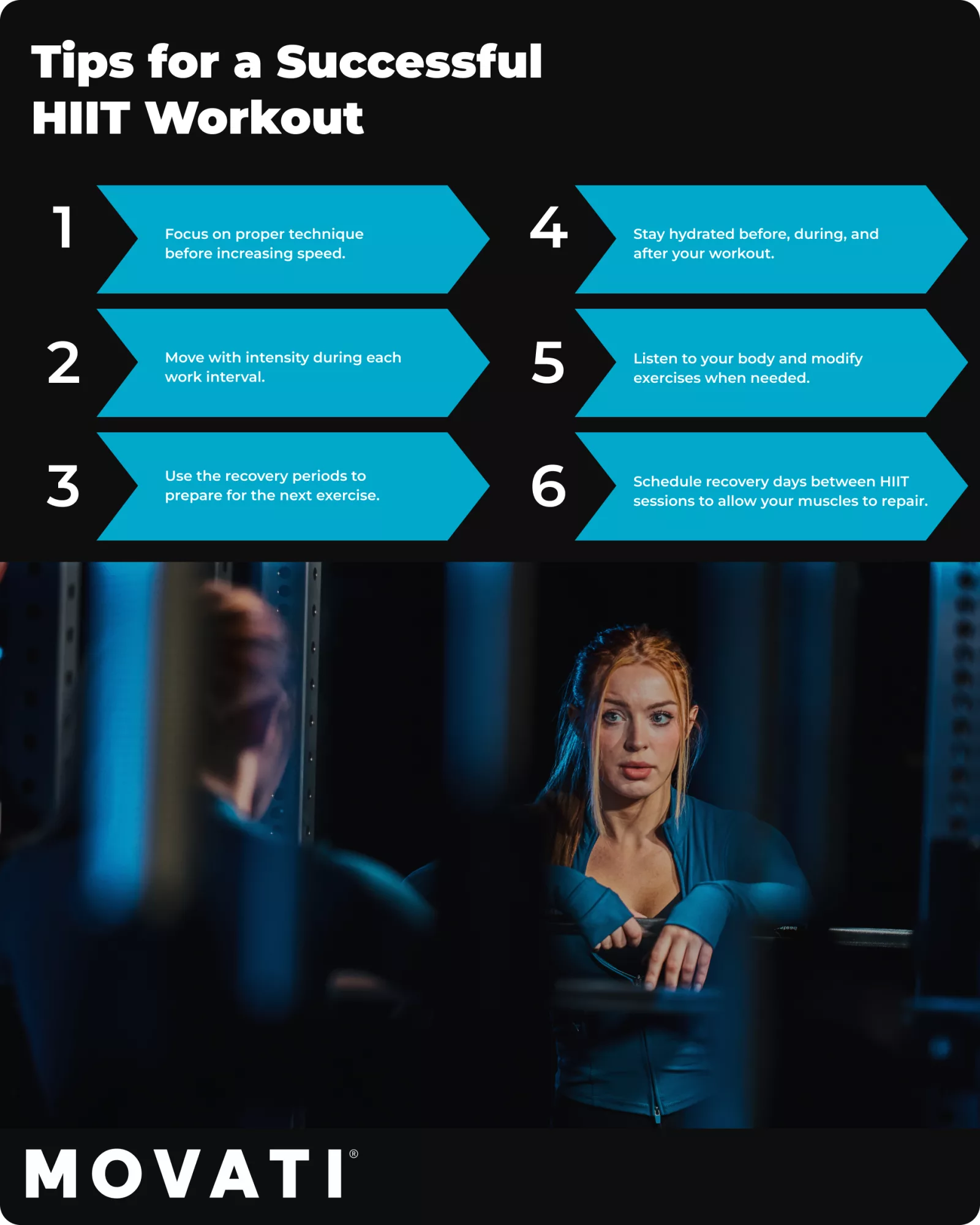
Tips for Success
To get the most from your HIIT workout:
-
Focus on proper technique before increasing speed.
-
Move with intensity during each work interval.
-
Use the recovery periods to prepare for the next exercise.
-
Stay hydrated before, during, and after your workout.
-
Listen to your body and modify exercises when needed.
-
Schedule recovery days between HIIT sessions to allow your muscles to repair.
Is a HIIT Workout Good for Beginners?
Yes. Although HIIT is known for its intensity, the exercises can easily be modified.
For beginners:
-
Reduce the work interval to 30–45 seconds.
-
Increase rest periods if necessary.
-
Perform bodyweight versions before adding jumps.
-
Complete fewer rounds until endurance improves.
As your fitness level increases, gradually work toward completing the full workout.
How Often Should You Do HIIT?
Most people benefit from performing a HIIT Workout two to four times per week, depending on their training goals and recovery ability.
Pair HIIT with:
-
Strength training
-
Mobility work
-
Walking
-
Stretching
-
Recovery days
This balanced approach helps maximize results while reducing the risk of overtraining.
Why HIIT Is One of the Most Efficient Workouts
Few workouts combine strength, cardio, endurance, and functional movement as effectively as a full body HIIT session. By working multiple muscle groups with short bursts of high-intensity effort, you can improve your overall fitness in less time while keeping every workout engaging and challenging.
Whether your goal is to increase endurance, build lean muscle, burn calories, or simply fit an effective workout into a busy schedule, a HIIT Workout offers a versatile solution that can be adapted as your fitness improves.
Try This Full Body HIIT Workout at MOVATI
Ready to put these exercises into action? Follow along with MOVATI Athletic’s Full Body HIIT Workout video, featuring the complete circuits outlined above, including Skaters, Mountain Climbers, Bulgarian Jumps, Two-Point Planks, Walk Push-Ups, Flutter Kicks, and more.
Watch the full workout here: https://www.youtube.com/watch?v=XjEcNDQTXbA
If you’re looking for even more expert-led workouts, group fitness classes, and personal training, visit MOVATI Athletic to discover programs designed to help you reach your fitness goals.
*MOVATI’s trainers and/or consultants are not health care providers, and do not provide any medical diagnosis, treatment or advice, and any trainer and/or consultant tips are not intended to replace the advice of a health care professional.
