
8 Essential Cardio Exercises to Build Endurance and Support Heart Health
Cardio exercises are one of the most effective ways to support cardiovascular fitness, improve endurance, and build a more active lifestyle. Whether you enjoy walking, swimming, cycling, dancing, or higher-intensity workouts, there are many ways to get your heart rate up and move more throughout the week.
Cardiovascular or aerobic exercise, involve continuous or repeated movement that increases your heart rate and breathing. Over time, regular aerobic activity can improve cardiorespiratory fitness and help make everyday physical tasks feel easier. The best cardio routine is not necessarily the hardest one. It is the one you enjoy enough to return to consistently.
What Are Cardio Exercises?
Cardio exercises are activities that increase your heart rate and require your heart, lungs, and muscles to work together to supply oxygen throughout the body. They can range from brisk walking and swimming to cycling, running, dancing, and interval training. The intensity of cardio can vary considerably. Some activities are gentle enough to maintain for longer periods, while others involve shorter bursts of more demanding effort. That flexibility makes cardio adaptable to different fitness levels, goals, schedules, and personal preferences.
What Are the Benefits of Cardio Exercises?
Regular cardio can support several areas of physical and mental well-being. Physical activity is associated with improved cardiovascular fitness, greater stamina, better sleep, improved mood, and a lower risk of several chronic health conditions. The Heart and Stroke Foundation of Canada notes that regular physical activity can help reduce risk factors associated with heart disease and stroke, including high blood pressure, high cholesterol, and type 2 diabetes.
Support Heart Health
Aerobic activity challenges the cardiovascular system and can help improve how efficiently the heart and lungs respond to movement. Over time, this can make everyday activities such as climbing stairs, walking longer distances, or completing a workout feel more manageable. Regular physical activity is also an important part of supporting long-term heart health. Heart and Stroke reports that people who are inactive have approximately double the risk of heart disease and stroke compared with people who are physically active.
Improve Endurance
Cardio can help build the body’s ability to sustain activity over time. As cardiovascular endurance improves, both workouts and everyday movement can begin to feel easier. That endurance can support everything from completing a longer walk to participating in recreational activities or maintaining energy throughout a busy day.
Support Mood and Stress Management
Physical activity can also support mental well-being. Exercise has been associated with reduced stress, improved mood, and better overall quality of life. For some people, even a short walk, swim, cycling session, or group fitness class can provide an opportunity to reset mentally while still contributing to their weekly activity.
Support Better Sleep
Regular movement can also be part of a routine that supports healthy sleep. Sleep is influenced by many factors, but staying physically active can contribute to better overall rest and recovery. The Canadian 24-Hour Movement Guidelines for adults recommend balancing physical activity with adequate sleep and reduced sedentary time as part of overall health.
Support Weight Management
Cardio can increase energy expenditure and can contribute to a broader weight-management routine. However, body composition is influenced by many factors, including nutrition, resistance training, sleep, stress, total activity, and individual differences. Cardio does not need to be viewed only as a way to burn calories. It can also help build endurance, confidence, physical capacity, and a more consistent movement routine.
8 Types of Cardio Exercises to Try
There is no single best form of cardio exercise. The right option depends on your goals, fitness level, access to equipment, joint comfort, and what you genuinely enjoy doing. Trying different activities can help you find exercises that feel sustainable rather than repetitive.
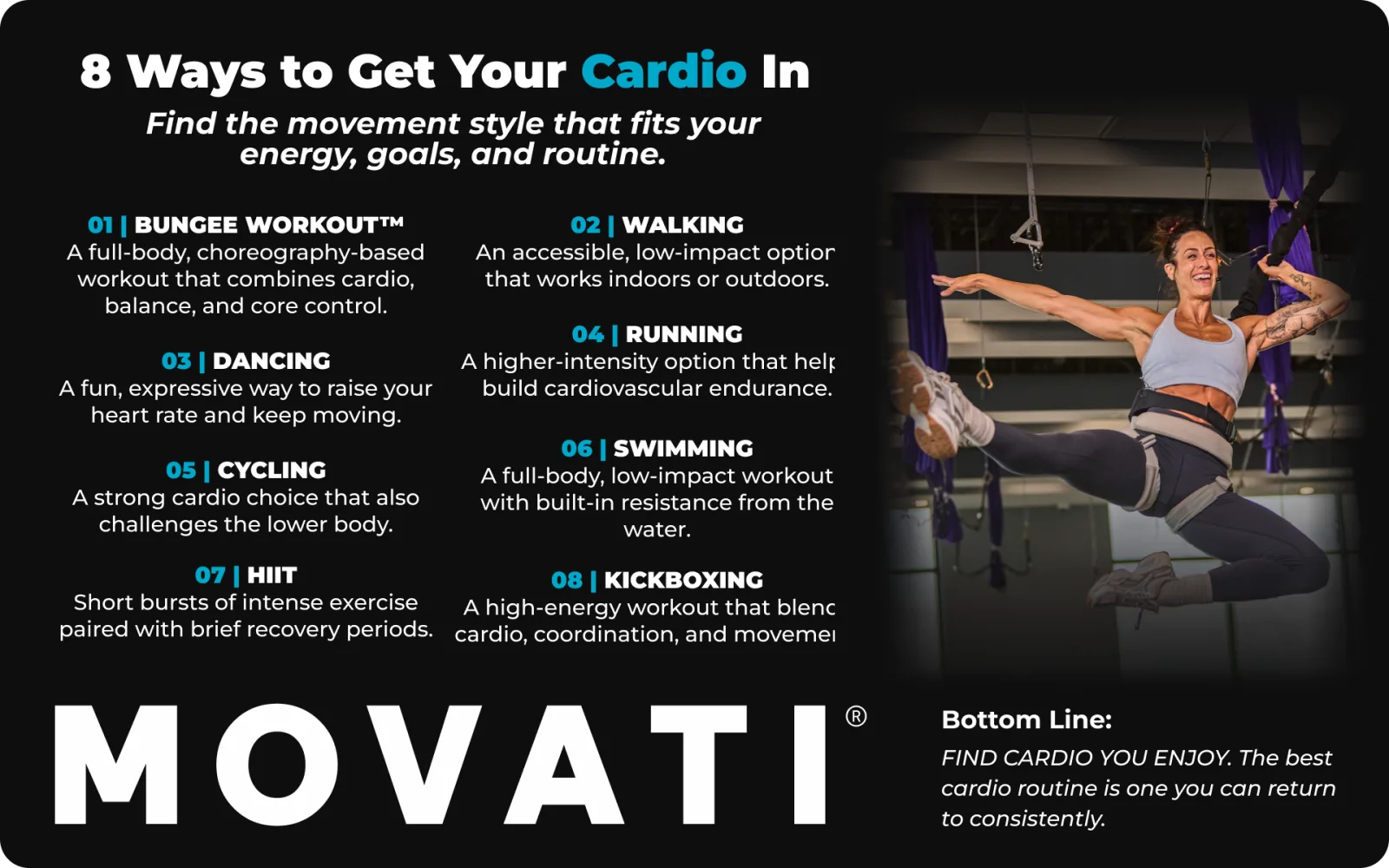
1. Bungee Workout™
With a focus on choreography and supported movement, Bungee Workout™ provides a dynamic full-body experience that combines cardio, balance, coordination, and core engagement. The harness changes how the body moves through space, creating a workout that feels playful while still challenging the cardiovascular system.
MOVATI members can learn more about Bungee Workout™ through the MOVATI Group Fitness program.
2. Dancing
Dancing can be an enjoyable way to incorporate cardio into your routine without making exercise feel repetitive. Dance-based workouts may include movements inspired by Zumba, salsa, hip-hop, ballet, or other choreographed formats.
MOVATI’s BurlesK class is one option for members who enjoy combining movement, music, and group fitness.
3. Walking
Walking is one of the most accessible forms of cardio exercise. It requires little equipment, can be adapted to different fitness levels, and can be performed indoors or outdoors. A brisk walk can elevate your heart rate while remaining relatively low impact. You can increase the challenge by adjusting your pace, distance, incline, or terrain. Walking is also a useful reminder that cardio does not need to feel extreme to count.
4. Running
Running is a higher-impact aerobic activity that can help build cardiovascular endurance. It can be performed on a treadmill, track, road, or trail and adjusted through pace, duration, and interval structure. Beginners do not need to start by running continuously. Alternating between walking and running can be a more approachable way to build endurance gradually.
5. Cycling
Cycling provides cardiovascular exercise while placing less impact on the joints than many running-based activities. You can cycle outdoors, use a stationary bike, or participate in an indoor cycling class. Resistance, pace, and duration can all be adjusted, making cycling suitable for both steady-state cardio and more challenging interval workouts.
6. Swimming
Swimming is a full-body cardio option that combines cardiovascular work with resistance from the water. Because the water supports the body, swimming and aqua fitness can also be appealing to people looking for a lower-impact form of exercise.
MOVATI offers Aqua Fitness classes and open swim opportunities at participating clubs.
7. HIIT
High-Intensity Interval Training, or HIIT, alternates shorter periods of challenging effort with easier recovery periods. A HIIT workout might include cycling, rowing, running, bodyweight exercises, or other cardio-based movements. HIIT can be time-efficient, but it is also more demanding than many steady-state cardio exercises. You do not need to perform HIIT every day to improve cardiovascular fitness.
8. Kickboxing
Cardio kickboxing combines martial arts-inspired movements with aerobic exercise. Punching, kicking, footwork, and combinations can raise your heart rate while also challenging coordination and balance. The intensity can often be modified through speed, range of motion, and impact, making it possible to adapt the workout to different fitness levels.
How Much Cardio Exercise Do You Need?
According to the Canadian 24-Hour Movement Guidelines, adults aged 18 to 64 should accumulate at least 150 minutes of moderate-to-vigorous aerobic physical activity each week. The guidelines also recommend muscle-strengthening activities involving major muscle groups at least twice per week.
That 150-minute target equals about 2.5 hours of moderate-to-vigorous activity across the week. It does not need to come from one type of workout or one long session.
For example, a weekly routine could include 30 minutes of brisk walking, 45 minutes of cycling, 30 minutes of swimming, 20 minutes of HIIT, and 25 minutes of dance-based cardio. Together, those sessions total 150 minutes.
The goal is to accumulate movement in a way that feels realistic enough to maintain.
Moderate vs. Vigorous Cardio Exercises
Understanding intensity can make it easier to choose cardio exercises that match your fitness level and training goals.
Moderate-Intensity Cardio
During moderate-intensity activity, your breathing and heart rate increase, but you can usually still speak in short sentences. Examples can include brisk walking, comfortable cycling, recreational swimming, moderate dance classes, and incline treadmill walking. These workouts can be a useful foundation for building endurance because they are often easier to sustain for longer periods.
Vigorous-Intensity Cardio
Vigorous activity requires more effort. Your breathing becomes heavier, and carrying on a full conversation becomes more difficult. Examples may include running, faster cycling, hard rowing, HIIT, or more intense kickboxing. You do not need to spend every workout at vigorous intensity. Combining easier and harder sessions can create a more balanced and manageable cardio routine.
How to Choose the Right Cardio Exercises
The best exercises are the ones that fit your body, goals, lifestyle, and preferences. Rather than choosing an activity only because it appears difficult or burns a lot of calories, consider whether it is something you can realistically continue.
What Do You Enjoy?
Enjoyment matters because consistency matters. If you dislike running but love swimming, there is no reason your cardio routine needs to revolve around a treadmill. Trying different formats can help you discover forms of movement that you actually look forward to.
What Feels Good on Your Body?
Joint comfort, previous injuries, mobility, and fitness level can influence which activities feel best. Lower-impact options such as swimming, cycling, walking, or elliptical training may feel more comfortable for some people. Your preferred activity can also change over time depending on how your body feels.
What Fits Your Schedule?
Some days may allow time for a full group fitness class, while other days may only leave room for a 20-minute walk. Both can contribute to your weekly activity total. A routine that fits into your actual schedule is generally more sustainable than one that requires perfect circumstances.
What Are You Training For?
Someone preparing for a running event may naturally prioritize running, while someone who wants general cardiovascular fitness may prefer a mix of several cardio exercises. Your routine should reflect what you actually want to improve.
Can Beginners Do Cardio Exercises?
Absolutely. Beginners do not need to jump directly into long workouts or high-intensity sessions. Starting with shorter, manageable sessions can make exercise feel more approachable. A beginner might start with 10 to 20 minutes of walking, easy cycling, a beginner aqua class, low-impact dancing, or short intervals of walking and jogging.
As your endurance improves, you can gradually increase duration, frequency, or intensity. There is no need to increase everything at once.
How Often Should You Do Cardio Exercises?
Your weekly frequency depends on the length and intensity of each workout. Some people prefer longer cardio sessions on three or four days per week, while others find shorter cardio exercises spread across five or six days easier to maintain. Both approaches can work. The important part is allowing enough recovery between more challenging sessions and balancing cardio with other types of exercise.
Should You Combine Cardio and Strength Training?
For most people, cardio and strength training can complement one another. Cardio exercises help develop cardiovascular fitness and endurance, while resistance training supports muscular strength and function. Canadian movement guidelines include both aerobic activity and muscle-strengthening exercise as part of a balanced routine. Your weekly schedule might include cardio on some days, strength training on others, or a combination of both within the same workout.
Cardio for Low-Impact Training
Cardio does not need to involve jumping or running. Lower-impact options can still challenge the cardiovascular system and improve endurance. Swimming, aqua fitness, cycling, elliptical training, rowing, walking, low-impact dance, and incline treadmill walking can all provide effective cardio options. Low impact also does not automatically mean low intensity. Resistance, pace, duration, and incline can still make these workouts challenging.
How to Make Cardio More Enjoyable
A cardio routine is easier to maintain when it does not feel like a chore. Variety can help keep exercise interesting while giving you different ways to challenge your body. You might try a group fitness class, walk outdoors, listen to music or a podcast, train with a friend, alternate between cardio machines, swim instead of run, add short intervals to a steady workout, or experiment with a new class format. Changing the environment or type of cardio exercise can make your routine feel fresh without requiring you to abandon the progress you have already made.
Personal Experience: Variety Makes Cardio Easier to Stick With
One thing I found with cardio is that I am much more likely to stay consistent when I do not force myself to rely on one type of exercise. Some days, a structured workout feels great. Other days, walking, cycling, swimming, or simply choosing a lighter form of movement feels much more realistic. Having different options makes it easier to adjust based on energy, schedule, and how my body feels that day. That flexibility has made cardio feel less like something I have to complete and more like something I can fit naturally into my routine.
Safety Tips for Cardio
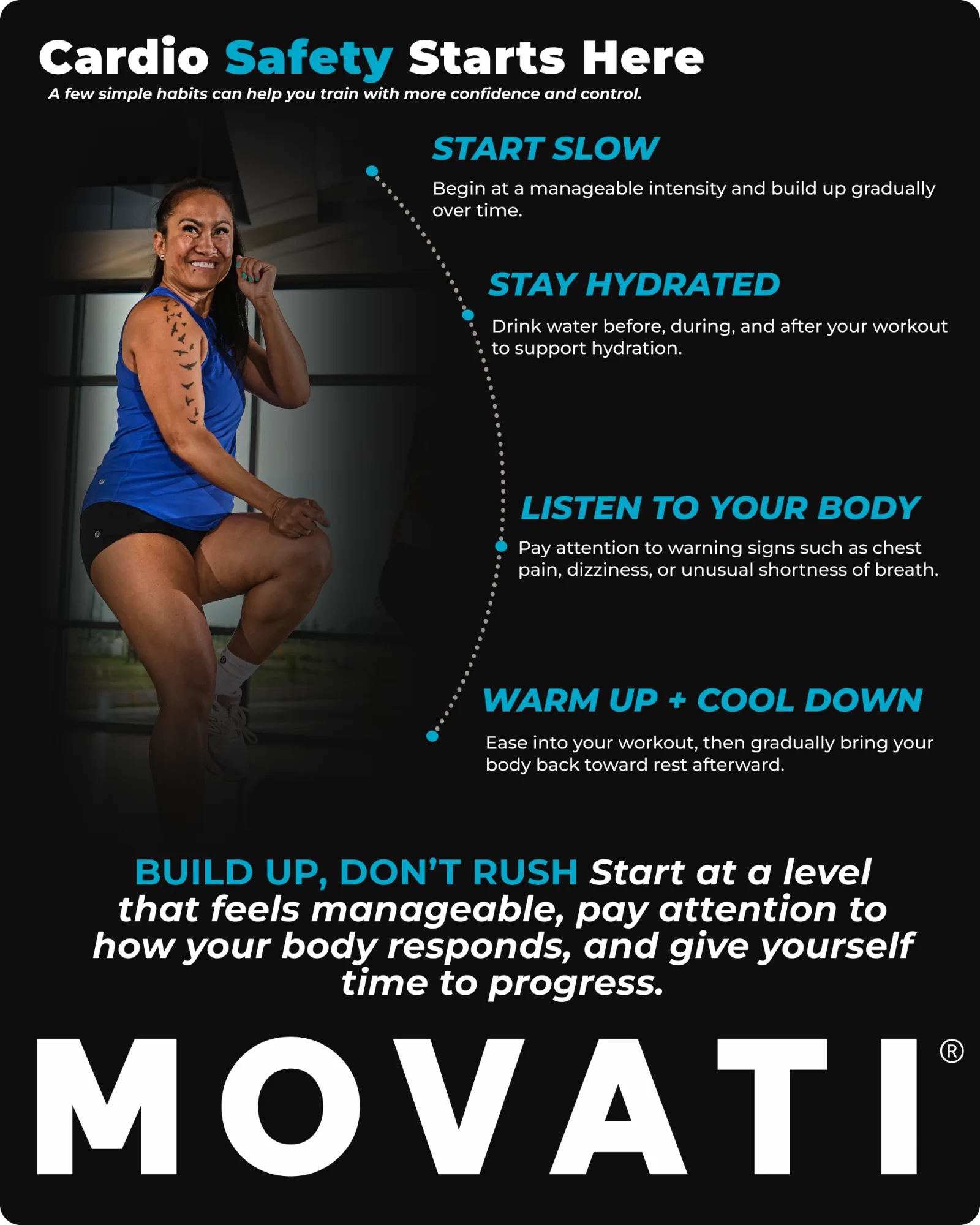
Cardio can be adapted to a wide range of fitness levels, but a few basic habits can help make workouts more comfortable and manageable.
Start Gradually
If you are new to exercise, begin with manageable sessions and increase the challenge over time. You do not need to start at your maximum intensity to make progress.
Stay Hydrated
Drink fluids throughout the day and around your workouts according to your needs. Hydration requirements can change depending on temperature, workout duration, intensity, and how much you sweat.
Listen to Your Body
It is normal for your breathing and heart rate to increase during cardio. However, stop exercising and seek appropriate medical guidance if you experience concerning symptoms such as chest pain, faintness, severe dizziness, or unusual shortness of breath.
Warm Up and Cool Down
Begin with several minutes of easier movement before gradually increasing your effort. At the end of your workout, gradually lower the intensity so your breathing and heart rate have time to settle.
Build Cardio Exercises Into a Routine You Enjoy
Cardio exercises can support cardiovascular fitness, endurance, mood, sleep, and overall well-being, but you do not need to approach cardio the same way every day. Walking counts. Swimming counts. Cycling counts. Dancing counts. Group fitness counts. Canadian guidelines recommend at least 150 minutes of moderate-to-vigorous aerobic activity each week, but how you accumulate those minutes can reflect your lifestyle, goals, and preferences. Experiment with different cardio exercises, find activities you genuinely enjoy, and build your routine gradually.
The most valuable cardio routine is not the one that looks the most impressive. It is the one you can keep coming back to.
Story Credit: Allen Panuncio – Canadian Professional Golf Association, Senior Instructor, Richmond Hill Golf Club
*MOVATI’s trainers and/or consultants are not health care providers, and do not provide any medical diagnosis, treatment or advice, and any trainer and/or consultant tips are not intended to replace the advice of a health care professional.
Join MOVATI Today and get Started with This Special Offer. Already a member? To customize programming and learn more cardio exercises, consult with one of our Personal Trainers in club and complete your Game Plan Session or join seminars with one of our fitness professionals.
