Walk onto the gym floor with a plan, and leg day becomes much easier to start. A pair of dumbbells, a mat and a few well-chosen movements can give your lower body a challenging workout—with plenty of room to progress.
At MOVATI Athletic, the free-weight and strength areas provide a setting to build that routine. Equipment and layouts vary by club, so get familiar with your location and choose a clear space suited to the exercises ahead.
This session combines squats, hip hinges, lunges, bridges and calf raises. You can begin with bodyweight, introduce light resistance as your technique develops, and gradually increase the challenge.
Get ready for your MOVATI leg workout
Keep your setup simple. Choose dumbbells you can lift and return to the rack comfortably, and use a mat for the floor exercise. A mini resistance band is optional.
For your first session, use lighter weights while you learn the movements. The final repetitions should require effort, but you should still be able to control the weight and maintain your position. Reduce the resistance or finish the set if your technique starts to slip.
Warm up for five to eight minutes
Start with an easy walk on a treadmill or a comfortable pace on a stationary bike. Then rehearse the movements you will use:
8–10 bodyweight squats: Lower into a comfortable range and stand smoothly.
8–10 hip hinges: Soften your knees and push your hips back.
5 reverse lunges per side: Take a controlled step back, using stable support if needed.
10 calf raises: Lift and lower your heels slowly.
Finish with a light practice set of your first weighted exercise.
Your dumbbell and bodyweight leg workout
Begin with one or two sets of each exercise. As the session becomes familiar and you recover comfortably, build towards the sets listed below.
Rest approximately 60–90 seconds between sets, taking longer when needed to feel ready for the next effort. Complete your sets before moving to the next exercise; there is no need to reserve several stations.
| Exercise | Sets to build towards | Repetitions |
|---|---|---|
| Goblet squat | 2–3 | 8–12 |
| Dumbbell Romanian deadlift | 2–3 | 8–12 |
| Reverse lunge | 2 | 6–10 per leg |
| Glute bridge | 2 | 10–15 |
| Standing calf raise | 2 | 12–15 |
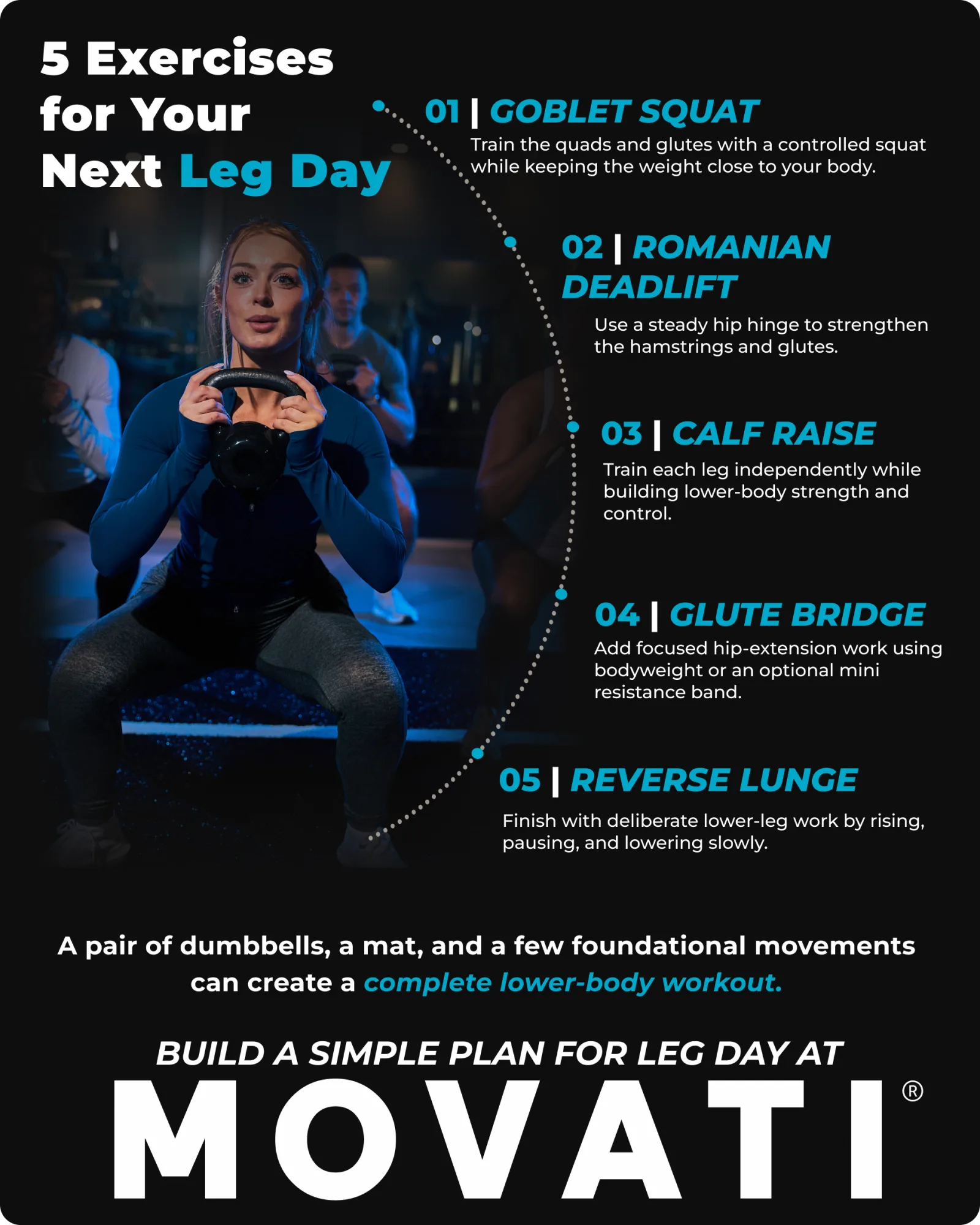
1. Goblet squat
The goblet squat gives you a straightforward way to add resistance to a familiar bodyweight movement.
Hold one dumbbell vertically close to your chest, supporting it securely with both hands. Place your feet around shoulder-width apart, adjusting your stance until it feels comfortable.
Bend at your hips and knees to lower between your feet. Keep your whole foot grounded and let your knees move in line with your toes. Stand smoothly, keeping the dumbbell close to your body.
Start here: Practise without a dumbbell. Use a comfortable depth that allows you to stay balanced.
Add a challenge: Increase the dumbbell weight once you can complete every set with consistent control.
Technique cue: Keep your heels grounded. Squat only as low as you can while maintaining your position.
2. Dumbbell Romanian deadlift
This exercise trains the hip hinge, bringing focused work to the back of your legs and your glutes.
Stand with your feet about hip-width apart and hold a dumbbell in each hand in front of your thighs. Keep a slight bend in your knees.
Push your hips backwards as the dumbbells travel close to your legs. Lower only as far as you can while keeping your back position steady. Stand by bringing your hips forward, finishing upright without leaning back.
Start here: Rehearse the hinge without weights, placing your hands on your hips to feel them move backwards.
Add a challenge: Gradually use heavier dumbbells while keeping the same controlled movement.
Technique cue: Let your hip movement determine the depth. The dumbbells do not need to reach the floor.
3. Reverse lunge
Reverse lunges let you work each leg individually, with bodyweight or added resistance.
Stand tall with your feet hip-width apart. Step one foot backwards, keeping enough space between your feet to stay balanced. Bend both knees and lower through a comfortable range, then push through your front foot to return to standing.
Complete the repetitions on one side before switching, or alternate legs.
Start here: Use bodyweight and light fingertip support on a stable, fixed surface. If stepping feels awkward, try a stationary split squat: keep your feet in a split stance and lower and rise in place.
Add a challenge: Hold a light dumbbell in each hand.
Technique cue: Place your feet as though they are on two parallel tracks, leaving room to balance.
4. Glute bridge
Move to a mat for a floor-based exercise that keeps the setup simple.
Lie on your back with your knees bent and your feet flat on the floor, about hip-width apart. Press through your feet to lift your hips, stopping when your shoulders, hips and knees form a roughly straight line.
Pause briefly, then lower with control. Keep your ribs relaxed and avoid arching your lower back to lift higher.
Start here: Use bodyweight and focus on a smooth lift and lower.
Add a challenge: If a mini band is available, place it above your knees and maintain gentle outward tension. Keep your knees aligned with your feet.
Technique cue: Finish the movement with your glutes rather than trying to gain extra height.
5. Standing calf raise
Finish by giving your calves their own focused work.
Stand on a level floor with your feet about hip-width apart. Use a stable support for balance if needed. Rise onto the balls of your feet, pause briefly and lower your heels slowly.
Start here: Use bodyweight with both feet on the floor.
Add a challenge: Hold a dumbbell in one hand while supporting yourself with the other, or progress to a supported single-leg version.
Technique cue: Make each repetition deliberate. Avoid bouncing through the bottom.
How to make lighter weights challenging
The best starting weight is one you can control. As you become stronger, your workout needs to develop with you.
Record the dumbbell weight, repetitions and sets you complete. When you reach the top of the repetition range across all your sets with steady technique, try the next manageable weight increase. Gradually increasing resistance as an exercise becomes easier is an established way to progress strength training.
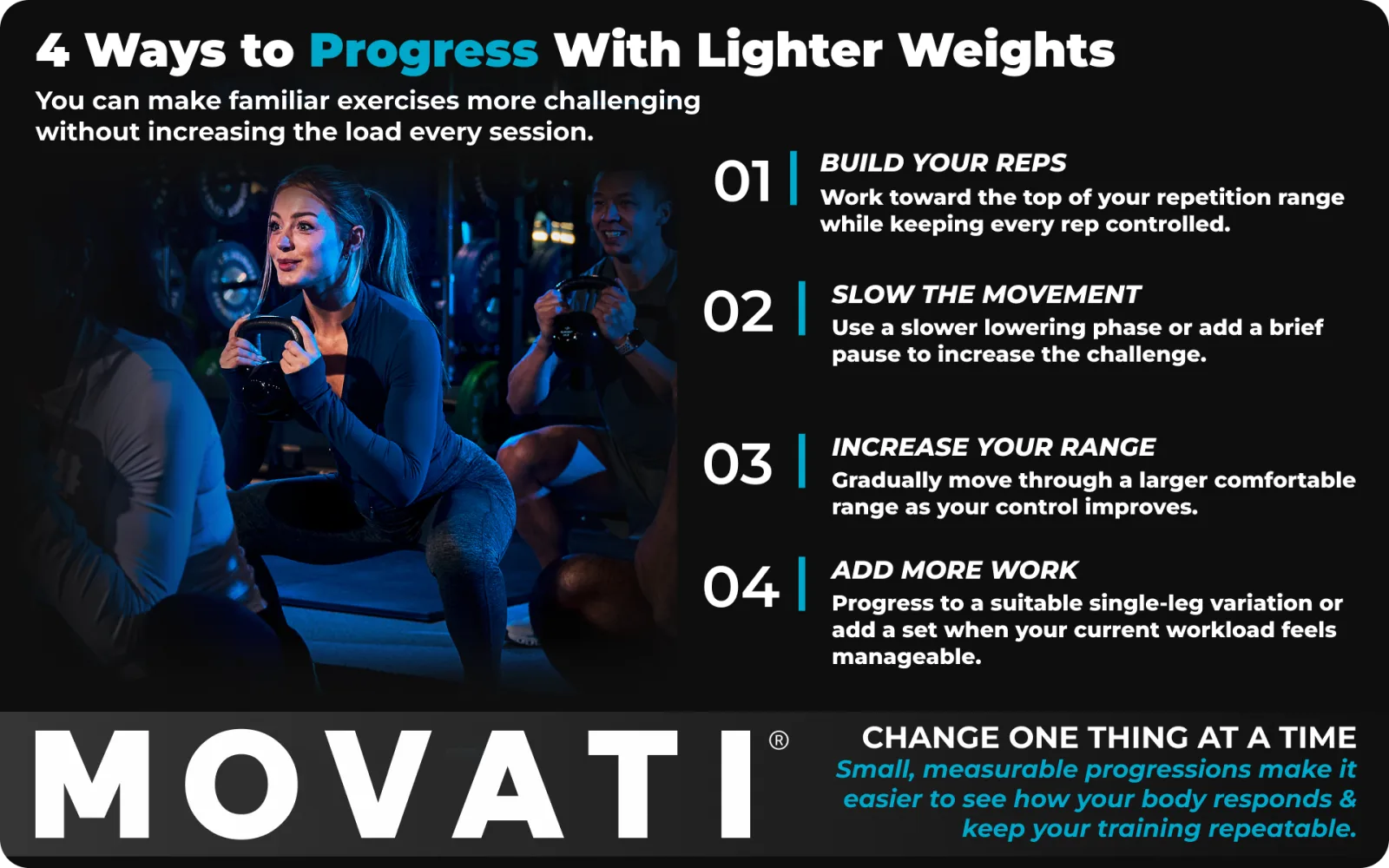
For example, you might begin goblet squats with two sets of eight repetitions. Over several sessions, work towards two sets of 12. Once those feel controlled and repeatable, increase the weight slightly and return to eight repetitions.
When you are using bodyweight or light equipment, you can also:
Lower more slowly.
Add a brief pause.
Gradually increase your comfortable range of motion.
Progress to an appropriate single-leg variation.
Add a set when you are recovering well from your current workload.
Change one thing at a time so you can judge how it affects your workout.
How often should you train your legs?
Two sessions per week can be a practical starting point. Leave at least one full day between challenging workouts for the same muscles, and adjust your schedule around your other activities.
Consider everything your legs are doing during the week. Cycling classes, running, sports and other demanding sessions all contribute to your workload. Start with a routine you can recover from and repeat consistently.
If an exercise causes pain, stop. A MOVATI Coach can help you review your technique and choose suitable movements; persistent or worsening pain warrants assessment by a qualified healthcare professional. MOVATI offers personalized coaching for strength, mobility and performance goals.
Make your next leg day a confident one
On your next visit to MOVATI, bring this five-exercise plan and begin with the versions you can perform comfortably. Give yourself time to learn the movements, record what you complete and build from there.
For help choosing starting weights or adapting the session to your experience, connect with a MOVATI Coach. A clear plan—and a few useful technique cues—can help you make each visit count.
