
Rowing vs SkiErg is less about finding one universally better machine and more about choosing the movement that fits your goal. Both can deliver demanding cardiovascular work, train coordination and build muscular endurance. Rowing spreads the effort across a powerful leg drive and an upper-body finish, while the SkiErg emphasizes a downward pull supported by the core and hips. If you understand that distinction, choosing between them becomes much easier.
Rowing vs SkiErg at a glance
The rower is usually the stronger choice when you want a seated, full-body exercise with substantial lower-body involvement. The SkiErg is useful when you want upright conditioning, more emphasis on the upper body and trunk, or a training option that does not require repeated knee bending through a deep seated position.
- Choose the rower for a leg-driven, full-body stroke and sustained rhythm.
- Choose the SkiErg for an upright pulling pattern that challenges the lats, arms, trunk and hips.
- Use both when variety, balanced conditioning or preparation for mixed-modality events matters.
How does the rowing movement work?
A rowing stroke has four connected phases: the catch, drive, finish and recovery. At the catch, the knees are bent, the torso is slightly forward and the arms are long. The drive begins by pressing through the feet. The hips then open before the handle finishes toward the torso. The recovery reverses that sequence under control.
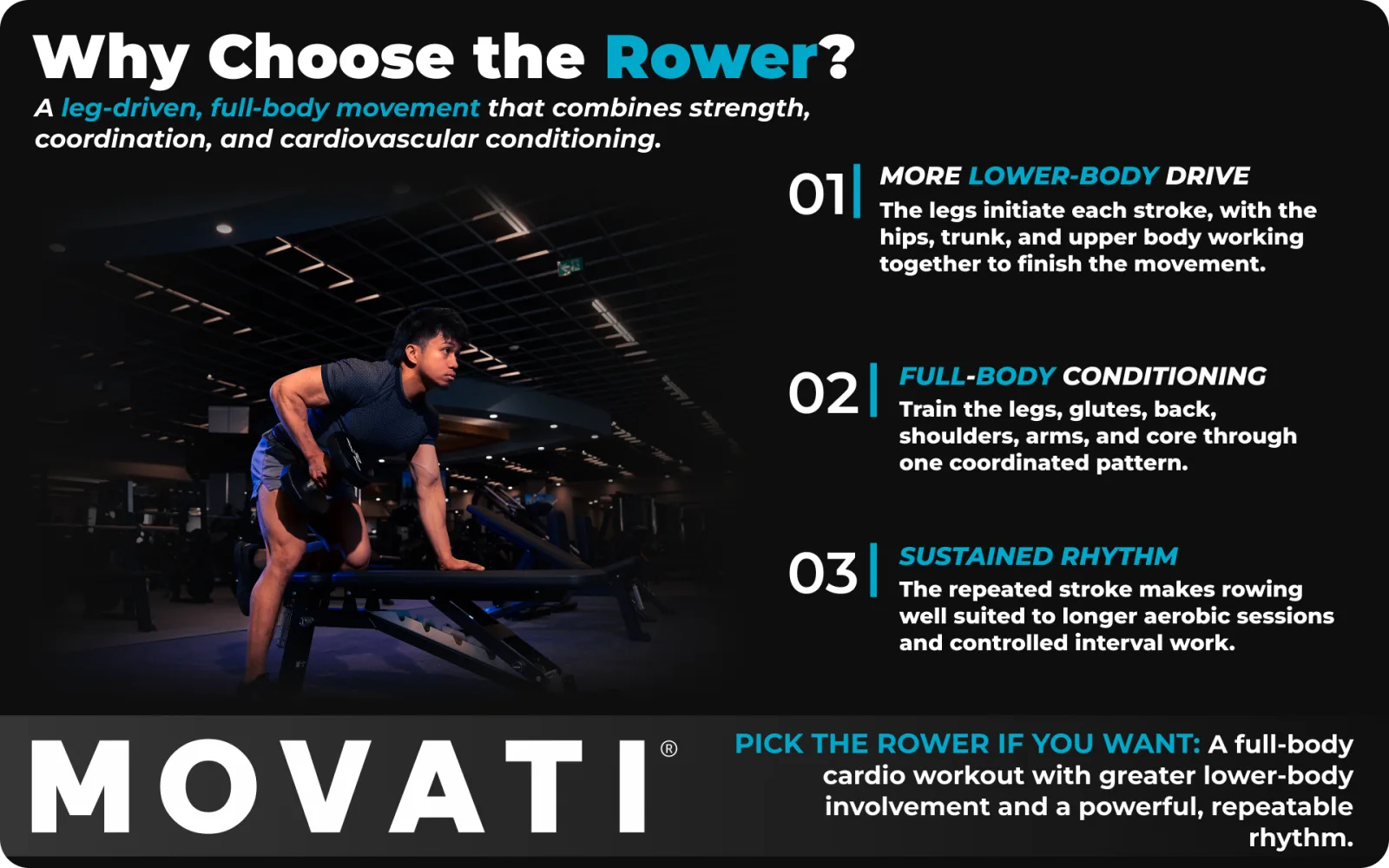
The important detail is that rowing is not an arm exercise with some leg movement added. The legs initiate the drive, the trunk transfers force and the upper body completes the stroke. When those parts work in sequence, the movement feels smooth and powerful rather than rushed.
What muscles does rowing use?
Rowing recruits the legs, glutes, back, shoulders, arms and trunk. Because the stroke repeatedly moves between a compressed and extended position, it also asks for coordination and control through the hips and knees. The resistance may feel strongest in the upper body, but efficient rowing depends heavily on the lower body.
How does the SkiErg movement work?
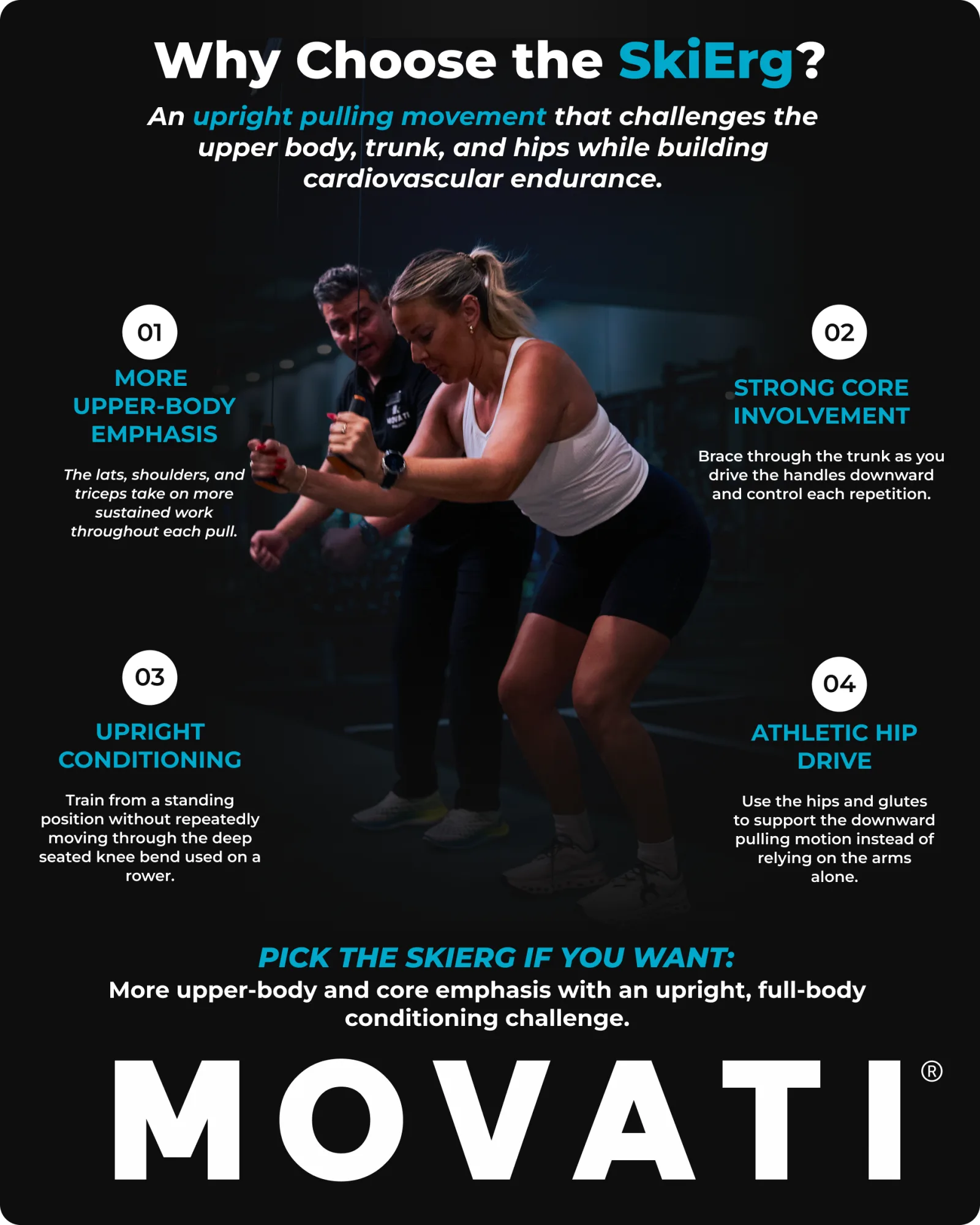
The SkiErg uses a standing double-pole action inspired by cross-country skiing. You begin tall with the handles overhead, then drive them down by engaging the lats, bracing the trunk and hinging slightly at the hips. The arms finish the pull before returning overhead for the next repetition.
A good stroke is not simply a hard triceps push. The torso and hips contribute to the movement, while the shoulders remain controlled. Depending on your stance and technique, the legs can assist, but the machine generally places more sustained demand on the upper body than a rower does.
What muscles does the SkiErg use?
The lats, shoulders, triceps and abdominal muscles do much of the visible work. The glutes and hamstrings support the hip hinge, and the legs help maintain a stable athletic position. This combination makes the machine useful for conditioning the upper body without isolating it from the rest of the body.
Which machine is better for cardio?
Both machines can support aerobic conditioning, interval training and high-intensity efforts. The better cardio option is usually the one on which you can maintain sound technique at the intended effort.
For longer steady sessions, many people find the rower’s repeated leg drive useful for sharing the workload across more muscle groups. The SkiErg can create a strong cardiovascular challenge quickly because the upper body may fatigue sooner. That does not make one machine more effective; it changes how the effort feels and how you should pace it.
Which is better for strength and muscular endurance?
Neither machine replaces progressive resistance training, but each can strengthen a specific pattern through repeated work. Rowing develops endurance in the legs, hips, back and trunk through a coordinated horizontal pull. The SkiErg develops repeated pulling capacity through the lats, arms and core while reinforcing an athletic hip hinge.
If lower-body contribution is a priority, rowing has the advantage. If you want additional pulling volume or upper-body conditioning, the SkiErg may be more useful. Athletes training for events that include both machines should practise each one because efficient technique is highly specific.
How should beginners choose?
Start with your goal, then consider comfort and access. A coach can help you adjust the machine and learn the movement before fatigue makes technique harder.
- General full-body fitness: Begin with the rower, then add the SkiErg for variety.
- Upper-body conditioning: Give the SkiErg more attention while keeping the trunk and hips involved.
- Mixed-modality performance: Train both and practise switching from one movement to another.
- Joint or mobility considerations: Test both at an easy pace and choose the option that allows controlled, comfortable movement. Seek professional guidance when pain or an injury affects your training.
- Enjoyment and consistency: Choose the machine you are more likely to use regularly.
Technique mistakes that waste energy
Common rowing mistakes
- Pulling with the arms before the legs have driven.
- Rushing forward on the recovery and losing rhythm.
- Leaning excessively at the finish.
- Setting the resistance high before learning an efficient stroke.
Common SkiErg mistakes
- Using only the arms and ignoring the trunk and hips.
- Pulling the handles too far behind the body.
- Collapsing through the shoulders or lower back.
- Starting each stroke too fast to maintain control.
Two simple workouts to try
Use a resistance setting that lets you move smoothly. The goal is repeatable technique, not an all-out first interval.
Steady conditioning session
- Warm up gradually for five minutes.
- Complete three rounds of five minutes at a sustainable conversational effort.
- Recover easily for two minutes between rounds.
- Cool down for several minutes.
Rower and SkiErg combination
- Warm up on both machines.
- Row for two minutes at a controlled, challenging pace.
- Transition to the SkiErg for two minutes at a similar effort.
- Rest or move easily for two minutes.
- Repeat for three to five rounds while keeping your technique consistent.
The bottom line
The rower and SkiErg train different expressions of full-body conditioning. Rowing relies more on the legs and a horizontal pulling sequence. The SkiErg places greater emphasis on the upper body, trunk and downward pull. Choose according to your goal, comfort and training context—or use both to build a broader conditioning base. Whichever machine you select, efficient technique and repeatable effort will take you further than resistance settings or frantic pace.
