
Spending years sitting behind a desk can gradually change how your body feels, moves, and responds to physical activity. Long hours working at a computer, limited movement throughout the day, and a lack of regular exercise can contribute to muscle weakness, reduced flexibility, stiffness, and declining physical endurance. These changes don’t necessarily happen overnight. They develop gradually, often becoming noticeable when everyday activities that once seemed effortless begin to feel more challenging. Functional fitness training offers a practical approach to rebuilding physical strength and mobility by focusing on movements that support everyday life.
I understand this experience personally. After spending years working at a desk and living a largely sedentary lifestyle, I’ve come to recognize that becoming physically active again is more than simply starting an exercise program. It’s a recovery process that requires patience, consistency, and an understanding of how years of inactivity can affect the body. Rebuilding strength, improving mobility, and developing endurance take time. For me, the goal isn’t simply to become fitter; it’s about restoring physical capabilities, developing healthier habits, and creating a more active lifestyle that can be maintained over the long term.
The Problem: How a Sedentary Lifestyle Affects Physical Fitness
Modern working environments often encourage prolonged periods of sitting. For individuals who spend much of their careers working at computers, attending meetings, or performing other desk-based activities, physical movement can gradually become a smaller part of everyday life.
While sitting itself isn’t inherently harmful, spending extended periods inactive without sufficient physical activity can contribute to changes in muscular strength, flexibility, cardiovascular conditioning, and overall physical function.
One of the challenges is that these changes can be difficult to recognize as they’re happening. A gradual decline in physical conditioning may not become apparent until you attempt an activity that requires greater strength, balance, or endurance than your normal daily routine.
The Gradual Loss of Strength and Mobility
Muscles adapt to the demands placed upon them. When regular physical activity decreases, the body has fewer reasons to maintain the same levels of muscular strength and endurance.
Over time, individuals who spend much of their day sitting may experience reduced strength in important muscle groups, particularly when their daily routines involve limited walking, lifting, or other physical activities.
The hips, glutes, legs, back, and core all contribute to supporting posture and everyday movement. When these muscles aren’t regularly challenged, activities such as climbing stairs, carrying groceries, or standing for extended periods may begin to require more effort.
Mobility can also become an issue. Spending hours in similar seated positions may contribute to feelings of stiffness in the hips, shoulders, and back. Without regular movement through comfortable ranges of motion, certain activities may begin to feel less natural.
These changes don’t mean that physical abilities are permanently lost. However, rebuilding them generally requires consistent activity and gradual increases in physical demands.
Why Returning to Exercise Can Feel Difficult
One of the most frustrating aspects of returning to fitness after years of inactivity is discovering that your body may not respond the way you remember.
Activities that once felt manageable can suddenly seem demanding. Muscles may fatigue more quickly, cardiovascular endurance may be lower, and unfamiliar movements can require greater concentration and coordination.
There’s also a psychological component to returning to exercise. It’s easy to compare your current abilities with what you could do years earlier or with the performance of individuals who have maintained active lifestyles.
That comparison can create unrealistic expectations.
The important distinction is that returning to physical activity after prolonged inactivity isn’t simply about resuming an old routine. It often involves rebuilding the physical foundation needed to exercise comfortably and consistently.
For someone who has spent years behind a desk, this means recognizing that progress may begin with relatively simple movements rather than demanding workouts.
The Agitation: Why Ignoring Physical Inactivity Can Make Everyday Life More Challenging
The consequences of prolonged inactivity can extend beyond the gym. Reduced strength, mobility, and endurance may influence how comfortably individuals perform everyday activities and participate in recreational interests.
Tasks such as bending to pick something up, carrying heavier objects, walking longer distances, or maintaining balance on uneven surfaces all require different combinations of muscular strength, coordination, and joint mobility.
When physical conditioning declines, these movements can become more demanding.
Everyday Activities Can Require More Effort
Consider how frequently ordinary activities depend on physical strength and movement.
Getting out of a chair requires coordination between the legs, hips, and core. Carrying groceries involves grip strength, upper-body stability, and balance. Climbing stairs challenges the cardiovascular system and lower-body muscles.
These activities may seem insignificant when performed regularly, but they demonstrate how physical fitness supports independence and quality of life.
For individuals returning to exercise after a long sedentary period, improving these fundamental abilities can be just as meaningful as increasing the amount of weight lifted in a gym.
Stiffness and Reduced Mobility Can Become Frustrating
Long periods of inactivity may also contribute to a sense of physical restriction.
Movements such as reaching overhead, rotating the torso, bending at the hips, or getting down to the floor can feel less comfortable when the body hasn’t regularly practiced them.
This can create a difficult cycle. When movement feels uncomfortable or physically demanding, individuals may become less inclined to participate in activities that challenge their mobility.
Reduced activity can then contribute to further deconditioning.
Breaking this cycle doesn’t necessarily require intense exercise. It often begins with introducing manageable movement throughout the day and gradually improving strength and flexibility.
The Challenge of Rebuilding Confidence
Returning to exercise can also involve overcoming uncertainty about physical limitations.
After years of inactivity, it’s natural to question which exercises are appropriate, how much activity is enough, and whether certain movements might cause discomfort.
Trying to progress too quickly can lead to excessive soreness, fatigue, or frustration, making it more difficult to maintain a consistent routine.
This is where a change in perspective becomes valuable.
Rather than viewing fitness as a competition or expecting immediate results, it can be more productive to approach physical conditioning as a gradual process of restoring movement, strength, and confidence.
For me, recognizing that this is a recovery process has changed how I think about exercise. The objective is no longer to push through every workout or measure success solely through intensity. It’s about making consistent improvements while respecting where my body is today.
The Solution: How Functional Fitness Training Helps Rebuild Physical Capability
Functional exercise focuses on developing strength, mobility, balance, and coordination through movements that support everyday activities.
Rather than concentrating exclusively on individual muscles, this approach often uses exercises that involve several muscle groups working together.
The goal is to improve how the body performs practical movements such as squatting, bending, lifting, carrying, pushing, pulling, and rotating.
For individuals returning to physical activity after a sedentary lifestyle, this provides a useful framework for rebuilding overall physical conditioning.
Rebuilding Strength Through Everyday Movement Patterns
Many functional exercises resemble movements performed throughout daily life.
A squat, for example, develops muscles used when standing up from a chair. A carrying exercise challenges the grip, shoulders, and core in ways similar to transporting groceries. Step-ups strengthen the muscles involved in climbing stairs.
These movements can be introduced gradually and modified according to individual abilities.
Someone beginning a fitness routine might start with chair-assisted squats before progressing to bodyweight squats and eventually adding resistance.
Similarly, a person rebuilding upper-body strength might begin with wall push-ups before progressing to more challenging variations.
The emphasis is on developing movement quality and strength progressively rather than immediately performing demanding exercises.
Improving Balance and Stability
Balance is an important component of physical fitness that can receive less attention than strength or cardiovascular endurance.
Everyday activities require the body to maintain stability while standing, walking, changing direction, or carrying objects.
Functional exercises can help improve balance by strengthening supporting muscles and developing better coordination between different parts of the body.
Movements such as supported single-leg stands, step-ups, and controlled lunges challenge stability in practical ways.
For beginners, these exercises can be performed near a wall or sturdy support to provide additional confidence.
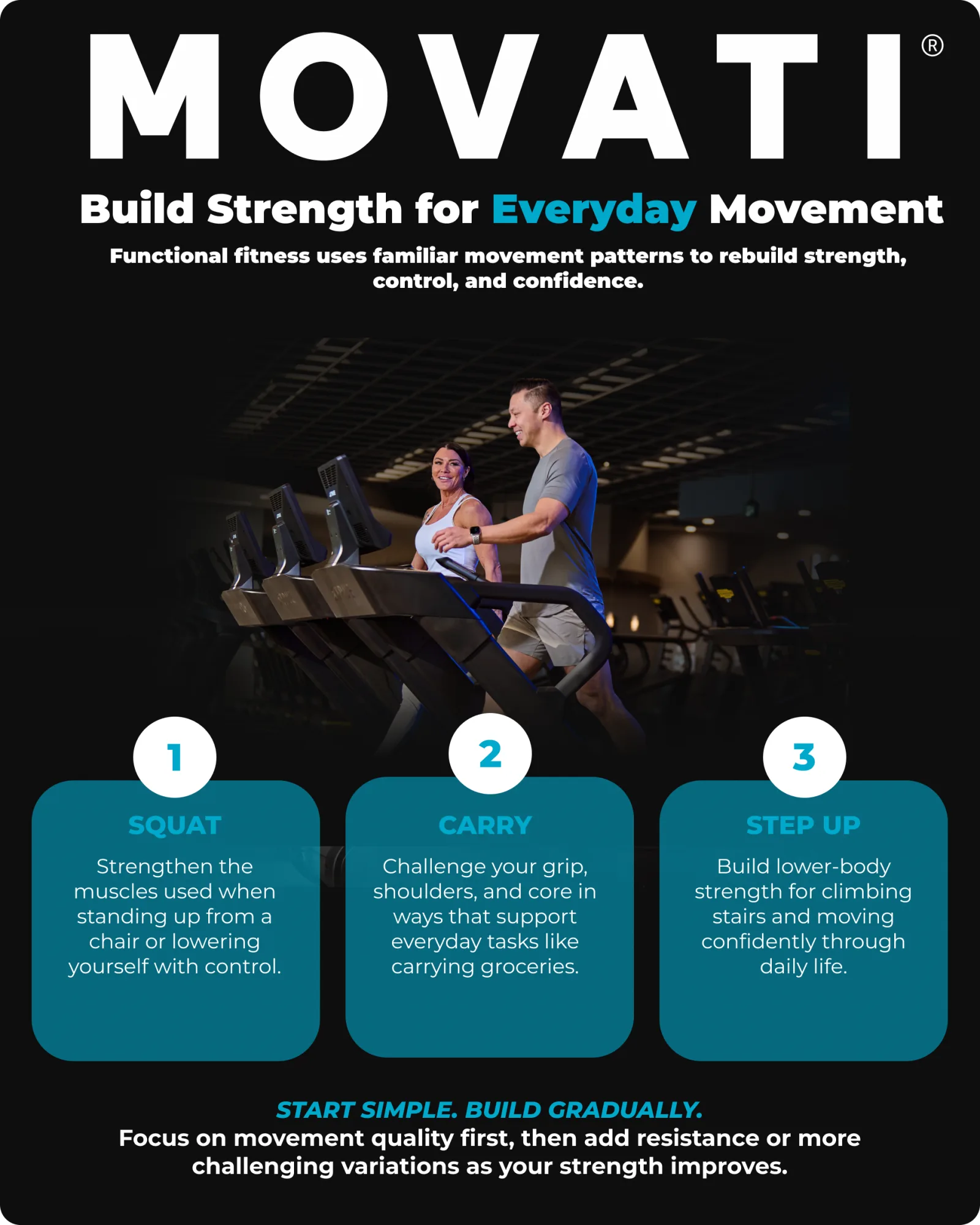
As strength and coordination improve, the movements can gradually become more challenging.
Restoring Mobility and Flexibility
Mobility refers to the ability to move a joint through an available range of motion with appropriate control, while flexibility describes the ability of muscles and other tissues to lengthen.
Both contribute to comfortable, efficient movement.
For individuals who spend considerable time sitting, mobility exercises targeting the hips, shoulders, ankles, and spine may be particularly useful.
Gentle hip movements, controlled torso rotations, shoulder exercises, and dynamic stretching can help prepare the body for more demanding activities.
Improving mobility doesn’t require forcing joints into uncomfortable positions. Consistent, controlled movement within an appropriate range is generally a more sustainable starting point.
Over time, combining mobility exercises with progressive strength training can help individuals develop greater confidence and control during everyday activities.
Developing Muscular Endurance
Muscular endurance is the ability of muscles to perform repeated movements or maintain effort over time.
This becomes important during activities such as walking longer distances, performing household tasks, climbing stairs, or participating in recreational sports.
Functional exercises can help develop endurance through repeated movements performed with manageable resistance.
For example, completing several sets of controlled step-ups, squats, or carrying exercises can gradually improve the ability to sustain physical effort.
As conditioning improves, individuals can increase repetitions, resistance, or exercise duration according to their goals and recovery needs.
Creating a Sustainable Routine After Years of Inactivity
One of the most important considerations when returning to exercise is establishing a routine that can be maintained consistently.
A program that is too demanding may lead to unnecessary fatigue or frustration, while a manageable routine provides opportunities to build confidence and gradually improve physical conditioning.
For someone transitioning from a sedentary lifestyle, the initial objective should be to establish regular movement and develop a foundation of strength, mobility, and endurance.
Start With Movements You Can Perform Comfortably
Beginning with basic exercises allows you to focus on technique and understand how your body responds to physical activity.
Chair squats, supported step-ups, wall push-ups, gentle resistance exercises, and controlled mobility movements can provide an accessible starting point.
These exercises can be adjusted according to your current abilities.
For example, reducing the depth of a squat or using additional support during a balance exercise can make a movement more manageable while still providing benefits.
As strength and confidence improve, the exercises can gradually become more challenging.
Combine Strength, Mobility, and Cardiovascular Activity
A balanced fitness routine should address several aspects of physical conditioning.
Strength exercises help develop the muscles needed for everyday activities, while mobility exercises support comfortable movement through the joints.
Cardiovascular activities such as walking, swimming, or cycling can help improve endurance and support heart health.
Combining these activities throughout the week provides a more comprehensive approach than focusing exclusively on one type of exercise.
For individuals returning to activity, shorter sessions may be easier to manage initially. Over time, workout duration and intensity can increase as conditioning improves.
Make Recovery Part of the Process
Recovery is particularly important when the body is adapting to new physical demands.
Muscle soreness and fatigue can occur when introducing unfamiliar exercises, but excessive discomfort isn’t a requirement for progress.
Allowing sufficient rest between demanding sessions, maintaining proper hydration, getting adequate sleep, and eating a balanced diet all contribute to physical recovery.
It is also important to distinguish ordinary muscle fatigue from pain that may indicate an injury or underlying medical concern.
Persistent or worsening pain should be assessed by an appropriate healthcare professional rather than ignored.
For individuals with existing health conditions or significant physical limitations, guidance from a qualified fitness or healthcare professional can help establish a suitable exercise program.
Measuring Progress Beyond the Gym
One of the most encouraging aspects of rebuilding physical fitness is recognizing improvements in everyday life.
Progress doesn’t always need to be measured through heavier weights, faster running times, or changes in physical appearance.
For someone recovering from years of inactivity, meaningful achievements may include walking farther without becoming tired, climbing stairs more comfortably, standing for longer periods, or experiencing greater confidence during physical activities.
These improvements demonstrate how exercise can contribute to practical, everyday functioning.
Tracking progress through a simple journal or fitness app can help identify changes that might otherwise go unnoticed.
Recording how exercises feel, how frequently you complete them, and whether everyday movements are becoming easier can provide valuable motivation.
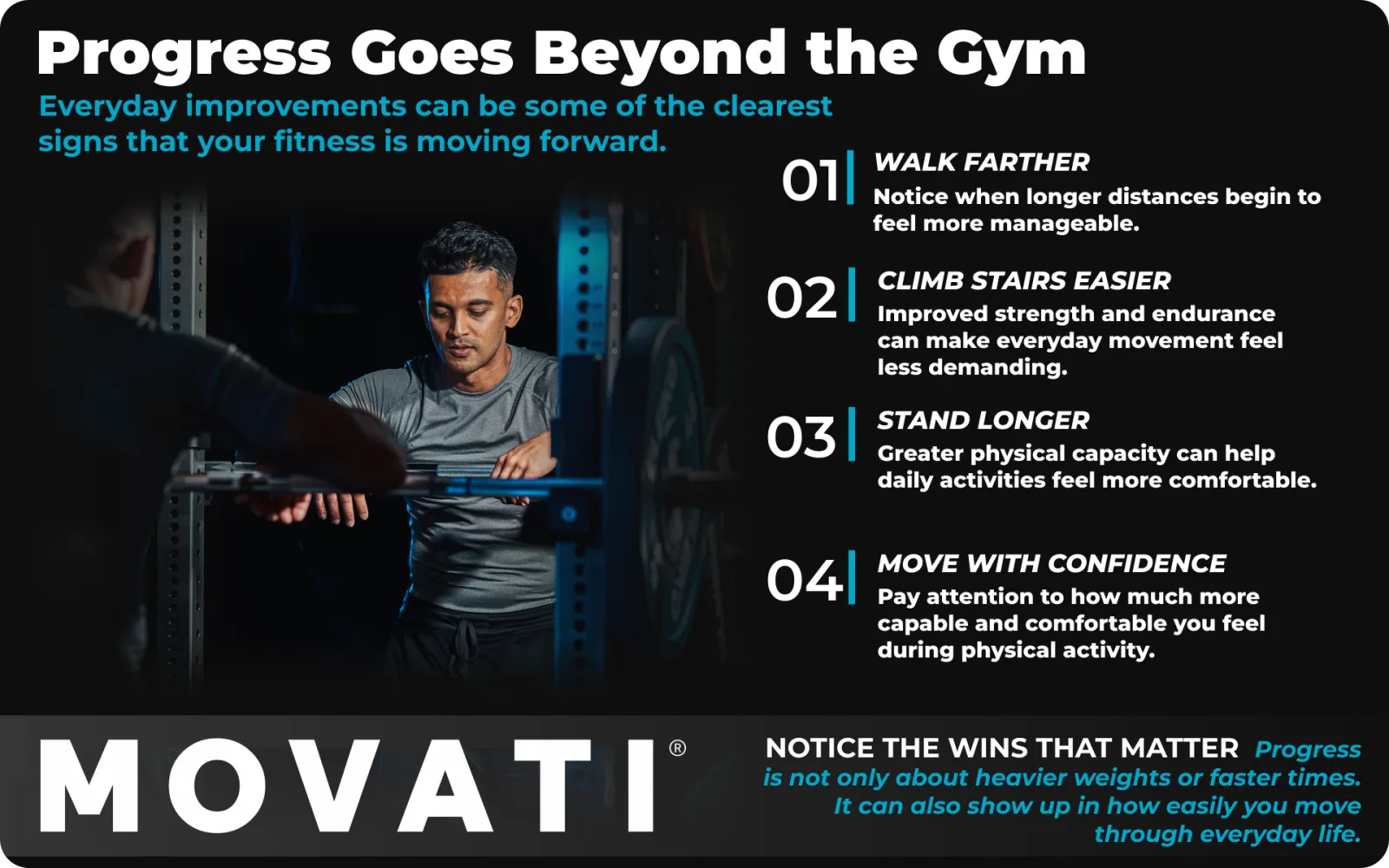
It’s also important to recognize that progress isn’t always linear. Some weeks may feel easier than others, and changes in energy, sleep, stress, or recovery can influence performance.
The goal is to maintain a sustainable pattern of activity rather than expecting continuous improvement with every workout.
A Different Perspective on Fitness and Aging
As we get older, physical fitness often becomes less about appearance and more about maintaining the ability to enjoy life.
Strength, mobility, balance, and cardiovascular conditioning all contribute to the activities that support independence and quality of life.
Whether it’s cycling, travelling, walking through a new city, participating in recreational activities, or simply moving comfortably throughout the day, physical conditioning plays an important role.
After spending years working at a desk, I’ve developed a greater appreciation for the importance of movement and the gradual process of rebuilding physical fitness.
What once might have seemed like a simple decision to exercise has become a broader commitment to improving how my body functions.
The experience has also reinforced the importance of patience. Years of sedentary habits aren’t necessarily reversed through a few weeks of exercise, and expecting immediate results can create unnecessary frustration.
Instead, I view the process as a long-term investment in strength, mobility, and overall health.
Conclusion: Rebuilding Fitness Is a Long-Term Investment
Returning to physical activity after years of inactivity requires patience, consistency, and realistic expectations. Functional fitness training provides a practical approach to rebuilding strength, improving mobility, and developing the physical capabilities needed for everyday life. Rather than focusing exclusively on appearance or athletic performance, it emphasizes movement quality, stability, endurance, and long-term physical independence.
My own experience of spending years behind a desk has helped me recognize that becoming active again is a recovery process, not something that happens overnight. Every improvement in strength, flexibility, balance, or endurance represents progress toward a healthier and more capable body. By starting with manageable movements, allowing time for recovery, and maintaining consistent habits, it’s possible to gradually rebuild physical fitness and develop a more active lifestyle that supports health and well-being for years to come.
*MOVATI’s trainers and/or consultants are not health care providers, and do not provide any medical diagnosis, treatment or advice, and any trainer and/or consultant tips are not intended to replace the advice of a health care professional.
