Whether you’re preparing for a dance class, rehearsing choreography, or getting ready for a performance, properly preparing your body is an important part of dancing safely and confidently. Dance Warm Ups help gradually increase your heart rate, improve circulation, activate important muscle groups, and prepare your joints for the physical demands of movement. From ballet and contemporary dance to hip-hop and ballroom, a consistent warm-up routine can help dancers of all experience levels improve coordination, mobility, and overall performance.
An effective warm-up doesn’t need to be complicated or time-consuming. By combining gentle cardiovascular movements, joint mobility exercises, dynamic stretching, and dance-specific movements, you can prepare your body for more demanding choreography. The following ten exercises offer a practical approach to building a balanced routine that supports flexibility, stability, and physical readiness.
Why Warming Up Before Dancing Matters
Dancing requires a combination of strength, flexibility, balance, endurance, and coordination. Moving directly into demanding choreography without adequate preparation can leave muscles feeling stiff and make certain movements more difficult to perform comfortably.
A structured warm-up gradually prepares your body for activity while helping you transition mentally into your practice or performance.
Some of the most important benefits include:
Improved circulation: Gentle movement increases blood flow to working muscles, helping prepare them for more demanding physical activity.
Greater mobility: Moving joints through comfortable ranges of motion can help improve movement quality and reduce feelings of stiffness.
Better coordination: Practicing controlled movements helps activate the muscles and movement patterns used during dancing.
Increased muscle readiness: Gradually increasing activity prepares muscles for movements such as turns, jumps, extensions, and directional changes.
Improved mental focus: A consistent preparation routine provides time to concentrate on technique, breathing, and upcoming choreography.
Potential injury prevention: Appropriate warm-up activities may help reduce certain injury risks, particularly when combined with proper technique and progressive training.
10 Effective Exercises to Prepare for Dancing
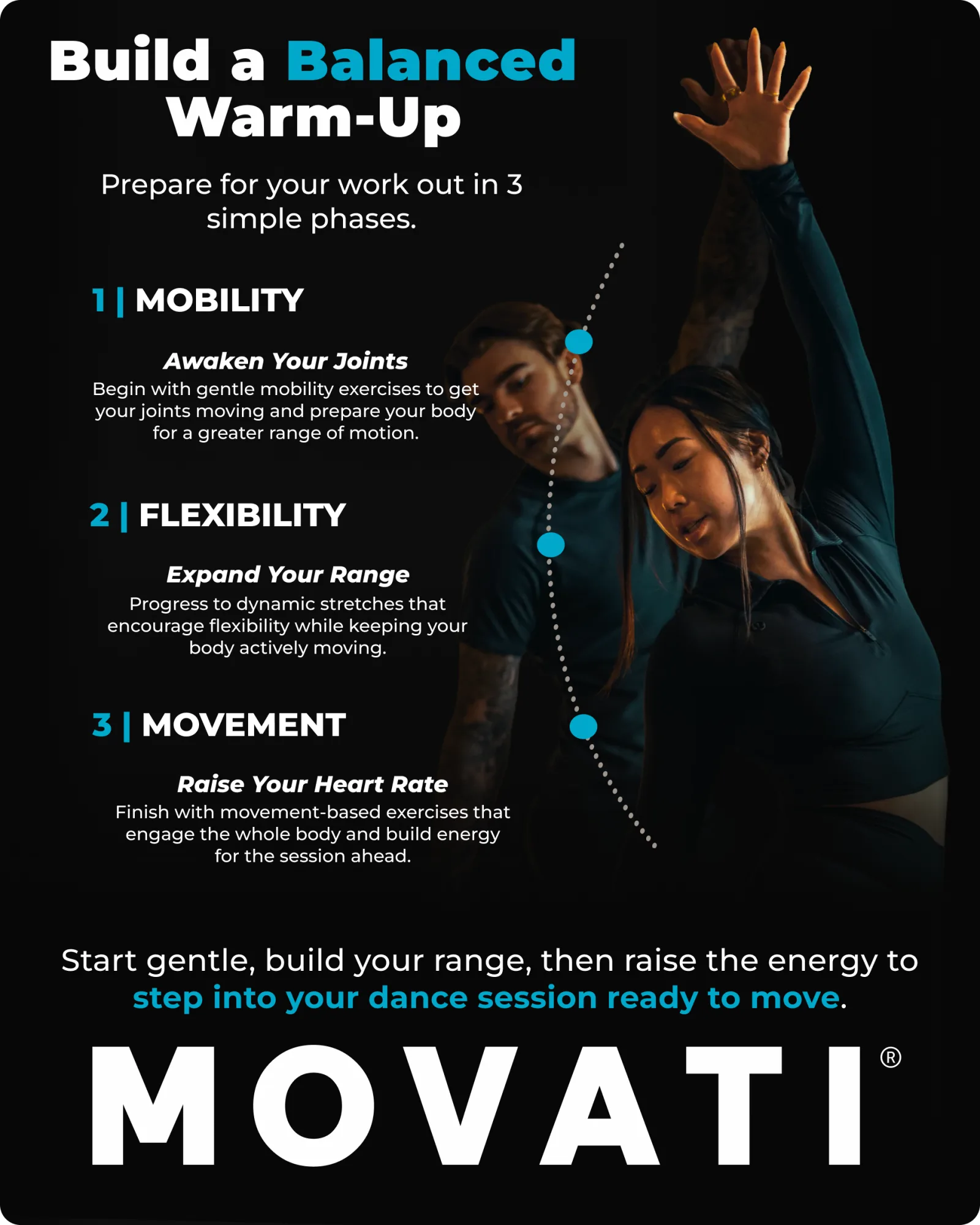
A balanced routine should gradually progress from gentle movements to activities that resemble the demands of your chosen dance style. These exercises can be modified according to your experience, mobility, and physical abilities.
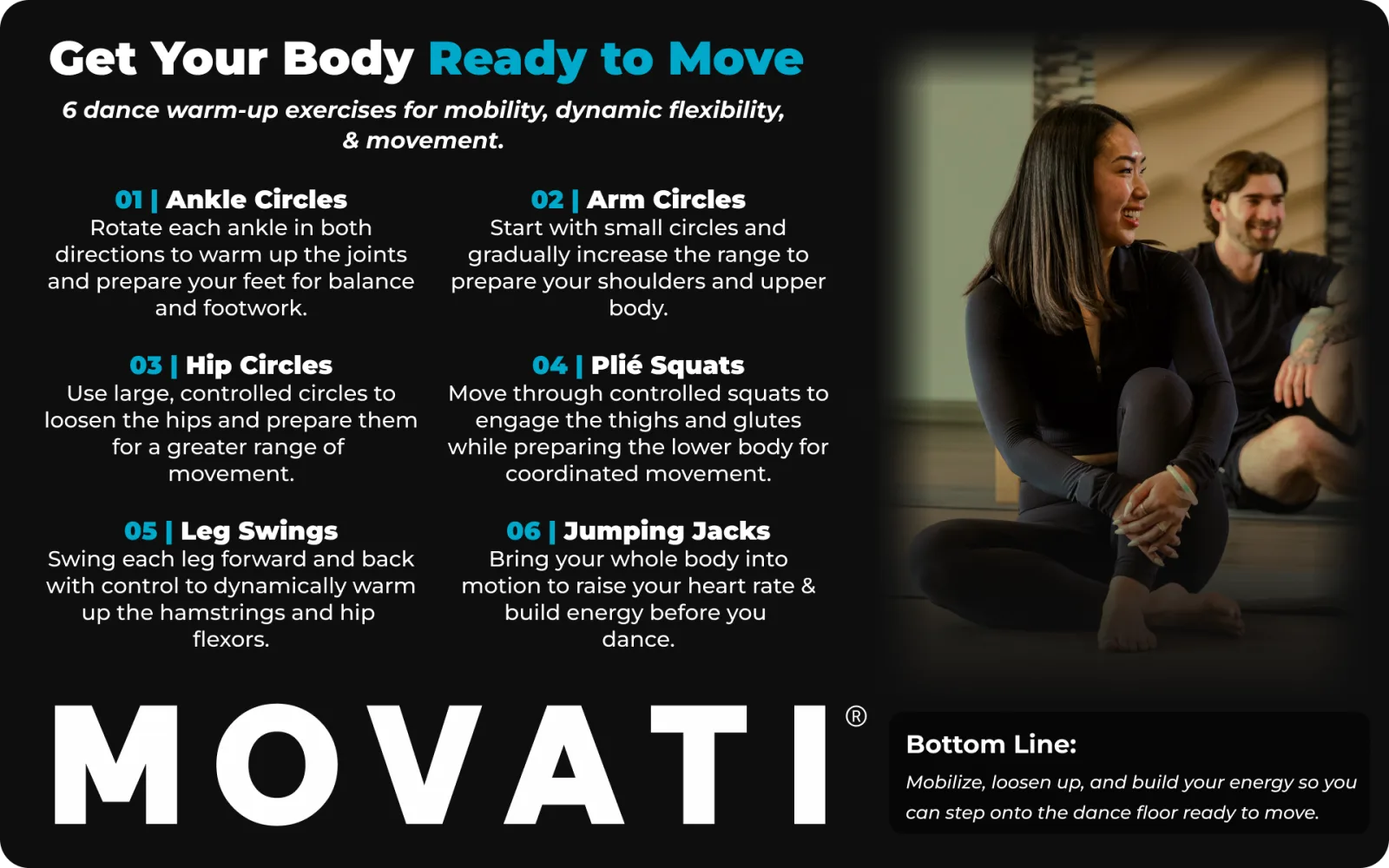
1. Marching in Place to Increase Circulation
Marching in place is a simple way to begin preparing your body for physical activity. It gradually raises your heart rate while engaging the legs, hips, and core without requiring complex movements.
This exercise is particularly useful at the beginning of a warm-up because it allows you to increase your movement intensity at a comfortable pace.
How to perform marching in place:
Stand upright with your feet hip-width apart and shoulders relaxed.
Begin lifting one knee at a time in a comfortable marching motion.
Allow your arms to swing naturally alongside your body.
Gradually increase your pace as your muscles begin to feel warmer.
Continue for approximately 60 to 90 seconds.
Benefits: Encourages circulation, activates lower-body muscles, and prepares the cardiovascular system for more demanding movements.
2. Ankle Circles for Footwork and Stability
Ankle mobility plays an important role in dance movements that involve balancing, turning, jumping, and changing direction. Preparing the ankles can help improve comfort and control during footwork.
Ankle circles encourage gentle movement through the joint’s available range of motion while engaging the muscles responsible for foot and ankle control.
How to perform ankle circles:
Stand beside a wall or sturdy surface for balance.
Lift one foot slightly off the ground.
Slowly rotate your ankle in a controlled circular motion.
Complete 10 to 15 circles in one direction before reversing.
Repeat the movement with your opposite ankle.
Benefits: Promotes ankle mobility, improves awareness of foot positioning, and prepares the lower legs for dance movements.
3. Hip Circles to Improve Lower-Body Mobility
The hips are involved in nearly every dance style, supporting movements such as turns, extensions, lateral steps, and changes in direction.
Hip circles help prepare the surrounding muscles and joints for movement while encouraging better coordination between the pelvis and lower body.
How to perform hip circles:
Stand with your feet approximately shoulder-width apart.
Place your hands on your hips for stability.
Slowly move your hips forward, sideways, backward, and around in a circular motion.
Complete 10 circles in one direction.
Reverse the movement and complete another 10 circles.
Benefits: Encourages hip mobility, reduces feelings of stiffness, and prepares the pelvis for controlled movement.
4. Arm Circles for Shoulder Mobility
Dance often involves expressive arm movements, overhead reaches, coordinated gestures, and upper-body positioning. Preparing the shoulders helps support comfortable movement throughout these activities.
Arm circles are an accessible exercise that gradually increases movement through the shoulder joints.
How to perform arm circles:
Stand upright with your feet hip-width apart.
Extend both arms outward at shoulder height.
Begin making small, controlled circles with your arms.
Gradually increase the size of the circles without forcing the movement.
Complete 15 to 20 circles in each direction.
Benefits: Improves shoulder mobility, activates upper-body muscles, and supports coordination during expressive dance movements.
5. Dynamic Leg Swings for Flexibility and Control
Dynamic leg swings help prepare the hips and surrounding muscles for movements involving leg extensions, kicks, and changes in direction.
Unlike prolonged static stretching, dynamic movements encourage flexibility through controlled motion, making them particularly useful before physical activity.
How to perform leg swings:
Stand beside a wall, ballet barre, or sturdy support.
Keep your supporting leg slightly bent.
Swing your opposite leg gently forward and backward.
Begin with a small range of motion and gradually increase it as comfortable.
Complete 10 to 15 swings before switching legs.
You can also perform controlled side-to-side swings to prepare the hips for lateral movements.
Benefits: Encourages dynamic flexibility, activates the hip muscles, and prepares the legs for extensions and controlled kicks.
6. Standing Torso Rotations for Spinal Mobility
Many dance styles require controlled rotation through the upper body, particularly during turns, directional changes, and expressive choreography.
Gentle torso rotations help prepare the muscles surrounding the spine while encouraging coordinated movement between the shoulders, trunk, and hips.
How to perform torso rotations:
Stand with your feet shoulder-width apart and knees slightly bent.
Hold your arms comfortably in front of your body.
Slowly rotate your upper body toward one side.
Return to the centre before rotating in the opposite direction.
Repeat for 10 to 15 controlled rotations per side.
Avoid forcing the movement or twisting beyond your comfortable range.
Benefits: Encourages spinal mobility, activates core muscles, and supports controlled rotational movements.
7. Plié Squats for Lower-Body Activation
Pliés are commonly associated with ballet but can benefit dancers across many styles. They involve controlled bending and straightening of the knees while maintaining proper posture and alignment.
This movement activates the quadriceps, glutes, and other lower-body muscles involved in balance, jumping, and controlled landings.
How to perform plié squats:
Stand with your feet slightly wider than hip-width apart.
Turn your toes outward only as far as your natural hip mobility comfortably allows.
Keep your chest lifted and spine in a neutral position.
Slowly bend your knees, keeping them aligned with your toes.
Return to standing and repeat for 10 to 15 repetitions.
Benefits: Activates lower-body muscles, supports knee and hip control, and prepares the legs for bending and extending movements.
8. Calf Raises for Ankle Strength and Balance
Strong, responsive calf muscles are important for movements involving rising onto the balls of the feet, balancing, and preparing for jumps.
Calf raises provide a controlled way to activate the lower legs while practicing balance and ankle stability.
How to perform calf raises:
Stand upright with your feet hip-width apart.
Hold a wall or ballet barre for support if needed.
Slowly lift your heels off the ground.
Pause briefly at the top of the movement.
Lower your heels with control and repeat 10 to 15 times.
Benefits: Activates the calf muscles, encourages ankle stability, and prepares the lower legs for balance and footwork.
9. Jumping Jacks to Increase Heart Rate
Jumping jacks provide a full-body movement that can help increase circulation and prepare the cardiovascular system for more energetic dance routines.
They are particularly useful before choreography involving repeated steps, quick transitions, or jumps.
How to perform jumping jacks:
Stand with your feet together and arms relaxed at your sides.
Jump lightly while moving your feet apart.
Simultaneously raise your arms overhead.
Jump back to your starting position.
Continue for 30 to 60 seconds at a manageable pace.
For a gentler alternative, step one foot outward at a time while raising your arms instead of jumping.
Benefits: Raises heart rate, engages multiple muscle groups, and prepares the body for more energetic movement.
10. Dance-Specific Movement Rehearsal
The final stage of your warm-up should introduce movements that resemble the choreography or dance style you’re preparing to perform.
Practicing familiar steps at a slower pace helps connect physical preparation with coordination, timing, and technique.
How to perform movement rehearsal:
Begin with basic steps associated with your chosen dance style.
Practice simple directional changes and weight transfers.
Introduce controlled turns or extensions when appropriate.
Gradually increase movement speed and complexity.
Finish with a short sequence that resembles your upcoming choreography.
For example, ballet dancers might practice gentle tendus and pliés, while hip-hop dancers could incorporate basic grooves, step combinations, and rhythmic movements.
Benefits: Improves coordination, reinforces technique, and prepares the body and mind for the specific demands of your dance session.
How to Build a Balanced 10-Minute Warm-Up Routine
Combining several exercises into a structured sequence can help ensure your body is prepared without spending excessive time warming up.
The following example provides a practical starting point for a general dance class or rehearsal.
| Exercise | Duration |
|---|---|
| Marching in place | 1 minute |
| Ankle and hip circles | 2 minutes |
| Arm circles and torso rotations | 1 minute |
| Dynamic leg swings | 2 minutes |
| Plié squats and calf raises | 2 minutes |
| Jumping jacks or step jacks | 1 minute |
| Dance-specific movements | 1 minute |
This routine can be extended or modified depending on the intensity of your upcoming activity. More demanding sessions, particularly those involving repeated jumps, lifts, or advanced choreography, may require additional preparation.
Common Warm-Up Mistakes to Avoid
Even experienced dancers can develop habits that make their preparation less effective. Recognizing these mistakes can help improve the quality of your routine.
Skipping the warm-up entirely: Beginning demanding choreography without gradually increasing activity may leave your body less prepared for movement.
Moving too aggressively: Forcing stretches or immediately performing explosive movements can place unnecessary stress on muscles and joints.
Rushing through exercises: Controlled movements are generally more useful than completing repetitions quickly without attention to technique.
Ignoring certain muscle groups: Focusing exclusively on the legs while neglecting the shoulders, core, or ankles may leave important areas insufficiently prepared.
Holding deep static stretches too long: Prolonged static stretching immediately before explosive activity may temporarily reduce performance in some circumstances. Dynamic movements are generally better suited to the main warm-up.
Ignoring discomfort: Sharp pain or unusual symptoms should not be treated as a normal part of warming up. Modify or stop movements that cause pain.
Adjusting Your Routine for Different Dance Styles
Although the fundamentals of physical preparation remain similar, different styles of dance place unique demands on the body.
Ballet: Prioritize ankle mobility, calf activation, hip control, pliés, and gentle movements that prepare the legs for extensions and turns.
Contemporary dance: Include spinal mobility, controlled floor transitions, dynamic stretching, and exercises that prepare the body for changes in level and direction.
Hip-hop: Emphasize rhythmic movement, shoulder mobility, lower-body activation, and gradual cardiovascular preparation for energetic choreography.
Ballroom dancing: Focus on posture, ankle mobility, coordinated weight transfers, and movements that prepare the hips and upper body for partnered dancing.
Jazz dance: Incorporate dynamic leg movements, core activation, controlled turns, and progressive preparation for kicks and jumps.
Adapting your routine to the movements you’ll be performing can make your preparation more relevant and effective.
Conclusion
Developing a consistent approach to Dance Warm Ups can make a meaningful difference in how your body feels and performs during classes, rehearsals, and performances. By combining joint mobility, dynamic stretching, muscle activation, and dance-specific movements, you can gradually prepare for physical activity while improving coordination and movement confidence. Whether you’re a beginner learning foundational steps or an experienced dancer refining advanced choreography, taking time to warm up supports a safer, more comfortable, and more rewarding dance experience.
*MOVATI’s trainers and/or consultants are not health care providers, and do not provide any medical diagnosis, treatment or advice, and any trainer and/or consultant tips are not intended to replace the advice of a health care professional.
