
Creating an effective fitness routine involves more than choosing exercises and deciding how often to visit the gym. The way you organize your training sessions can influence muscle development, strength, recovery, and long-term progress. A workout split provides a structured approach to exercise by distributing different muscle groups or training activities throughout the week. Whether you’re beginning your fitness journey or looking to improve an established routine, understanding how to organize your workouts can help you train more effectively and achieve your goals.
Understanding How to Structure Your Weekly Training
A structured training schedule determines which muscle groups you exercise on specific days and how frequently you train them throughout the week. Rather than approaching every gym session without a plan, organizing your routine allows you to balance strength training, recovery, and overall physical conditioning.
For example, some individuals prefer exercising their entire body during each gym visit, while others dedicate separate days to upper-body and lower-body training. Both approaches can be effective when they include appropriate exercise selection, training volume, and recovery time.

The primary advantage of organizing your workouts is consistency. Following a structured schedule makes it easier to track progress, gradually increase resistance, and ensure that major muscle groups receive sufficient attention. It can also help prevent overtraining by allowing adequate recovery between demanding sessions.
Common Types of Training Schedules
There are several ways to organize a weekly fitness routine, each offering advantages depending on your experience, goals, and available time. Understanding the differences can help you select an approach that supports your lifestyle and encourages long-term progress.
Full-Body Training
Full-body training involves exercising all major muscle groups during a single workout session. These routines typically include compound movements such as squats, presses, rows, and other exercises that engage multiple muscles simultaneously.
This approach is particularly beneficial for beginners because it provides frequent opportunities to practice fundamental movements and develop overall strength. It is also convenient for individuals who can only visit the gym two or three times per week.
A typical schedule might involve training on Monday, Wednesday, and Friday, allowing recovery days between sessions. By engaging the entire body several times throughout the week, individuals can develop balanced strength while maintaining a manageable fitness routine.
Upper-Body and Lower-Body Training
An upper-body and lower-body training schedule separates exercises into two categories. Upper-body sessions focus on muscles such as the chest, back, shoulders, and arms, while lower-body sessions target the quadriceps, hamstrings, glutes, and calves.
This structure allows individuals to dedicate more time to specific muscle groups without requiring lengthy full-body sessions. It also provides opportunities to increase training volume while maintaining a balanced approach to recovery.
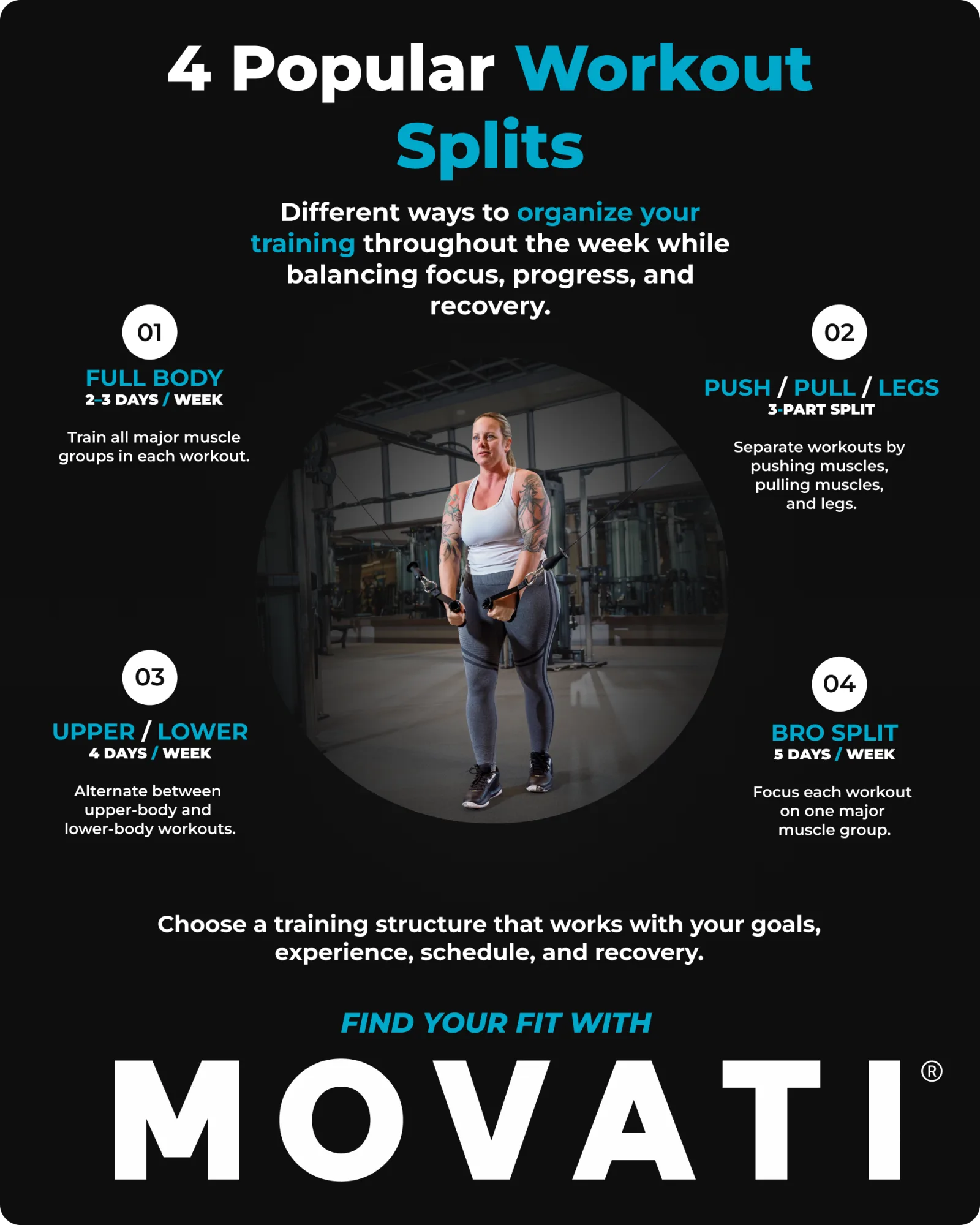
Many individuals follow a four-day schedule, alternating between upper-body and lower-body workouts. For example, Monday and Thursday might focus on upper-body exercises, while Tuesday and Friday are dedicated to lower-body training.
This approach is suitable for individuals who have developed basic strength training experience and want to progress toward more challenging routines.
Push, Pull, and Legs Training
Push, pull, and legs training organizes exercises according to the movement patterns and muscle groups involved.
Push sessions focus on movements that extend the arms away from the body, primarily targeting the chest, shoulders, and triceps. Pull sessions emphasize exercises that bring resistance toward the body, engaging the back and biceps. Leg sessions concentrate on developing lower-body strength through movements such as squats, lunges, and leg presses.
This approach is popular among intermediate and experienced fitness enthusiasts because it provides flexibility in exercise selection and training volume.
Depending on individual goals and recovery needs, the schedule can be performed across three to six training days per week. A three-day routine provides one dedicated session for each category, while a six-day schedule allows each category to be trained twice weekly.
Body-Part Focused Training
Body-part focused training, sometimes referred to as a bro split, dedicates individual workout sessions to specific muscle groups. A traditional five-day schedule might assign separate days to the chest, back, shoulders, legs, and arms.
This approach allows individuals to concentrate on a particular muscle group during each session, incorporating multiple exercises that target different areas of the same muscles.
It is commonly used by experienced weightlifters and bodybuilders who want to prioritize muscular development and dedicate additional attention to specific areas.
However, training each muscle group only once per week is not necessarily more effective for muscle growth than distributing the same weekly training volume across multiple sessions. The best results depend on factors such as exercise intensity, total training volume, consistency, and adequate recovery.
How to Choose the Right Training Schedule
Selecting an effective exercise routine involves considering your personal fitness objectives, experience, lifestyle, and ability to recover between sessions. Rather than following a program simply because it is popular, choosing a schedule that fits your individual circumstances can lead to better consistency and long-term results.
Identify Your Fitness Goals
Your fitness goals should guide how you organize your training sessions. Someone interested in improving general health may benefit from a combination of full-body strength training and cardiovascular activity, while an individual focused on muscle development may prefer a schedule that provides additional training volume for specific muscle groups.
If building strength is your primary objective, incorporating compound exercises such as squats, deadlifts, rows, and presses can help develop multiple muscle groups efficiently.
For individuals interested in muscular development, selecting a schedule that provides sufficient weekly training volume and opportunities for progressive overload is particularly important.
Regardless of your objective, establishing clear and realistic goals will help you choose exercises and monitor your progress.
Consider Your Fitness Experience
Experience plays an important role in determining how much training volume and complexity your routine should include.
Beginners often benefit from simpler programs that emphasize proper technique, controlled movements, and gradual increases in resistance. Full-body routines provide an opportunity to practice essential exercises several times per week while developing a foundation of strength and coordination.
As individuals become more experienced, they may benefit from increasing training volume or dedicating additional time to specific muscle groups.
However, more complicated schedules do not automatically produce better results. A consistent, well-designed routine that matches your abilities is generally more valuable than an advanced program that is difficult to maintain.
Evaluate Your Weekly Availability
An effective fitness routine should fit comfortably into your schedule rather than create unnecessary pressure or interfere with other responsibilities.
Individuals with limited availability may find that two or three full-body sessions per week provide an efficient way to maintain strength and improve overall fitness.

Those who can commit to four weekly sessions might prefer alternating upper-body and lower-body training. Individuals with additional time and experience may explore more specialized routines.
The important consideration is choosing a schedule you can follow consistently. A manageable routine performed regularly is more likely to produce lasting improvements than an ambitious program that becomes difficult to sustain.
Prioritize Recovery and Rest
Recovery is an essential component of any successful strength training program. During exercise, muscles experience physical stress that stimulates adaptations in strength and endurance. Adequate recovery allows the body to respond to these demands and prepare for future training sessions.
The amount of recovery required depends on exercise intensity, training volume, experience, sleep quality, and individual physical condition.
Allowing approximately 48 hours between demanding sessions for the same muscle groups is a useful starting guideline, although recovery needs vary.
Incorporating rest days, maintaining proper hydration, eating a balanced diet, and getting sufficient sleep can support muscle recovery and overall performance.
Paying attention to persistent soreness, unusual fatigue, or declining performance can also help identify when your training routine may need adjustment.
Tips for Building a Sustainable Fitness Routine
Developing a successful training program requires consistency, patience, and a willingness to make adjustments as your fitness improves.
Begin by selecting a manageable number of weekly sessions and focusing on exercises that support your goals. Gradually increasing resistance, repetitions, or training volume can help promote continued improvements without introducing unnecessary physical strain.
Tracking your workouts can also provide valuable insight into your progress. Recording exercises, weights, repetitions, and how you feel during each session makes it easier to identify improvements and determine when adjustments are appropriate.
Variety can help maintain motivation, but frequently changing your entire routine may make progress more difficult to measure. Maintaining a consistent foundation of exercises while introducing occasional adjustments can provide a balance between structure and enjoyment.
Finally, remember that fitness is a long-term commitment. Your routine should be flexible enough to accommodate changes in your schedule, energy levels, and personal goals.
In summary
Choosing the right workout split can help create a more organized, effective, and enjoyable approach to strength training. Whether you prefer full-body sessions, upper-body and lower-body training, or a more specialized routine, the most important factors are consistency, appropriate training volume, and sufficient recovery. By selecting a program that aligns with your fitness goals, experience, and lifestyle, you can build a sustainable foundation for improved strength, muscular development, and long-term physical well-being.
*MOVATI’s trainers and/or consultants are not health care providers, and do not provide any medical diagnosis, treatment or advice, and any trainer and/or consultant tips are not intended to replace the advice of a health care professional.
