Enhance your Golf Game: 5 Pilates Exercises to Support Strength, Rotation, and Control
Are you looking to enhance your golf game? Pilates may be a surprising place to start because Golf and Pilates have more in common than one might expect. Both require concentration, body awareness, coordination, balance, and the ability to control small changes in alignment. In golf, even a subtle shift in posture or rotation can affect how efficiently you move through your swing. Pilates can help golfers become more aware of those details while building the strength and mobility needed to support them.
A golf swing involves the entire body. The hips rotate, the core helps transfer force, the upper body turns, and the legs provide stability throughout the movement. When one area feels stiff, weak, or difficult to control, another area may compensate. Pilates focuses on controlled movement, posture, breathing, stability, and mobility, making it a useful complement to golf-specific training. Below are five Pilates exercises that can help golfers build strength, improve movement quality, and develop greater awareness of how their body moves through a swing.
Why Is Pilates Good for Golfers?
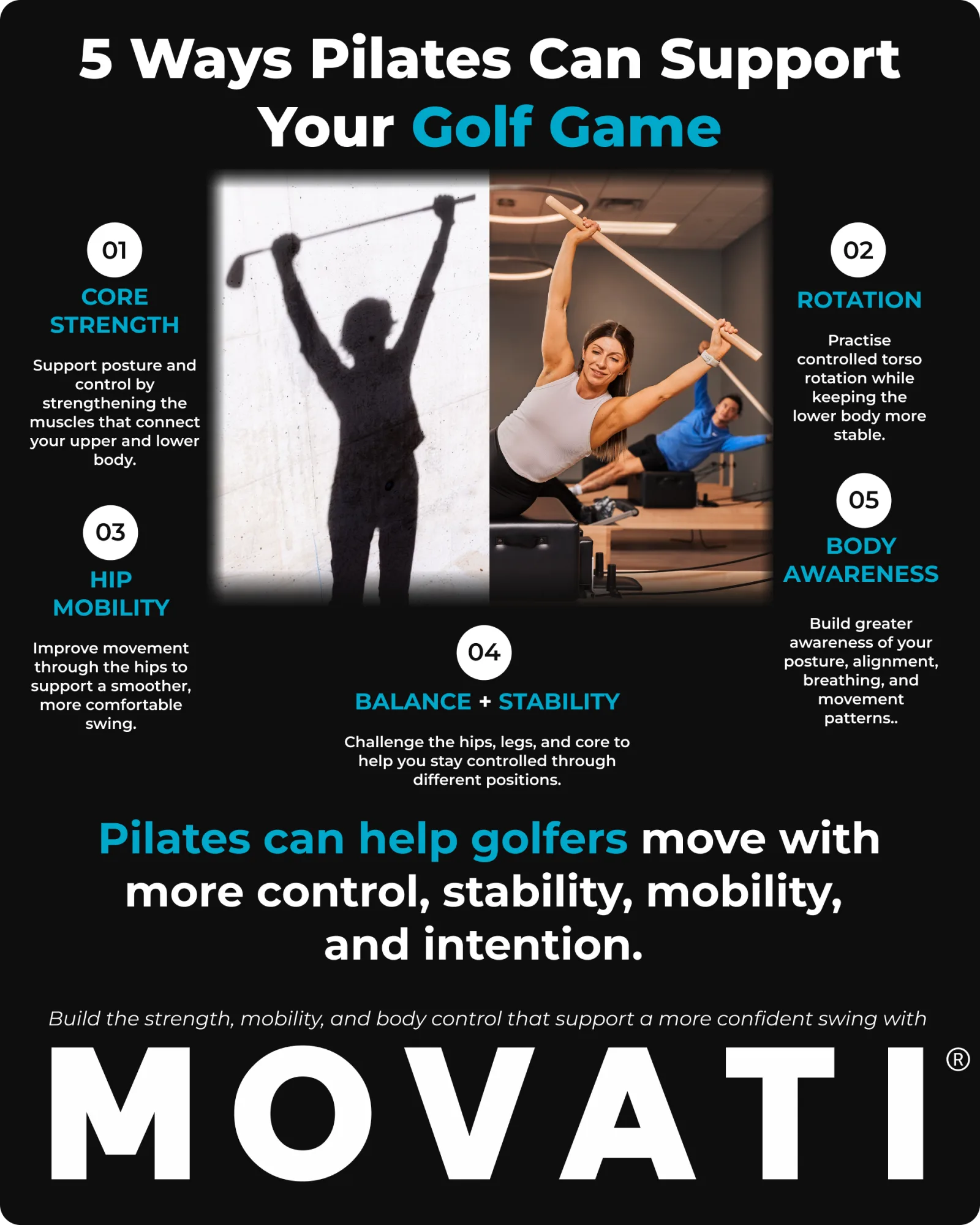
Golf requires more than simply swinging the club with your arms. An efficient swing depends on coordinated movement through the feet, legs, hips, torso, shoulders, and arms. The body needs enough mobility to rotate while also maintaining enough stability to control that movement. Pilates can help golfers work on several of these qualities at the same time and ultimately, enhance your golf game.
Build Core Strength
Your core helps connect the upper and lower body throughout the golf swing. Rather than thinking of the core as only the abdominal muscles, it is useful to think about the entire group of muscles that help stabilize the pelvis, spine, and torso. Pilates exercises often challenge these muscles while the arms or legs are moving, which can help build the type of stability needed for more complex movements. For golfers, stronger core control can help support posture and body positioning through different phases of the swing.
Improve Rotation
Rotation plays a major role in golf. The torso rotates during the backswing and then changes direction as you move through impact and into the follow-through. Pilates can help you practise controlled rotation while keeping other parts of the body more stable. Learning how to rotate through the torso without allowing every part of the body to move at the same time can improve body awareness and movement control.
Support Hip Mobility
The hips need to move well during the golf swing. Limited hip mobility can make it harder to rotate comfortably and may encourage additional movement through the lower back or upper body. Pilates includes exercises that challenge both hip mobility and hip stability, helping golfers develop better control through this important area.
Improve Balance and Stability
A golf swing involves shifting pressure and controlling your body while rotating. That requires balance. Pilates frequently uses exercises that challenge stability through the hips, legs, and core, which can help improve your ability to stay controlled throughout different positions.
Develop Better Body Awareness
One of the biggest benefits of Pilates helping to enhance your golf game is learning to notice how you move. Small changes in alignment, posture, muscle engagement, or breathing can change how an exercise feels. That awareness can transfer well to golf, where small adjustments can influence your stance, rotation, balance, and swing mechanics. Rather than simply moving harder or faster, Pilates encourages you to move with more intention.
Pilates and Golf Posture
Maintaining a comfortable and controlled posture throughout the swing can help golfers move more efficiently. At address, the body needs to hinge from the hips while maintaining control through the torso. As the swing progresses, the body rotates around that position before moving into the finish. If mobility or stability is limited, maintaining that position may become more difficult. Pilates can help strengthen the muscles that support posture while also improving mobility through the hips, spine, and shoulders. The goal is not to hold the body rigidly. It is to develop enough control to remain stable while still allowing the movement required for the swing.
5 Pilates Exercises to Enhance Your Golf Game
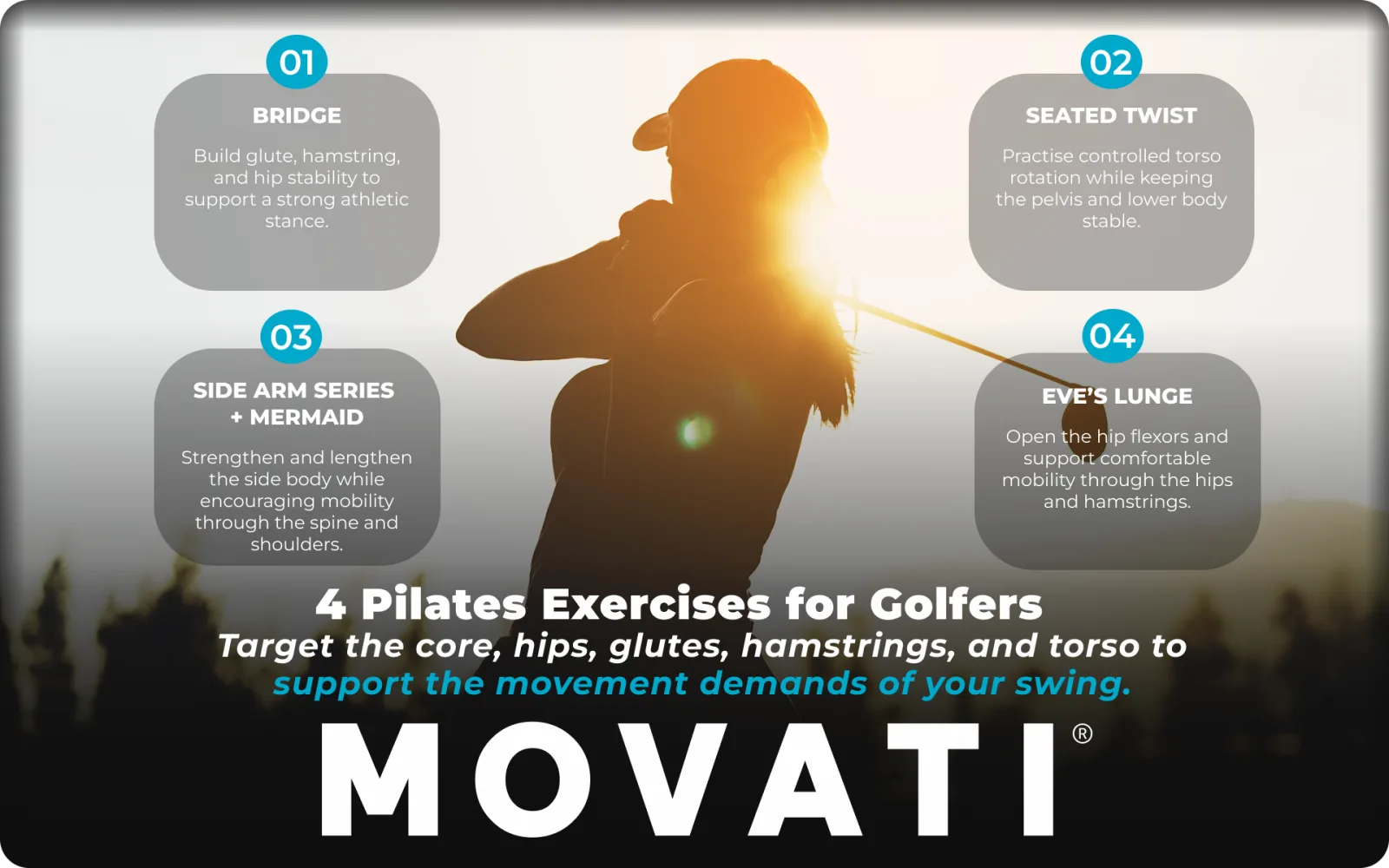
The following exercises target several areas that play an important role in golf, including the core, glutes, hamstrings, hips, side body, and torso. Move slowly, focus on control, and choose a range of motion that feels appropriate for your body.
1. Bridge
The Pilates bridge is a simple but effective exercise for strengthening the glutes, hamstrings, and muscles that support the pelvis. These muscles contribute to a strong athletic stance and help support stability through the hips during movement. On the Reformer, the bridge is performed by gradually lifting the pelvis and spine away from the carriage before slowly returning back down.
To perform a bridge:
- Lie on your back with your knees bent and feet planted comfortably.
- Gently engage your core and glutes.
- Begin lifting your hips away from the surface.
- Continue until you reach a comfortable bridge position.
- Pause briefly at the top.
- Slowly lower back down with control.
Focus on keeping the movement smooth rather than trying to lift as high as possible. For those golfers looking to enhance your golf game, this exercise can help strengthen the muscles that support hip stability and lower-body control.
2. Seated Twist on the Short Box
Golf requires the torso to rotate while the lower body remains controlled. The seated twist on the Reformer Short Box challenges that exact relationship. During the exercise, the pelvis remains relatively stable while the torso rotates. This can help golfers become more aware of where their rotation is coming from and how to control movement through the trunk.
To perform a seated twist:
- Sit tall with your pelvis stable.
- Engage your core gently.
- Keep your hips facing forward.
- Rotate your torso to one side without allowing the lower body to follow excessively.
- Return to centre with control.
- Repeat on the opposite side.
The goal is controlled rotation rather than simply turning as far as possible. For golf, this movement can help reinforce the idea of rotating through the torso while maintaining stability through the lower body.
3. Side Arm Series and Mermaid
The side body plays an important role in rotation, posture, and movement through the golf swing. Exercises such as the Side Arm Series and Mermaid combine side bending, rotation, shoulder movement, and core control. On the Reformer, these exercises may be performed seated or kneeling while using the straps for resistance. The movement can help strengthen and lengthen the muscles along the sides of the torso while encouraging mobility through the spine and shoulders. For golfers, improving movement through the side body can make rotation feel more comfortable and controlled all while aiding to enhance your golf game.
A typical Mermaid movement may include:
- Sit or kneel in a stable position.
- Maintain control through the pelvis.
- Reach through the arms while lengthening through one side of the torso.
- Move into a gentle side bend.
- Return to centre with control.
- Repeat on the opposite side.
Focus on creating length rather than collapsing into the side bend.
4. Supine Arms in Straps and Mid-Back Series
Pilates exercises performed while lying on the Reformer can challenge the core while the arms and legs move. Examples may include Supine Arms in Straps, Lower Lift, the Pilates Hundreds, and Oblique Press variations. These movements require the torso to remain controlled while the limbs move against resistance. That combination can be especially useful for golfers because the swing requires the core to help stabilize and transfer force between the upper and lower body.
Depending on the movement, these exercises can challenge:
- Abdominal strength
- Oblique control
- Shoulder stability
- Coordination
- Breathing
- Spinal control
The goal is not simply to complete the movement quickly. Focus on maintaining control through the torso while breathing steadily.
5. Eve’s Lunge or Single Thigh Stretch
Golfers can spend significant amounts of time sitting between rounds, driving, working, or travelling. That can leave the front of the hips feeling stiff. Eve’s Lunge, also known as a Single Thigh Stretch variation, targets the hip flexors and can also challenge stability through the hips and pelvis. On the Reformer, one foot may remain supported while the opposite leg extends behind the body.
To perform the movement:
- Begin in a stable lunge position.
- Keep your torso tall and your pelvis controlled.
- Slowly shift forward until you feel a comfortable stretch through the front of the rear hip.
- Keep the glutes gently engaged.
- Avoid excessively arching your lower back.
- Hold for approximately 20 to 30 seconds.
- Repeat on the opposite side.
You can also straighten the front leg slightly to create more of a hamstring stretch if that variation feels appropriate. For the golfers out there looking to enhance your golf game, maintaining comfortable mobility through the hips and hamstrings can support movement through the stance and swing.
Why Hip Mobility Matters in Golf
The hips play an important role in both generating and controlling rotation. During the backswing, the hips rotate while the torso continues turning above them. During the downswing, the sequence reverses as the body moves toward impact. If the hips feel stiff, the body may try to create additional movement elsewhere. To enhance your golf game, Pilates exercises that combine hip mobility with strength can help golfers develop a more balanced approach. Rather than simply stretching the hips, the goal is to build enough mobility to move comfortably and enough strength to control that movement.
Why Core Strength Matters in Golf
The core helps transfer force between the lower and upper body. During a golf swing, your legs and hips contribute to the movement while the torso rotates and the arms guide the club. The core helps connect those pieces. Pilates exercises often challenge the core while other parts of the body are moving, which makes the training especially relevant to athletic movement. A stronger core does not guarantee a better swing, but greater control through the torso can help support balance, posture, and coordinated movement.
Research supports the role of core training in golf performance. In one study of 36 club-level golfers, an eight-week core-training program was associated with improvements in core endurance and club-head speed which would undoubtedly enhance your golf game.
Can Pilates Help With Golf Flexibility?
Pilates can support mobility and flexibility through controlled movement. Unlike passive stretching alone, Pilates often asks you to move through a range of motion while maintaining muscular control. For golfers, this can be helpful through areas such as the hips, spine, shoulders, and hamstrings. The goal is not necessarily to become as flexible as possible. Instead, focus on developing enough mobility to move comfortably through your swing while maintaining stability and control.
Pilates for Golfers Who Sit a Lot
Many golfers also spend significant portions of the day sitting at a desk, driving, or travelling. Long periods of sitting can contribute to stiffness through areas such as the hips, upper back, and shoulders. Pilates introduces movement in several directions, including rotation, flexion, extension, and side bending. That makes it a useful way to add movement back into areas that may feel stiff after long periods in one position. Exercises such as bridges, lunges, Mermaid variations, and torso rotations can be particularly useful for encouraging movement through the hips and spine.
How Often Should Golfers Do Pilates?
There is no single schedule that works for every golfer. Some may include one or two Pilates sessions per week alongside golf, strength training, and cardiovascular exercise. Others may use shorter Pilates sessions as mobility or recovery-focused training. Your routine will depend on your experience, golf schedule, training goals, and recovery needs. If you are playing frequently, you may prefer a lighter Pilates session focused on mobility and control. During periods when you are playing less, you may choose more challenging Pilates sessions that place greater emphasis on strength. The goal is to complement your golfing routine rather than overload it to enhance your golf game.
Pilates Before or After Golf?
Pilates can fit into your schedule in several ways. Before golf, shorter mobility-focused movements may help prepare the hips, torso, and shoulders for rotation. After golf, gentler Pilates movements may provide an opportunity to slow down, restore movement, and focus on areas that feel stiff. A full Pilates workout may be better scheduled on a separate training day, depending on the intensity of the session. Pay attention to how your body responds and choose the timing that helps you feel prepared rather than fatigued.
Personal Experience: Small Adjustments Make a Big Difference
One thing I’ve found with movement is that small changes in alignment can completely change how an exercise feels. Pilates makes those differences especially noticeable because the movements are slower and more controlled. Paying attention to posture, core engagement, and where the movement is actually coming from has made me more aware of how connected the whole body is during athletic movement. That same awareness can be useful when trying to enhance your golf game, where a small change in balance or rotation can influence the entire swing.
Build a Stronger Foundation for Your Golf Game
Golf requires a combination of mobility, stability, strength, balance, coordination, and concentration. Pilates gives you an opportunity to work on those qualities in a controlled environment. Exercises such as bridges, seated twists, Mermaid variations, core work, and hip flexor stretches can help support the movement patterns involved in golf while giving you another way to train away from the course. You do not need to completely change your training routine. Start by adding a few Pilates exercises that target the areas most important to your swing, then gradually build from there. A stronger, more mobile, and more controlled body can give you a better foundation for the movement your golf game demands.
Story Credit: Allen Panuncio – Canadian Professional Golf Association, Senior Instructor, Richmond Hill Golf Club
*MOVATI’s trainers and/or consultants are not health care providers, and do not provide any medical diagnosis, treatment or advice, and any trainer and/or consultant tips are not intended to replace the advice of a health care professional.
Join MOVATI Today and get Started with This Special Offer. Already a member? To customize programming and help you enhance your golf game, consult with one of our Personal Trainers in club and complete your Game Plan Session or join seminars with one of our fitness professionals.
